
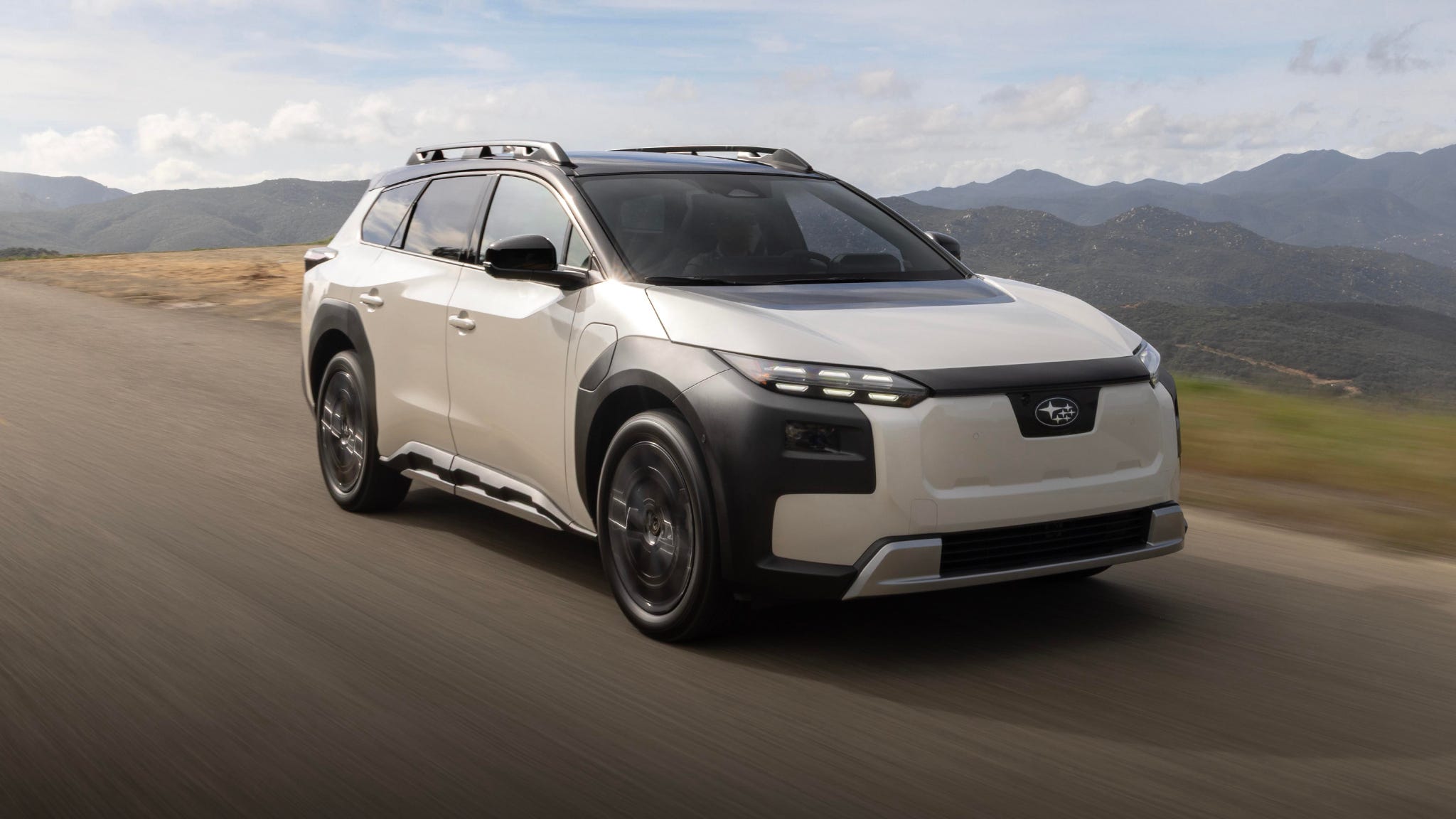
Let’s play a game of word association. We say “2026 Subaru Trailseeker.” Did you think “1970s General Motors station wagon with a big-block V-8”? No? Well, then, either you’re under the age of 50, haven’t driven the Trailseeker, or both. Strapping on the timing gear and taking a road trip in Subaru’s Toyota-designed electric SUV has us thinking about those old wagons, which packed huge V-8s that delivered heavy-hauling power. They were muscle cars masquerading as sensible transportation, and the Trailseeker is, too—at least, so sayeth our instrumented testing.
For those unfamiliar, a quick recap: The Trailseeker is basically a stretched Subaru Solterra EV, and just as the Solterra is a rebadged Toyota bZ, the Trailseeker is a relabeled Toyota bZ Woodland, with differences limited to minor cosmetic and major standard-equipment changes. (The entry-level Trailseeker can be had with less stuff for a lower price; the example we tested is the top-of-the-line $48,000 Limited model.) Toyota did the bulk of the engineering work, and Subaru did the bulk of coming up with good names (or at least we thought it did until the Uncharted and Getaway came along).
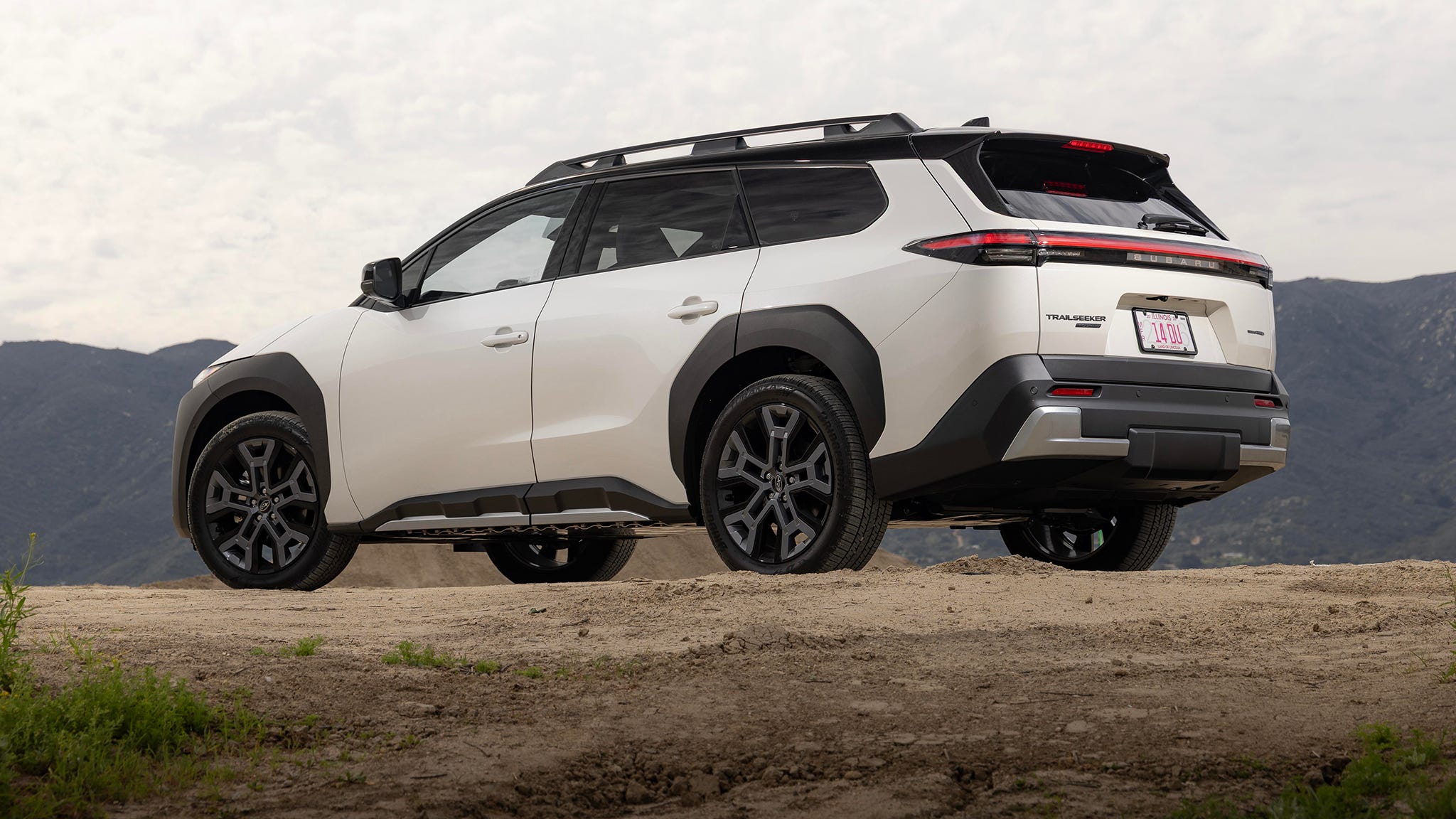
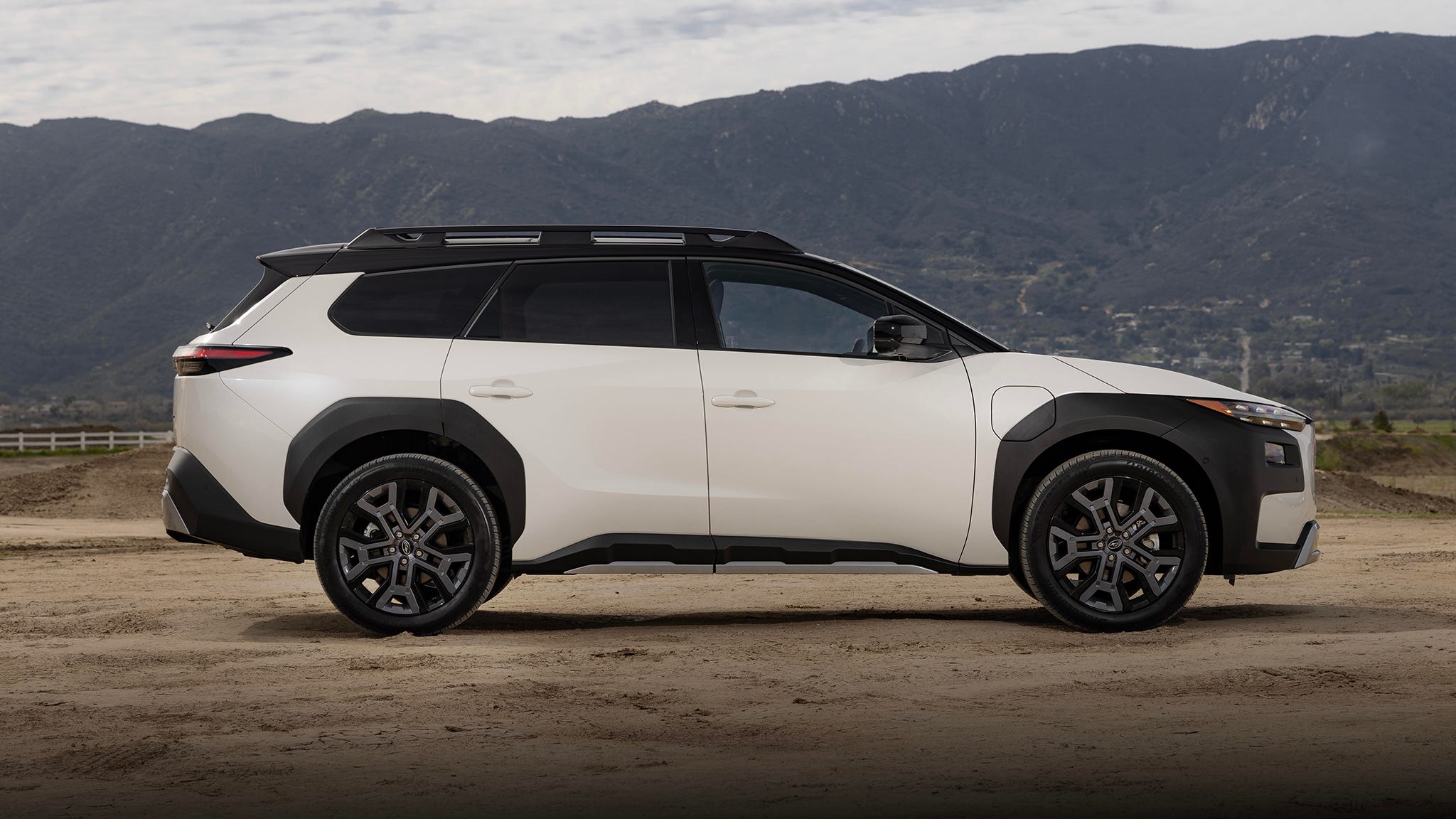
It was the Trailseeker’s styling that started us thinking about those old wagons. It has the stance and the ground clearance of a midsize SUV, but the Trailseeker’s long-back proportions are distinctly wagonlike.
Then we got in, powered it up, hit the accelerator, and … wowee. Talk about wagonlike—it’s the electric equivalent of an Oldsmobile Vista Cruiser with the aptly named 455 Rocket V-8 (7.5 liters, 300 hp, and 410 lb-ft of trailer-dragging torque). The Vista Cruiser was one hell of a muscle car, and so too is the Trailseeker. It feels quick even by EV standards, and far more so than we expected given the modest-sounding 375-hp combined rating of its two electric motors. The Trailseeker moves off from a start with deceivingly gentle ease, but it packs a mid-throttle punch that would send Manny Pacquiao staggering.
We strapped on our timing gear to find out just how quick the Trailseeker is. Laying down a patch of rubber that would make a muscle car proud, it rocketed to 60 mph from a standstill in just 3.9 seconds, a full half-second faster than Subaru’s own estimate. That’s far from the most remarkable number by EV standards, but it’s quick enough to outrun internal combustion sportsters like the Porsche Cayenne S, Volkswagen Golf R, and, embarrassingly for Subaru, the brand’s own performance-oriented WRX tS. Its 12.5-second quarter-mile run, with a 110.5-mph trap speed, puts the Trailseeker in a similarly rarefied company and within a second of the threshold where NHRA safety rules mandate the use of a roll cage.
The Trailseeker stopped from 60 mph in a respectable 123 feet, with plenty of noise from the antilock system but no pulsing in the pedal. It consistently delivered straight, true stops with little nose dive. But the brakes proved to be a nemesis in our figure-eight lap. We found it was very easy to trigger ABS—this is a 4,500-plus-pound wagon, so the brakes have their work cut out—but there was a delay between us releasing the pedal and the antilocks releasing their hold, which ruined our corner entry (and, honestly, most of our lap).
We found we had to brake very early so we could be off the binders long before turn-in, which the Trailseeker did with plenty of body lean. On corner exit, it was eager to set the inside-front-wheel spinning as it jetted out onto the straightaway. Oh, yes, the time: 26.3 seconds, a number on par with sportier SUVs and only 0.2 second behind the last Volkswagen Jetta GLI we tested.
With the Trailseeker reminding us so much of those classic old wagons, it seemed like a natural ride for a road trip. We took the Trailseeker from New York City to Rochester on a mix of scenic highways and back roads. Our trip corresponded with a late-in-the-season cold snap, which we expected to wreak havoc with our range and charging times. The Trailseeker is EPA-rated for 274 miles, except for the base model, which has an extra 6 miles of range. That puts the Trailseeker on the wrong side of the 300-mile psychological barrier. Our MotorTrend Road-Trip Range test, which measures how far an EV can drive at 70 mph from 100 percent down to 5 percent state of charge (SOC), gave us 223 miles. (We did the test in warmer weather.)
With the temps below freezing, we found that charging up to 80 percent gave us about 200 miles of range. The Trailseeker uses the Tesla NACS port, which opened our options for fast charging, but the charging speeds we saw were all over the place. Preconditioning the battery for a good long time (a process initiated from the center screen) certainly helped, and of course we expect slower charge rates above 80 percent SOC, which is typical EV charging behavior, but we only saw the Trailseeker hit and sustain its 150-kW charging rate (a mediocre number to begin with) when the battery was darn near empty. At slightly higher SOCs, charging started and stayed at lower rates. Subaru claims a 10 to 80 percent charging time of 28 minutes, but it seemed that no matter what the SOC was when we plugged in, getting to 80 percent always took about half an hour.
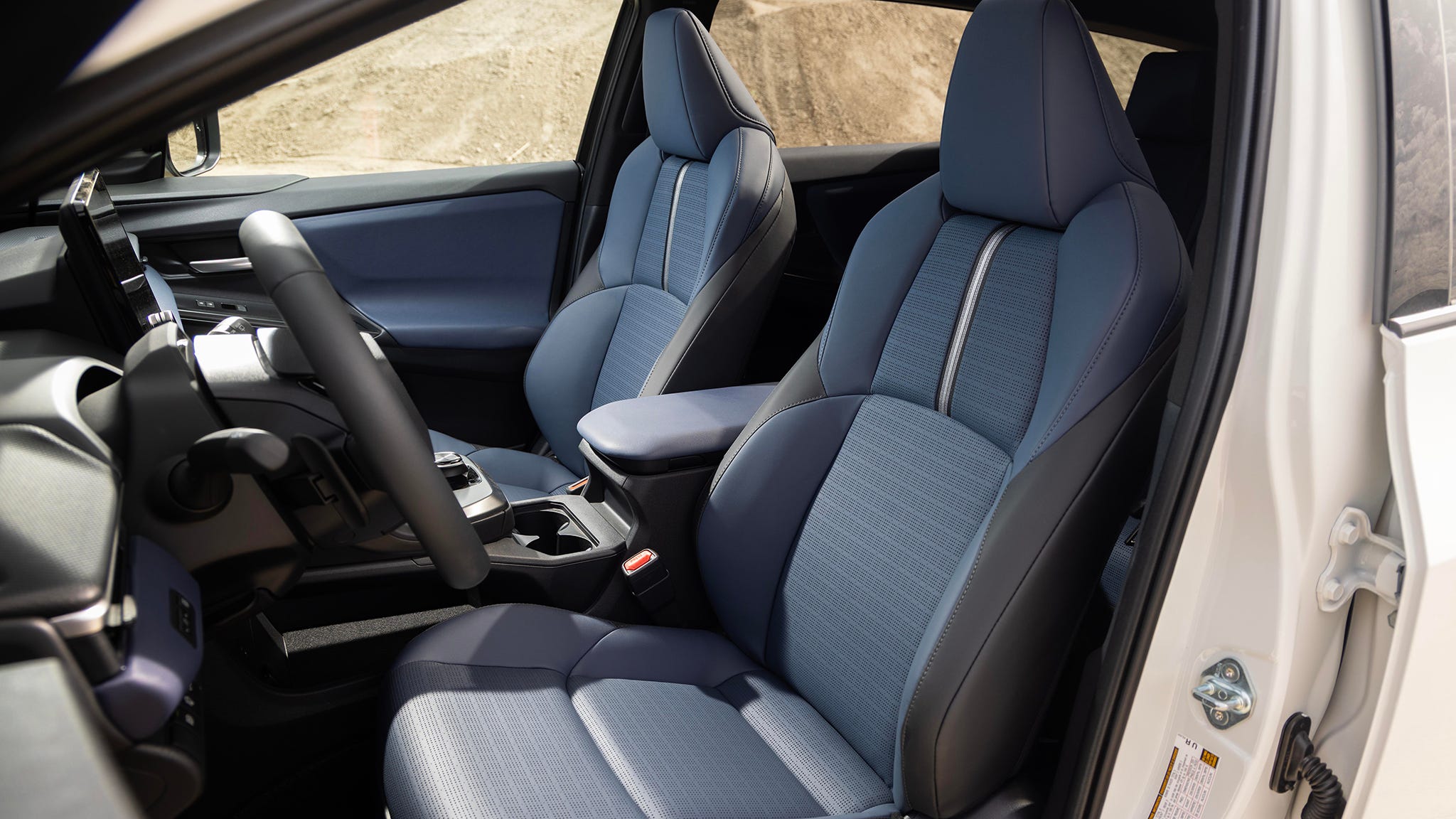
On the road, the Trailseeker proved a comfortable SUV, but like other Subarus, it’s an unyielding nag. If we turned to look at the scenery for more than a couple of seconds, the Trailseeker sounded an alarm warning of driver inattention. If we draped our hand over the stop of the steering wheel, we blocked the camera on the column, and it warned us to sit up. (Lucky the Subaru warns with beeps and not a voice. We can just imagine Mom’s voice: “Sit up! Don’t slouch!”) To its credit, the Trailseeker uses a touch sensor to detect a hand on the steering wheel when lane centering is engaged, and that’s a good thing because one only need ease one’s grip for a couple of seconds before it yells at you for that, too.
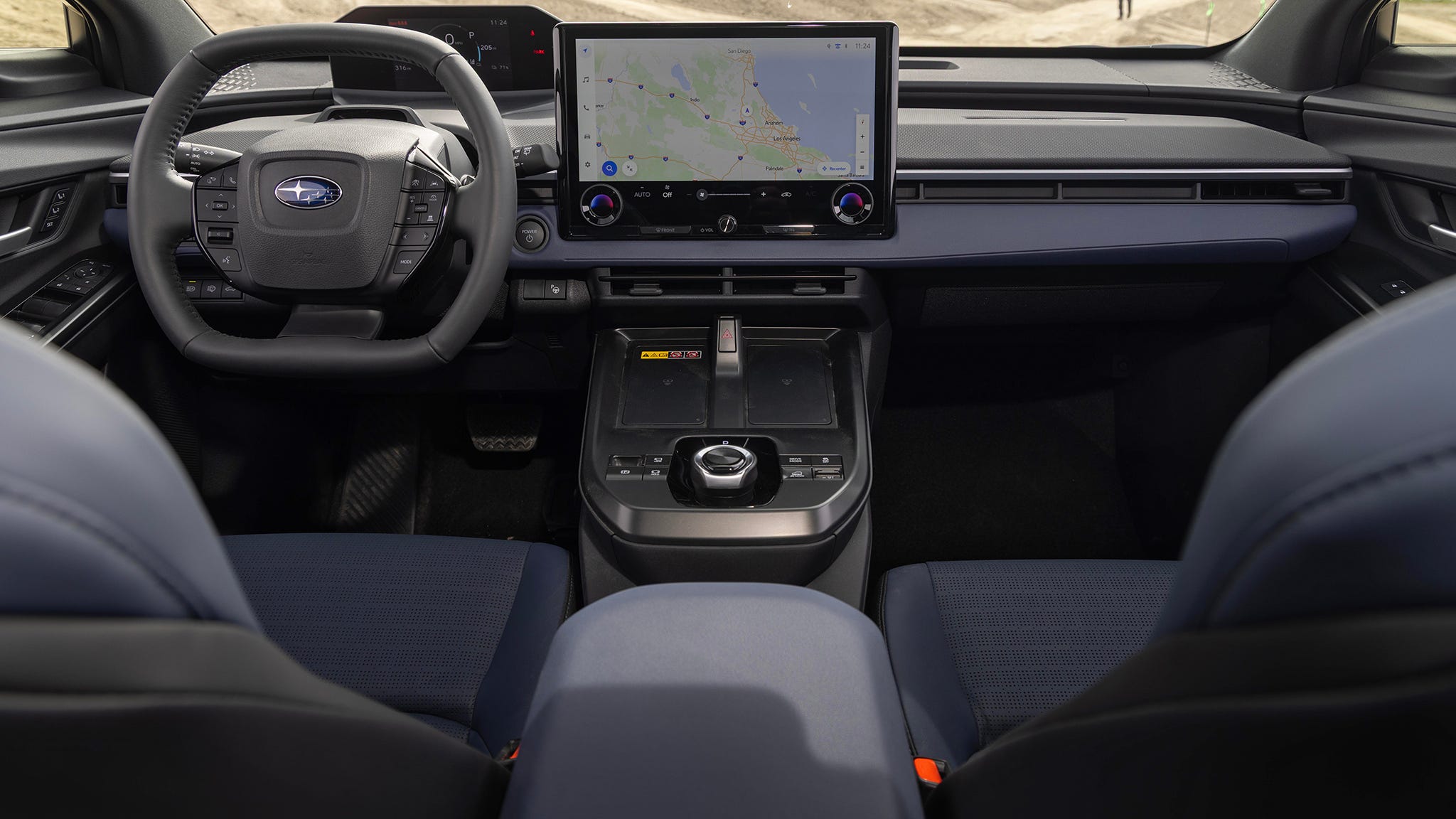
Another annoyance: The Trailseeker doesn’t remember driver settings when you shut it off. For our around-town cruising, we wanted to drive with auto-hold on and regen at its highest setting. Every time we powered up the car, we had to press the power button, then press the brake hold button, then pull on the steering-wheel paddle three times—so five button presses to get going instead of just one. Oh, and speaking of regen, that’s one of the Trailseeker’s biggest annoyances: Regenerative braking is strong, but it doesn’t work down to a full stop; you still need to step on the pedal to bring the Trailseeker to a halt.
On the plus side, we quickly got used to the instrument panel, which is set close to the windshield and intended to be viewed over, rather than through, the steering wheel. Subaru uses a squared-off wheel, as opposed to the round wheel in the Toyota bZ Woodland, which helps with visibility of the panel. But we still think the wide center console, with its twin phone charging pads, is a waste of space. We’d prefer a narrower console and more space to shift our knees, especially on long drives. Speaking of space for legs, the Trailseeker’s back seat, like many electric SUVs, suffers from a high floor and limited toe space under the front seats. Kids will be fine, but adults might not be so happy to make a long trek back there.
On this road trip, we didn’t make use of one of the Trailseeker’s prodigious off-road abilities, which we sampled in our first drive. The Trailseeker features 8.5 inches of ground clearance and X-Mode, which was developed, for both the Trailseeker and bZ Woodland, by Subaru. We’ve no doubt the Trailseeker will venture further off road than one might expect from an electric SUV. But with 275 miles of range, how far off the beaten path are you willing to go? So far, no one has invented a way to deliver a can of electricity to the middle of nowhere. (Though you can get portable electricity in a bigger container.)
The Trailseeker’s range might be the biggest barrier to its claim as a new-age Olds Vista Cruiser. (Then again, that old Rocket V-8 was good for around 12–14 mpg, so its range wasn’t much better.) We’ve been bellyaching for some time about Toyota and Subaru EVs needing a longer tether, and we wonder if cutting the Trailseeker’s prodigious power output might be one way to get the dual-motor, all-wheel-drive version above 300 miles. More range, quicker charging, and perhaps a little more thought put into the back seat and the center console would make the Trailseeker a contender for the ultimate family truckster.
Then again, the Trailseeker, as it is, can dust off Camaros and Mustangs at the stoplight rally, just like moms of yesteryear could do in their Rocket-powered Vista Cruisers—and who are we to deny suburban parents that pleasure?
Comments (0)