
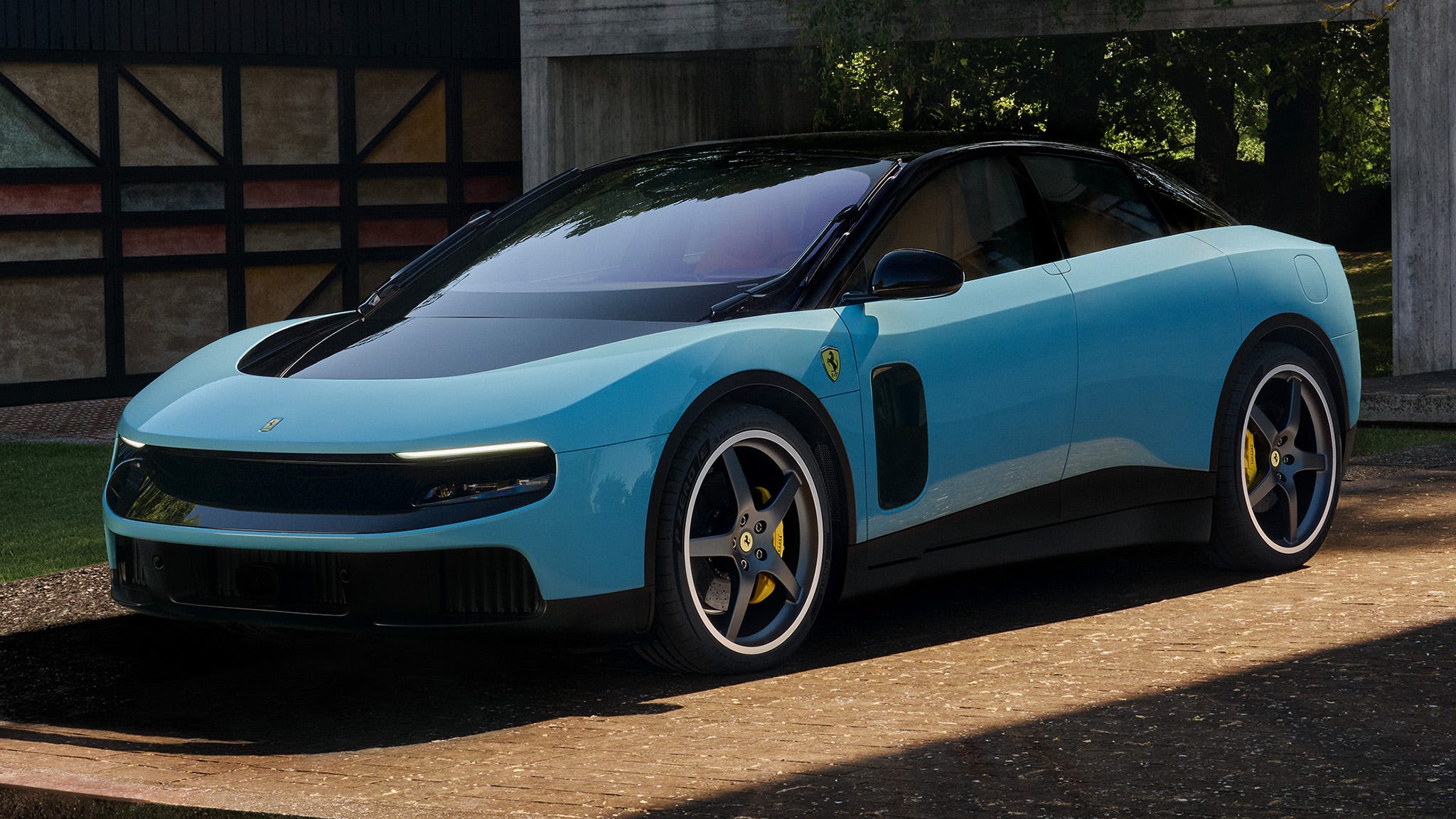
“It takes time to absorb it,” warned Ferrari CEO Benedetto Vigna when he spoke about the Ferrari Luce in October last year, well before anyone other than select insiders had seen the car. And he’s not wrong. It is without question the most radical Ferrari in the company’s history. A cab-forward four-door with limo-like room inside, it defies all Ferrari convention—a car that stampedes the fabled Prancing Horse deep into unfamiliar territory.
The Luce is the largest and heaviest Ferrari ever built, the only Ferrari whose interior and exterior have been shaped by a company based outside Italy, and the first Ferrari without an internal combustion engine. There’s a lot to unpack here.
Ferrari has already revealed the Luce’s powertrain and chassis technology in detail, but here’s a quick recap. Each wheel is driven by a radial-flow permanent synchronous magnet e-motor hooked up to a 122-kWh battery by an 800-volt electrical architecture and overseen by high performance silicon carbide inverters. The four e-motors have their magnets arranged in what is called a Halbach array, a setup used in Ferrari’s F1 powertrains that directs the magnetic flux toward the stator to maximize torque density. Each front motor develops 140 hp and 103 lb-ft of torque, each rear motor 415 hp and 262 lb-ft. Total system output is 1,035 hp and 730 lb-ft, and Ferrari says the battery, which can accept charge rates of up to 350 kW, will deliver a range of 330 miles on the WLTP test, which suggests a likely EPA-rated range of 280 miles.
The Luce rolls on an aluminum-intensive skateboard chassis with an upgraded version of the active suspension system used on the F80 and Purosangue, overseen by the latest generation of Ferrari’s accomplished Side Slip Control vehicle dynamics system, dubbed SSC X. The standard rear wheel steering system can independently turn each rear wheel a maximum of 2.15 degrees. Carbon ceramic brakes, with 15.4-inch rotors up front and 14.6-inch units at the rear, are also standard, though they won’t be used much in even relatively spirited road driving as the Luce’s powertrain will deliver up to 0.68 g of lift-off regenerative braking, sending up to 500 kW back into the battery. Despite its 4,982-pound curb weight, the SSC X-controlled active torque vectoring, active suspension and rear wheel steering mean the Luce should feel lighter and much more agile than its size and mass would suggest.
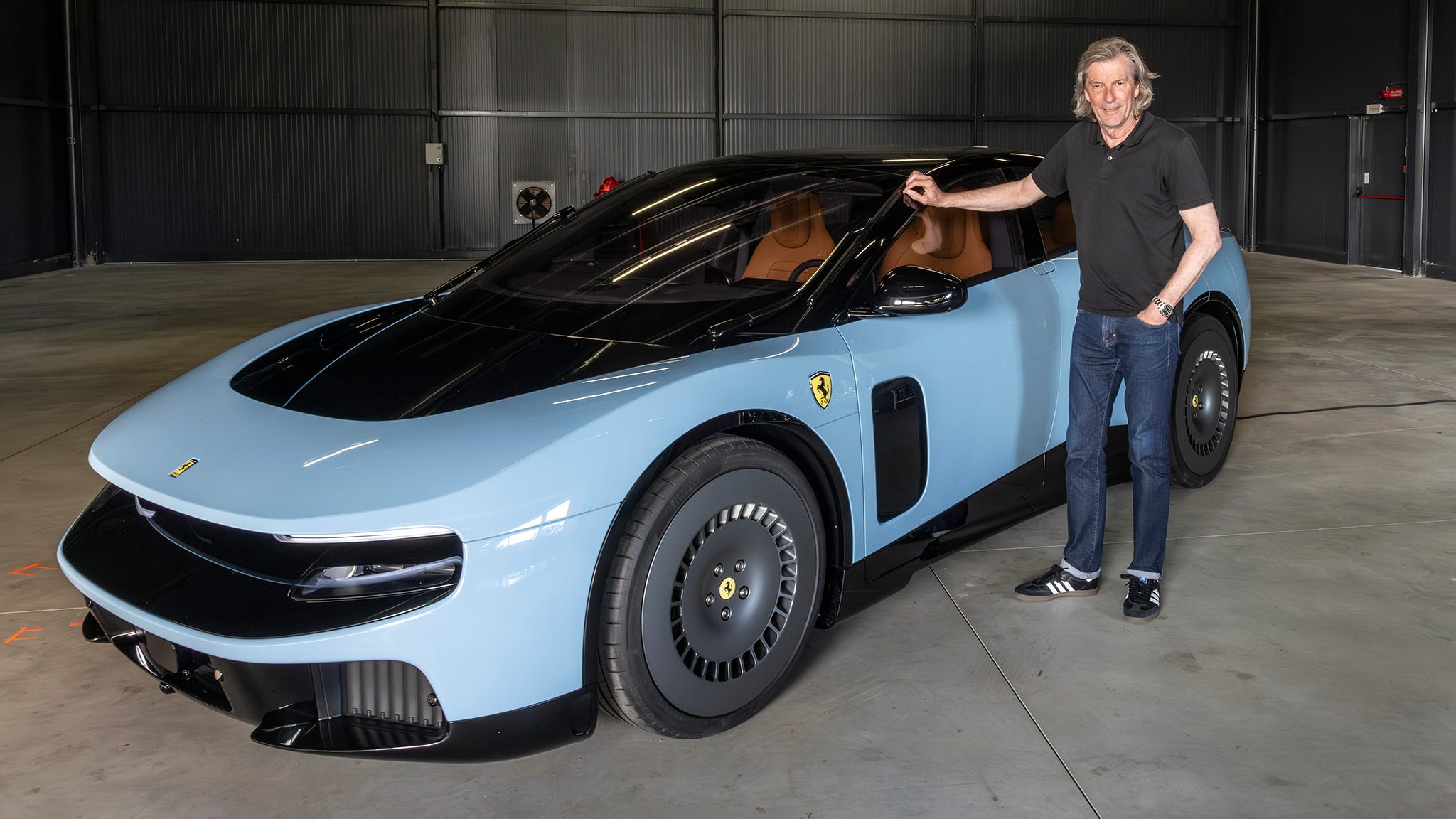
The car’s interior and exterior are largely the work of LoveFrom, the uber-cool San Francisco design shop founded in 2019 by Jony Ive, the British designer who shaped the look and feel of Apple products for almost 30 years, and Australian industrial designer Marc Newson, who worked with Ive on Project Titan, the stillborn Apple car project, and created the brilliant 021C concept for Ford in 1999. “It is a Ferrari, but it doesn't look like a Ferrari,” said Newson of the Luce. “It doesn't have all the typical design cues—we came to the conclusion that was actually the point of the exercise. There aren't any five seat Ferraris around, so this is by definition unique.”
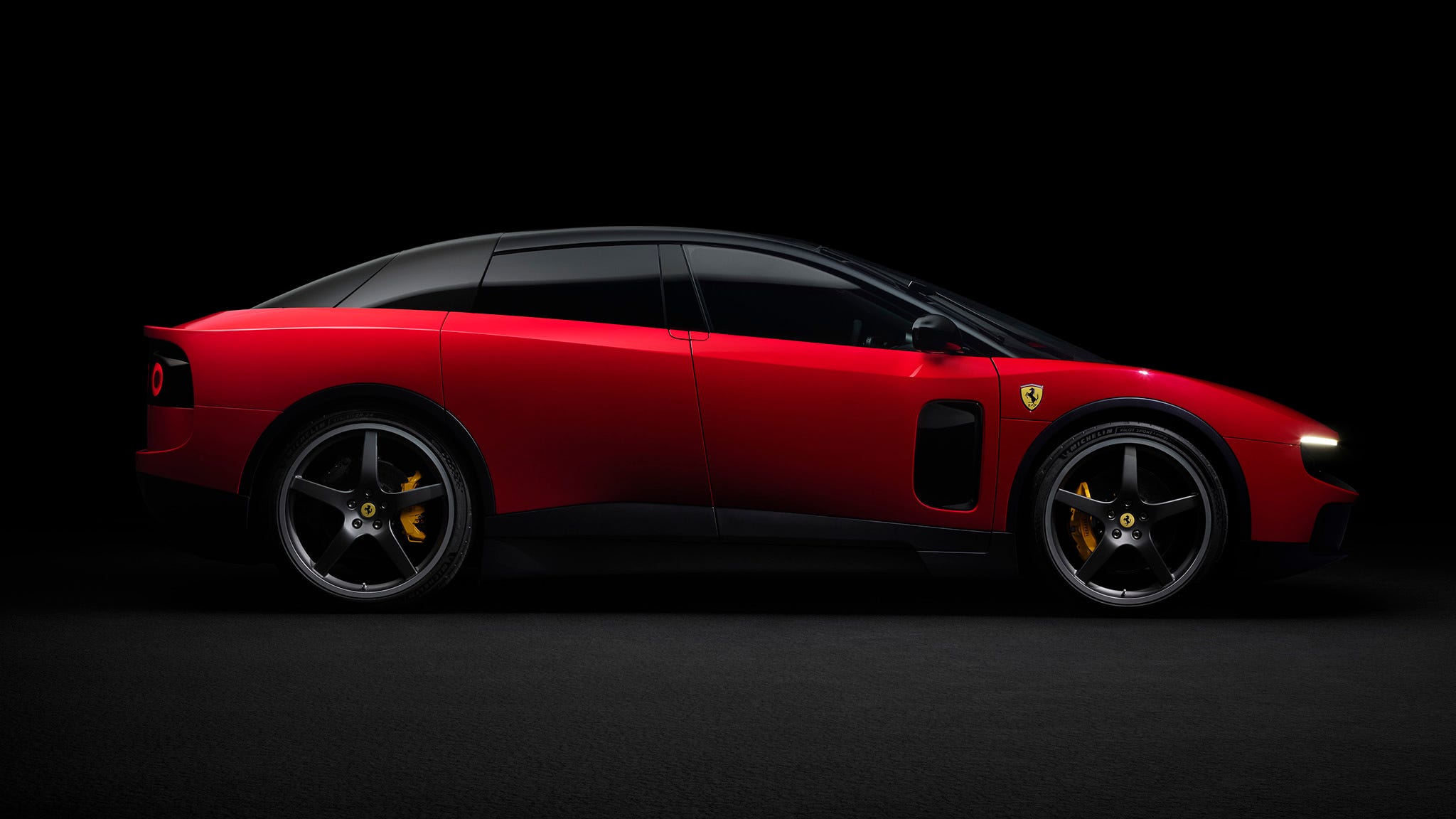
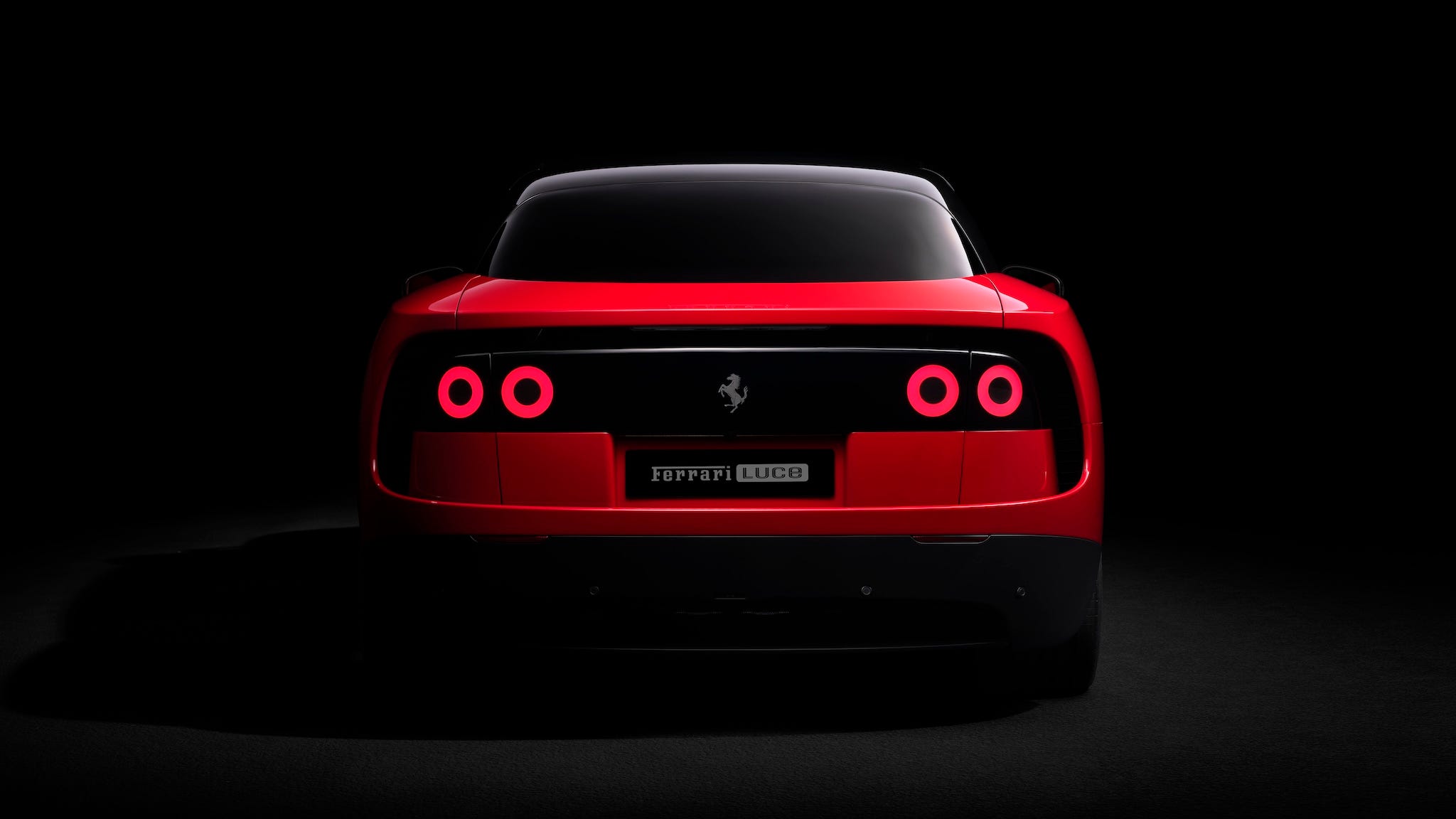
At 197.8 inches from nose to tail, the Luce is the longest Ferrari ever made, 2.0 inches longer overall than the Purosangue, yet it rolls on a wheelbase that’s 2.3 inches shorter. The Luce is also 1.1 inches narrower and 1.8 inches lower overall than Ferrari’s pseudo-SUV. Big wheels, 23 inches up front and 24 inches at the rear—the largest diameter wheel ever fitted to a production Ferrari—help disguise a mass that’s accentuated by relatively flat bodysides that pivot off a gently undulating shoulder line. The circular taillights in the black panel across the rear of the car are perhaps the only obvious Ferrari design cues.
“What we set out to do with this car, we understood could only be done on an EV platform,” says Newson of a project that began when Ferrari executive chairman John Elkann first discussed a collaboration with LoveFrom in 2019, and took shape when Vigna, a physicist who developed the three-axis accelerometer and gyroscope that allowed early iPhones to detect motion and enable screen rotation, was appointed Ferrari CEO by Elkann in 2021. “I guess they got us on board because—and this has nothing to do with the design team at Ferrari because we worked very, very closely with them—this is a different animal, and I think it needed a different approach and a different way of thinking,” Newson said.
The exterior of the Luce appears to float around a sleek, dark, aerodynamic cabin structure. “One of the big founding ideas was this one surface that sort of circles the entire car,” said Ive. The effect is most striking at the front end, where bodywork that connects the tops of the two front fenders forms a bridge over a cabin structure whose profile flows without a single break from the top of the roof all the way down to the front bumper (which is why the wipers are parked at the A-pillars rather than at the base of the windshield). It’s also evident at the rear, where the outer body surfaces appear to enshroud a separate inner structure.
Ive is very aware the Luce is a polarizing car, but he defends its deceptively simple surfacing and somewhat slab-sided form. “Whether people respond favorably or not, there's a reason behind every single surface,” he said. Added Newson: “With an EV aero is everything. It's probably the most challenging parameter to work within. But by separating [the body and the cabin forms] we gave ourselves a little more latitude to be able to play. You've got everything that keeps the people inside, and then you've got the car on the outside.”
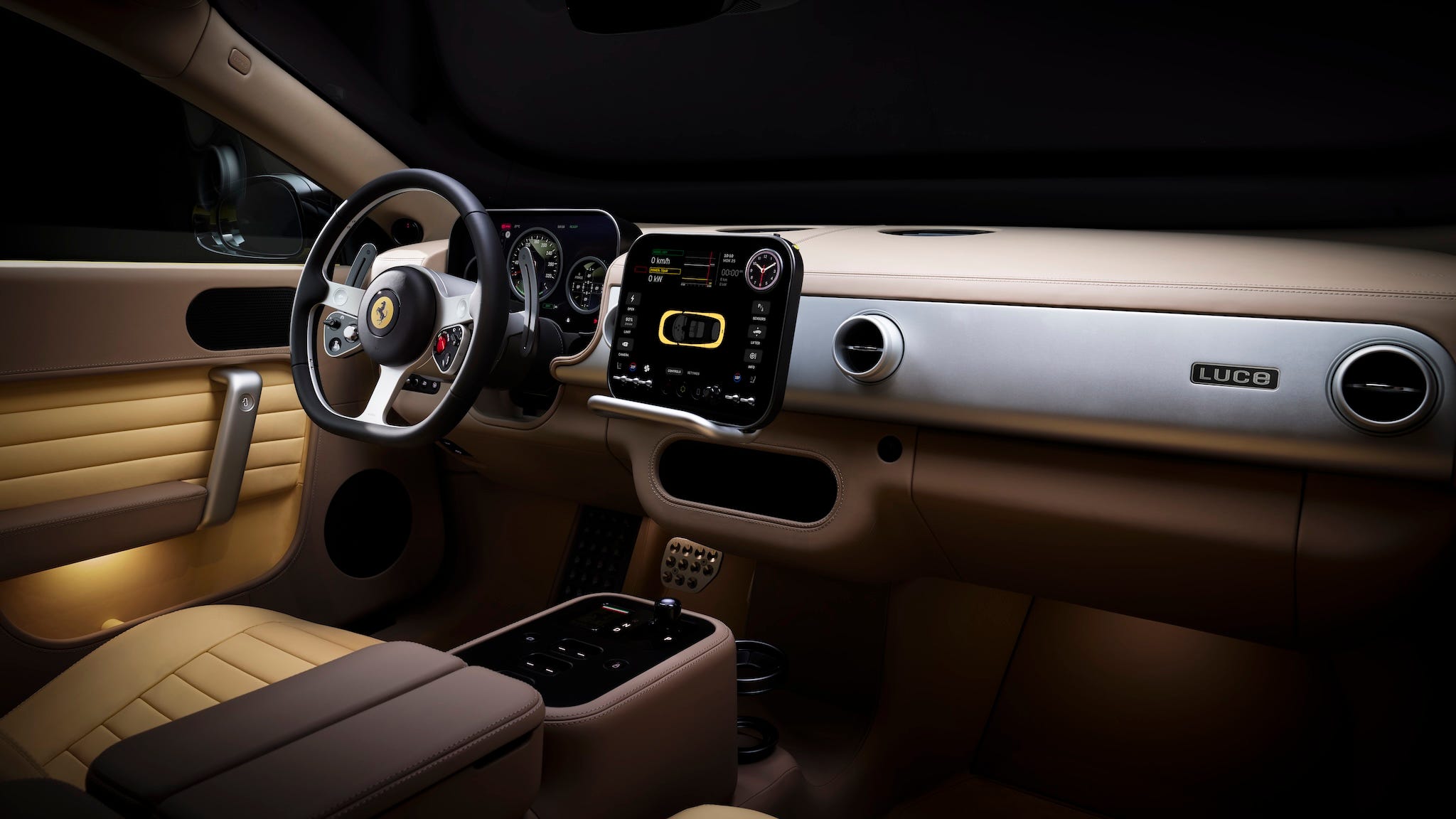
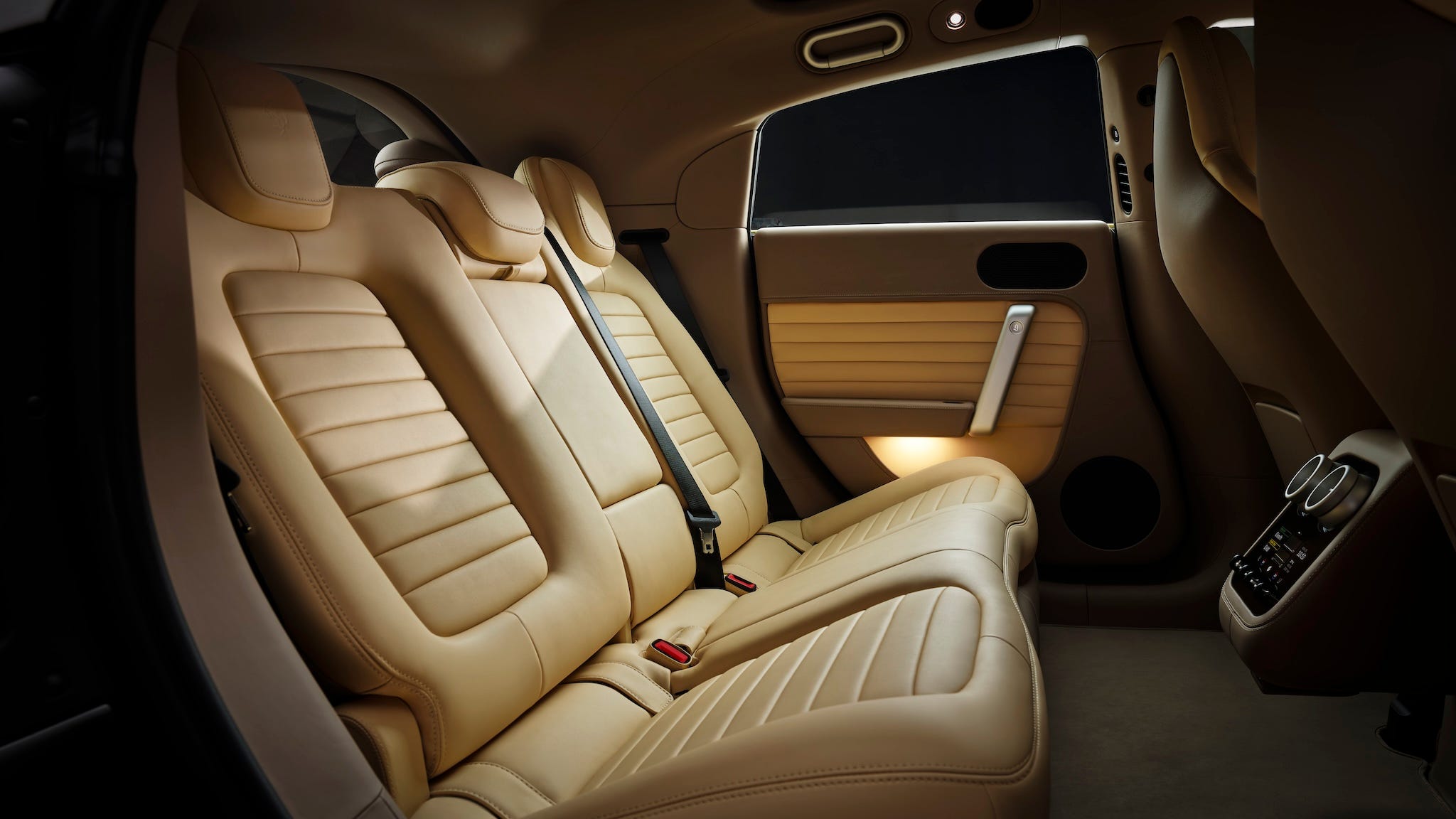
The interior is as modern and minimalist as you’d expect from Ive and Newson, though the tuck-and-roll leather trim on the seats and doors is a nod to classic Ferrari interiors. The screens are design elements, not merely displays, with nicely integrated physical elements such as the needle on the speedo and the hands on the clock/compass/stopwatch in the top right corner of the modestly sized central touchscreen. Almost everything you touch, from the simple vents to the toggle switches at the base of the center screen, from the drive selector to the paddles behind the steering wheel, has a delicious mechanical tactility not found in any other Ferrari.
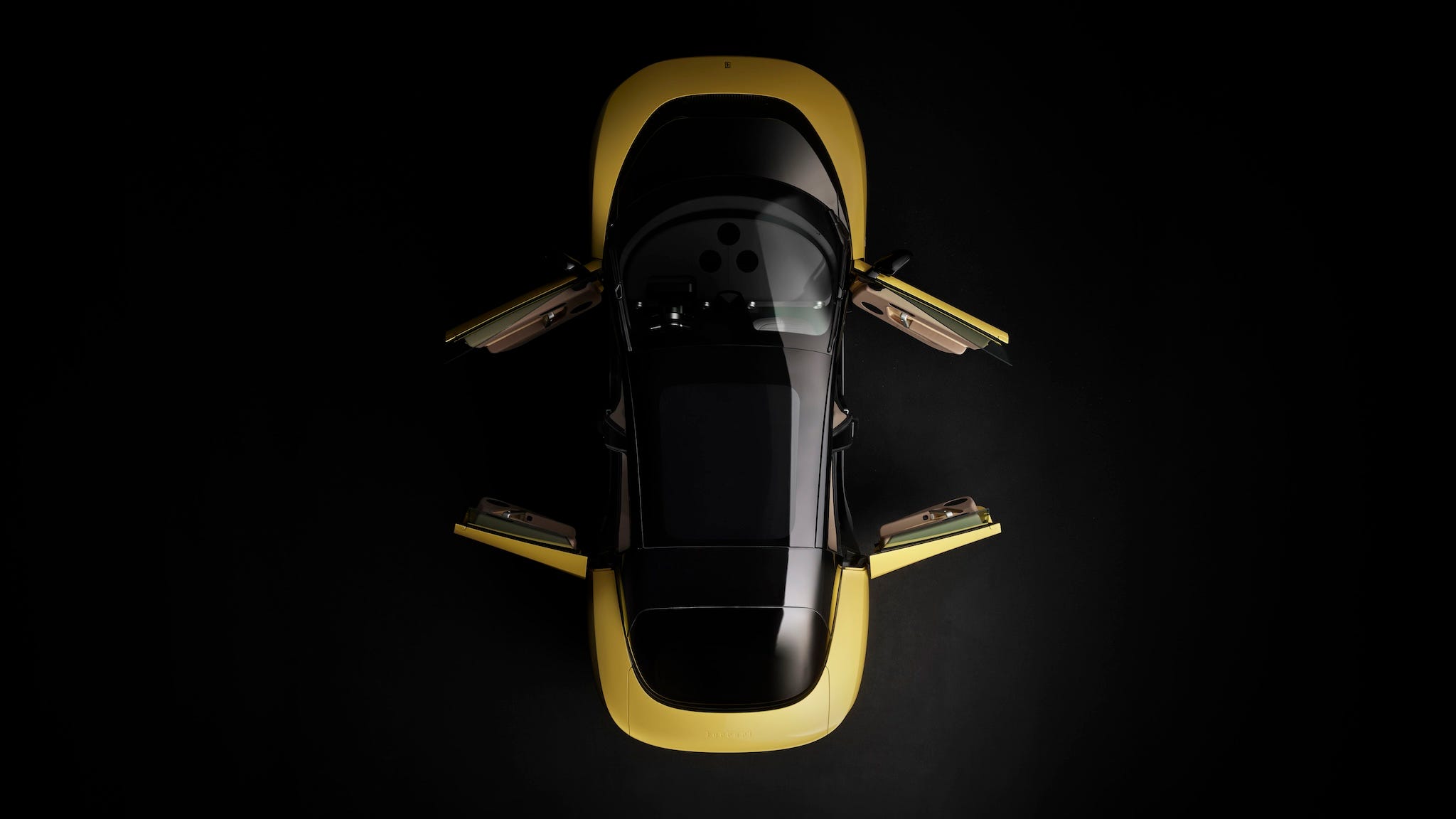
Despite a wheelbase shorter than that of the Purosangue, the Luce is much roomier inside, readily able to accommodate five adults; the rear-hinged rear doors make back seat entry and egress easy. But the relationship between the steering wheel, the top of the dash and the base of the A-pillar make it feel as if you’re sitting in a mid-engine Ferrari sports car, the road ahead right of you at the base of the windshield, rather than a four-door sedan. The paddles behind the steering wheel allow drivers to shift between five power and torque levels in certain drive modes, each level increasing sequentially every time the right-hand paddle is clicked. Flicking the left-hand paddle increases regen from the default 0.1 to 0.4 g to replicate the behavior of a progressively more intense engine braking effect.
As in Ferrari’s regular internal combustion engine models, the manettino under the right-hand spoke of the steering wheel selects different dynamic control system settings. In the Luce they range from Ice mode, which maximizes stability and maintains all-wheel drive for very low grip conditions, to ESC-Off mode, in which only the active suspension and front axle torque vectoring are enabled, leaving the rear e-motors free to punch out smoky drifts through corners. The Luce also debuts a new Dry mode that slots in between the traditional Wet and Sport modes and has been calibrated for day-to-day driving.
The new e-Manettino under the steering wheel’s left-hand spoke tweaks powertrain outputs to suit different driving scenarios. In Range mode, power is limited to 429 hp, top speed is pegged at 160 mph, and the front motors are disconnected as often as possible to improve efficiency. In Tour mode, the top speed remains 160 mph, but available power rises to 616 hp and all‑wheel drive is always active. Performance mode retains all-wheel drive but boosts maximum power to 972 hp and the top speed to 193 mph. Selecting Launch Control via the button in an overhead panel unlocks another 53 hp. With the powertrain on maximum attack, Ferrari claims the Luce will accelerate from 0–60 mph in less than 2.5 seconds, and from 0 to 124 mph in 6.8 seconds.
The Ferrari Luce is a huge gamble, not the least because people with the money to buy a Ferrari have so far shown little interest in electric-powered supercars. “This is not a supercar,” said Vigna. “We wanted to create a car that could be used by family and friends.” Vigna believes the Luce’s unique combination of functionality and versatility, performance and style will attract new customers to the brand, and the fact that it’s Ferrari’s first EV will also attract hardcore collectors. In terms of its design and its technology, the Luce is clearly a Ferrari like no other. But is it a true Ferrari? We’ll find out when we drive it.
Comments (0)