
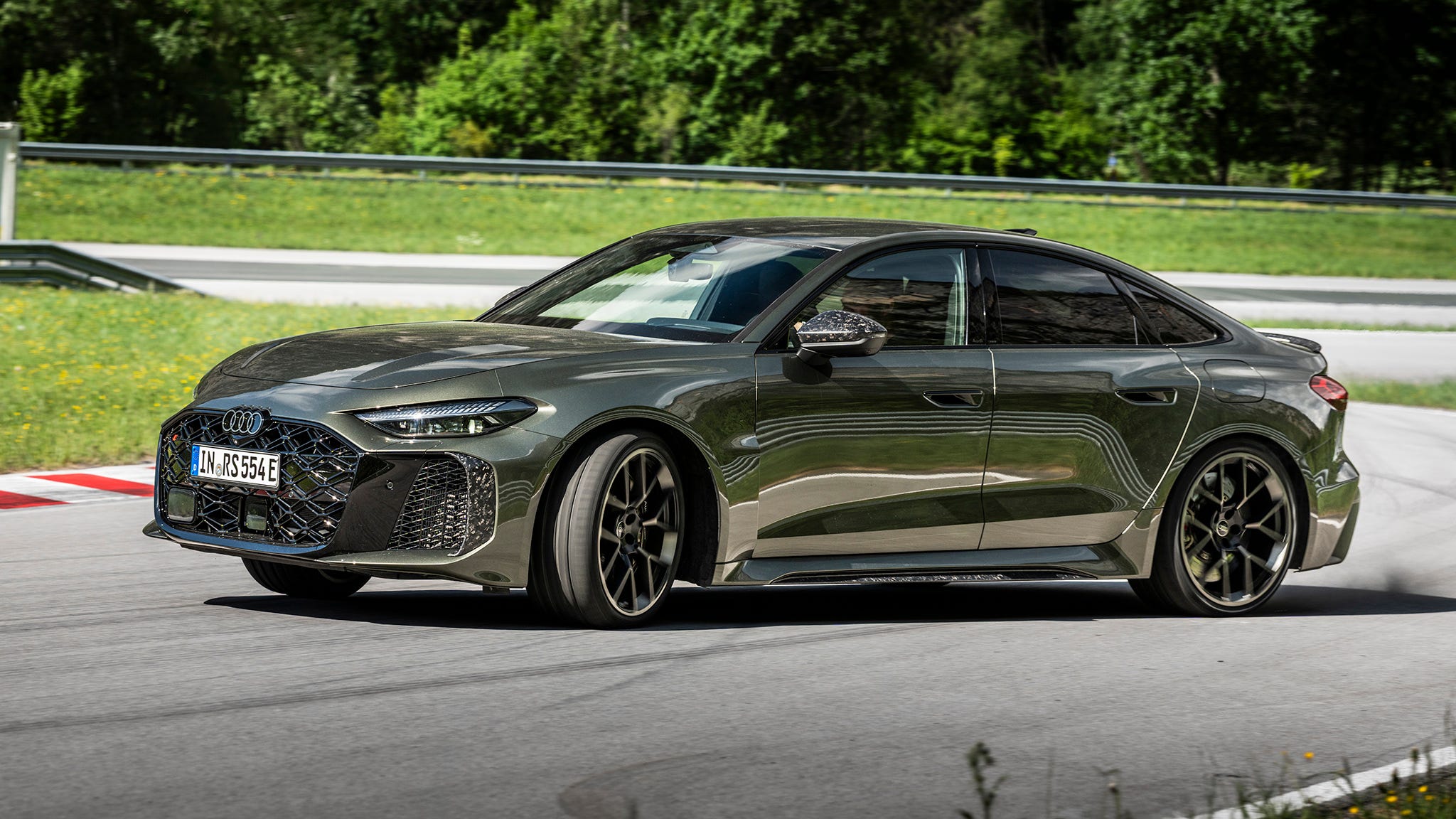
The track was small, the instructions simple: Set the new Audi RS5 to Dynamic mode, barrel into the corners, turn in late and abruptly, then nail the throttle. Given our past Audi experience, we figured the car would understeer in response to our ham-fisted inputs, and booting the accelerator would shift some power rearward, straighten out the car, and away we’d go.
“Not today,” the new RS5 said. Instead, booting the throttle cut the rear end loose, swinging the car around and pointing it in the direction we wanted to go.
“So what?” you say. “It’s not like oversteer is a new invention.” Yes, we know, though you must grant us that an oversteering all-wheel-drive Audi is quite the novelty. Still, it was the way the RS5 exhibited that oversteer that stunned us.
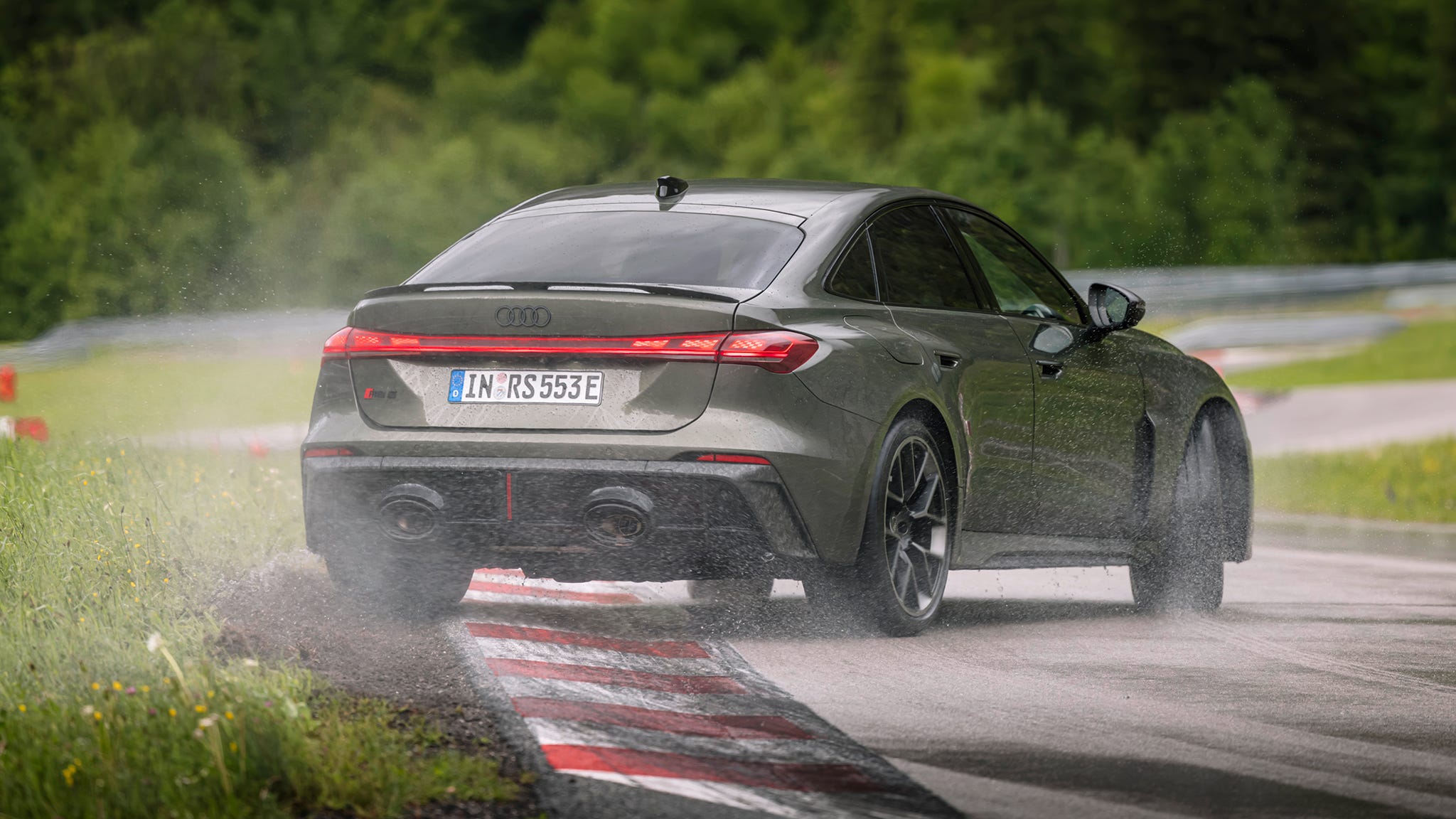
Instead of snapping out its tail, the RS5 rotated progressively and gently in a long and luxuriant swing. Never mind that we were still smothering the go-pedal between our foot and the floormat. All of this happened in the space of a second or two, but it felt like we had all the time in the world to countersteer and point the RS5’s nose in the right direction as we jetted out of the turn and right into the next one to do it all over again.
For the RS5’s next trick, the engineer in the passenger seat had us take another couple of laps in RS Sport mode, a more track-focused setting. Now, normally, we associate “track-focused” with “more likely to let us hoist ourselves by our own petard.” In the new RS5, this mode tightened up the car’s behavior. Careening into the corners the same way, the RS5 wiggled its rump, but almost before our brains had time to process the necessary correction, the RS5 was straightening itself out and blasting toward the next corner. Less foolish, more focused, and more what we expect from an Audi—except it was the rear wheels losing traction, not the fronts.
We’ve driven a lot of Audis that have thrilled the daylights out of us, but none (at least, none with Quattro all-wheel drive) has recalibrated our expectations for the brand the way the new RS5 has.
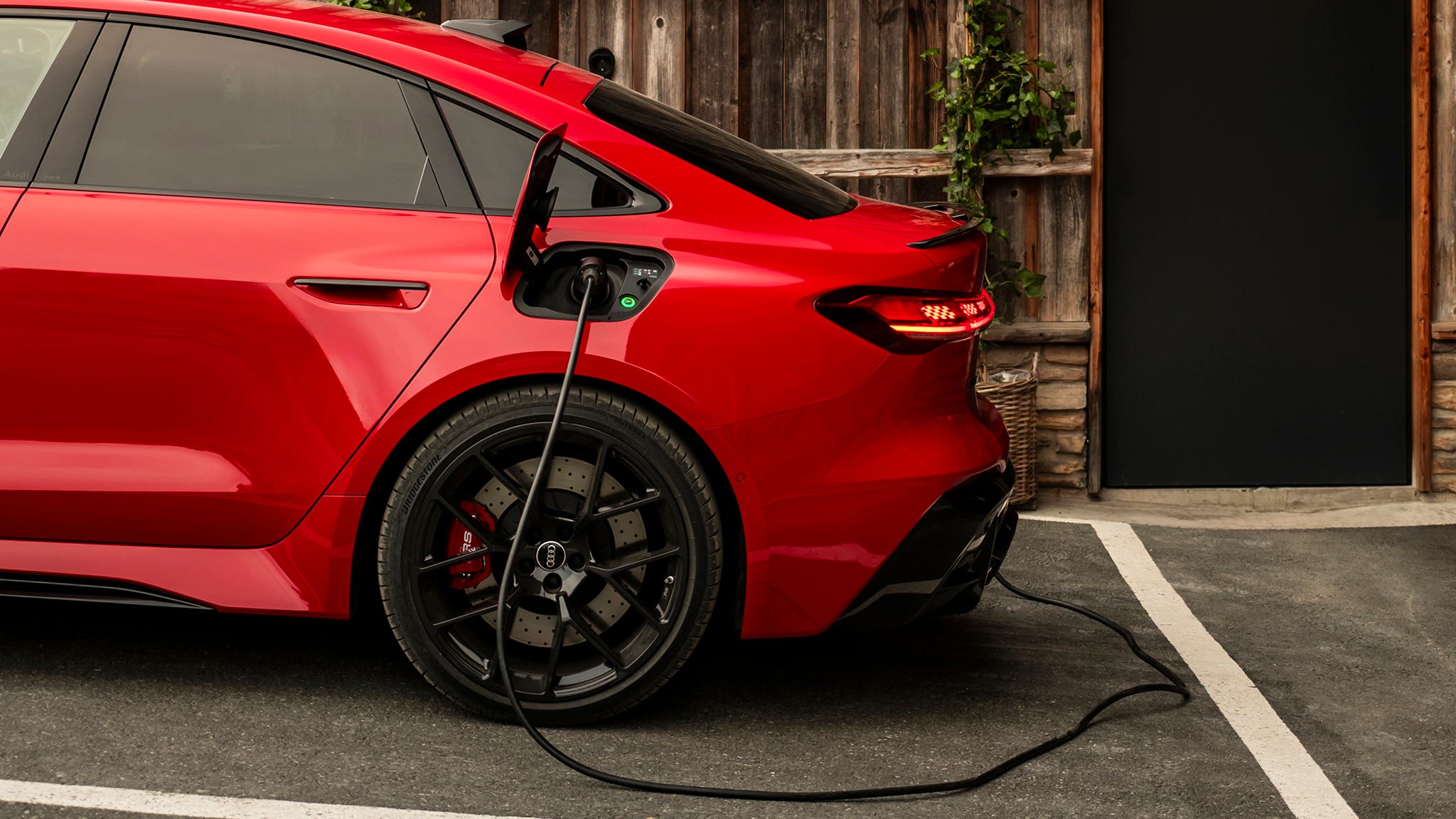
This new-for-Audi attitude comes almost entirely courtesy of a patented torque-vectoring rear axle that we shall soon endeavor to explain, but a point Audi wishes all of you to know is this: Said axle would likely not be possible without the plug-in hybrid (PHEV) powertrain that lurks under the RS5’s sexy new shell.
Now, the idea of a PHEV performance car is probably a turn-off to many of you. It’s certainly a warning signal to us, especially in the wake of our experience with last year’s BMW M5 Touring. Electric augmentation turns BMW’s big hot-rod wagon into a 717-hp missile at the cost of a 5,456-pound curb weight that the suspension struggles to control. The effect on the BMW’s ride quality and uneven-pavement handling is, shall we say, less than optimal.
Our first question when learning the new RS5 was a PHEV wasn’t, “How much horsepower?” (630) or, “Can it drive on electric power?” (yes). It was, “How much does the damn thing weigh?” The answer, according to Audi, is just shy of 5,200 pounds, a number that made our hearts sink.
Our concerns, it turns out, were unfounded. Careering around curvy Alpine roads, desperately searching for dry pavement as we dodged Austrian rain and snow, we would never have guessed this new RS5 weighed nearly 1,200 pounds more than its predecessor. The new RS5 feels light on its feet. Its ride is well controlled, and neither its tires nor its suspension seemed to have any trouble coping with the car’s newfound bulk. (Granted, Austrians take better care of their pavement than we’re used to in the U.S.) But for the explosion of low-end power and the off-putting transmission behavior—we’ll get to that in a moment, as well—we might never have guessed this new RS5 was electrified.
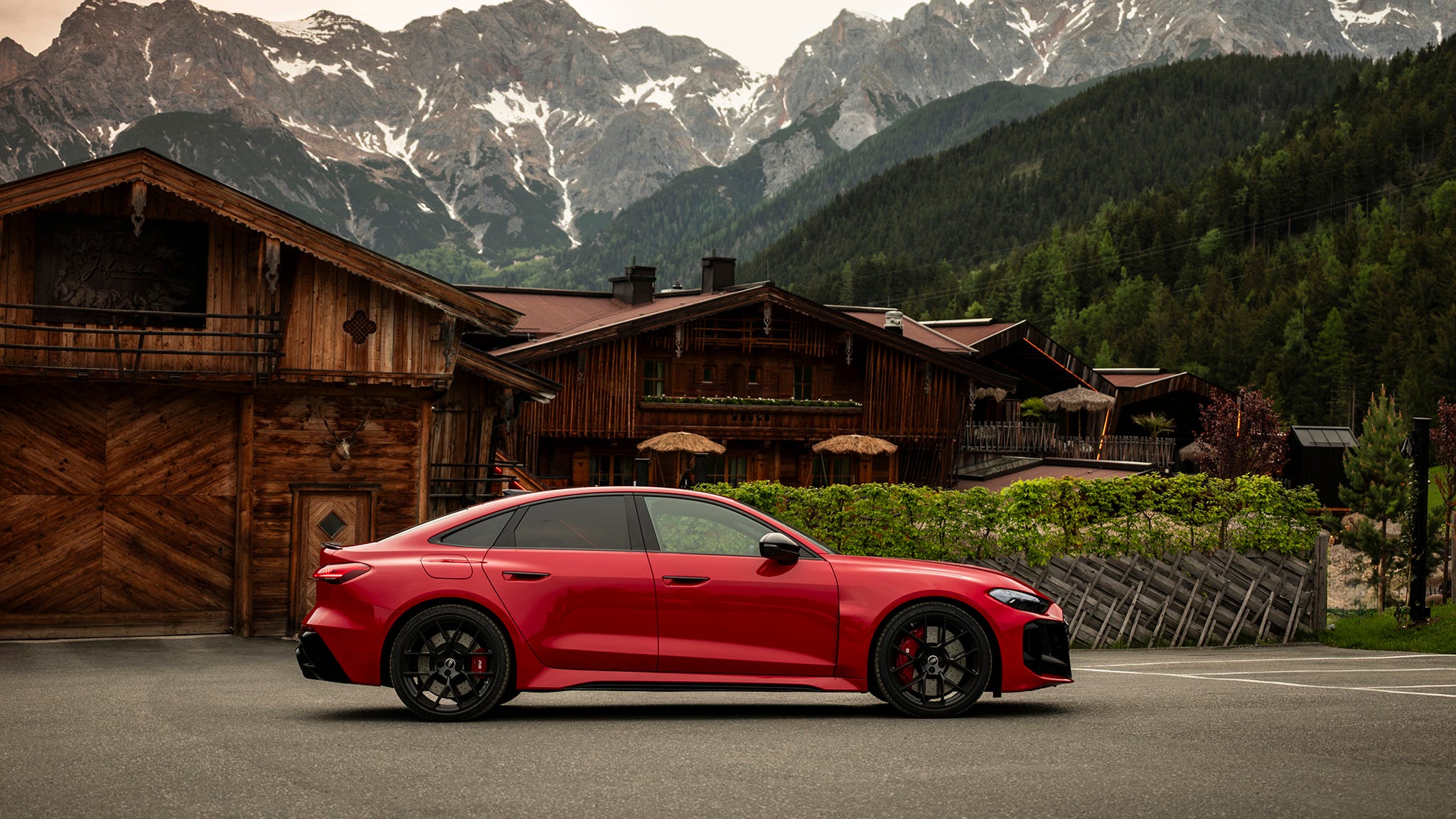
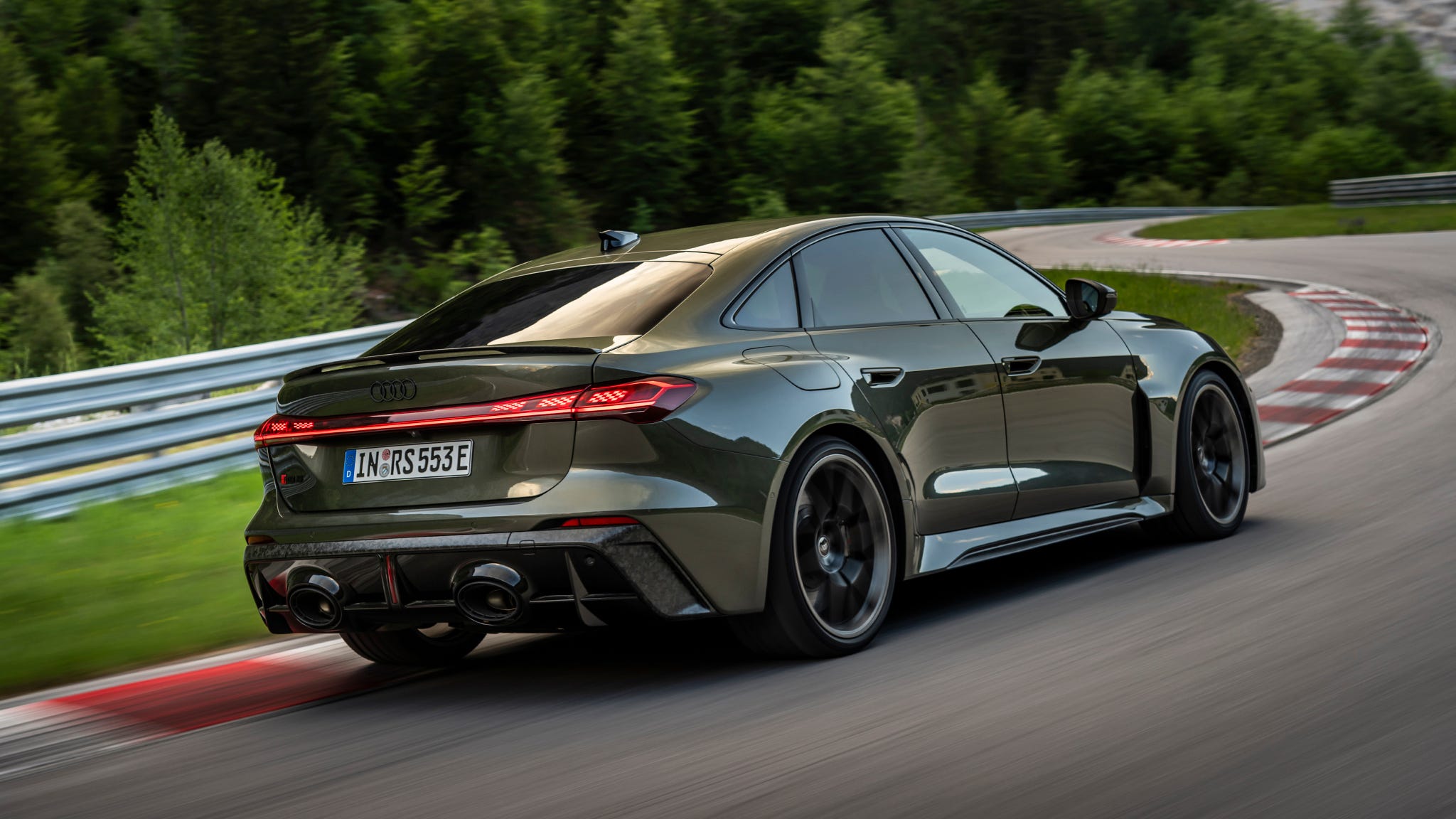
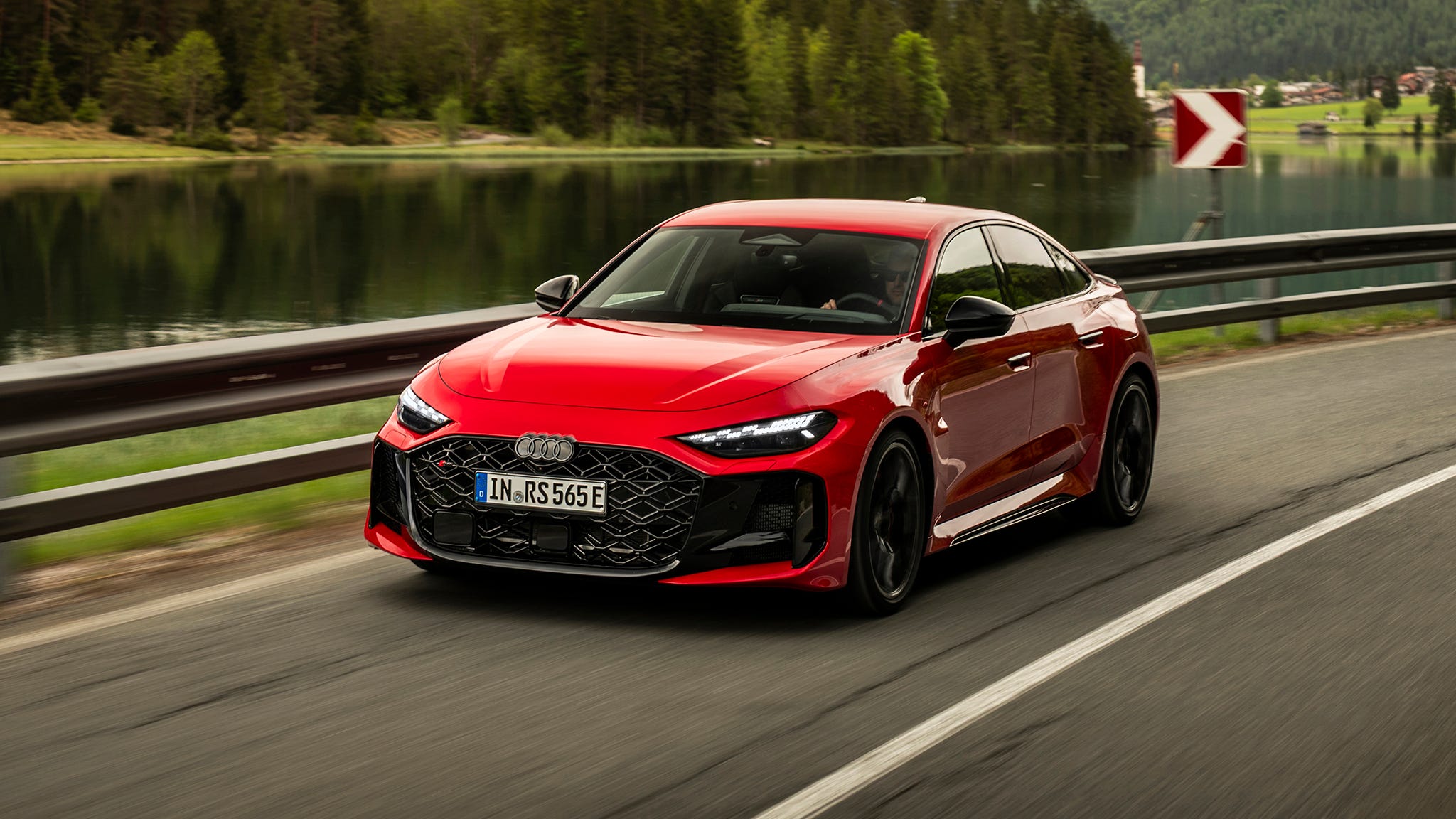
Now that we’ve told you what the RS5 can do, let’s talk about what it is. This is the new generation of the RS5 Sportback, Audi’s term for the four-door hatchback. It’s bigger than the old one—3 inches wider, 4.5 inches longer with a 3-inch wheelbase stretch, and 0.3 inch taller. The old RS5 Sportback was a handsome car, but this new version is one bad mama jama, with a wide, blacked-out grille, fenders flared to the ends of the earth, and extractors at the back of the front fenders that look serious but not silly.
The goggle-eye exhaust at the rear might be the closest the RS5 comes to a styling misstep, though they do get the point across. The tailpipes are positioned to accommodate a trailer hitch, of all things, because towing with an RS5 is apparently important to Europeans. (The RS5 can tow nearly 4,200 pounds, in case you were wondering.) Europe also gets an RS5 Avant, but Audi says the wagon is not coming to the U.S. The company sells the RS6 Avant here, though, so we’re holding out hope.
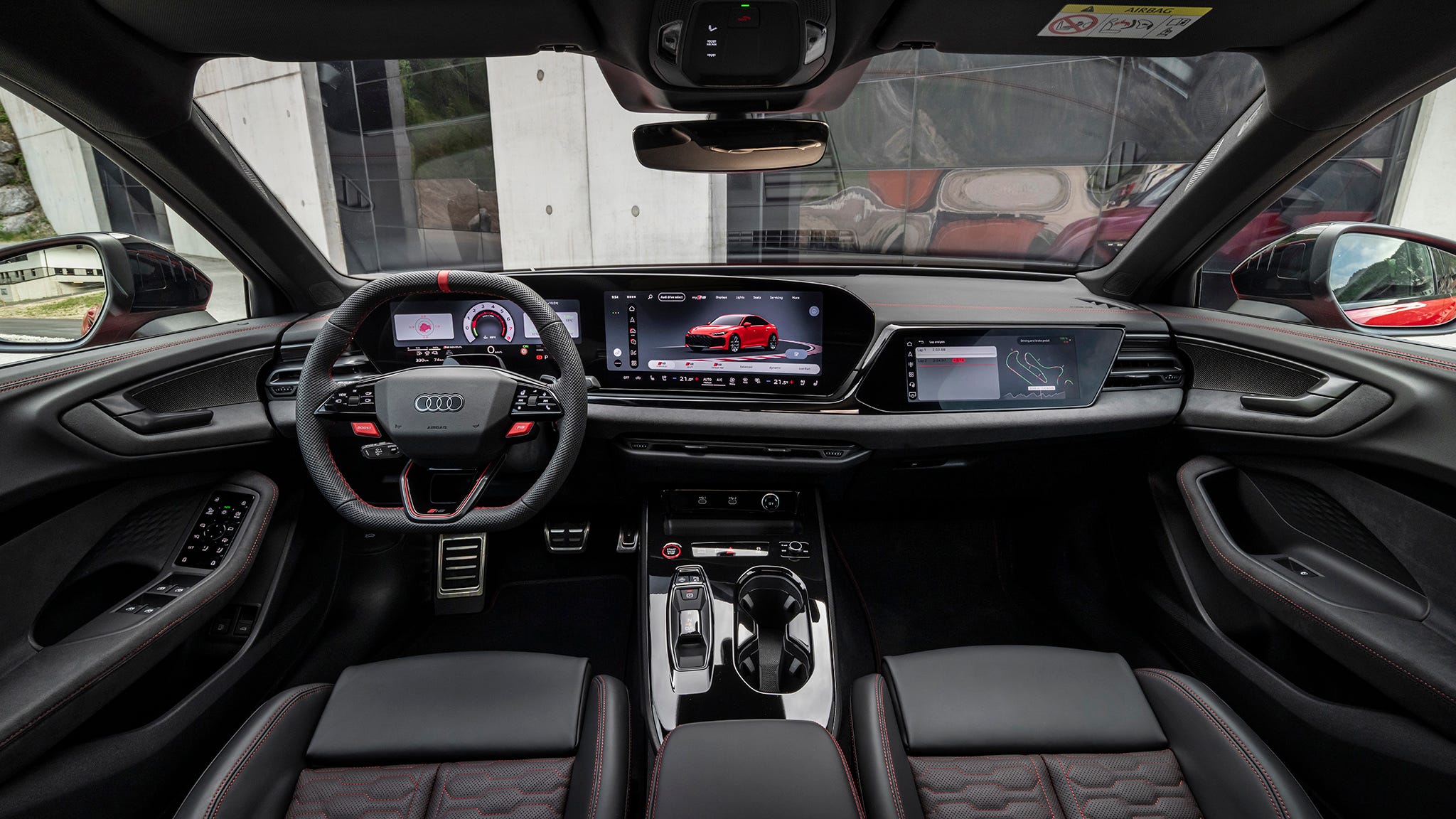
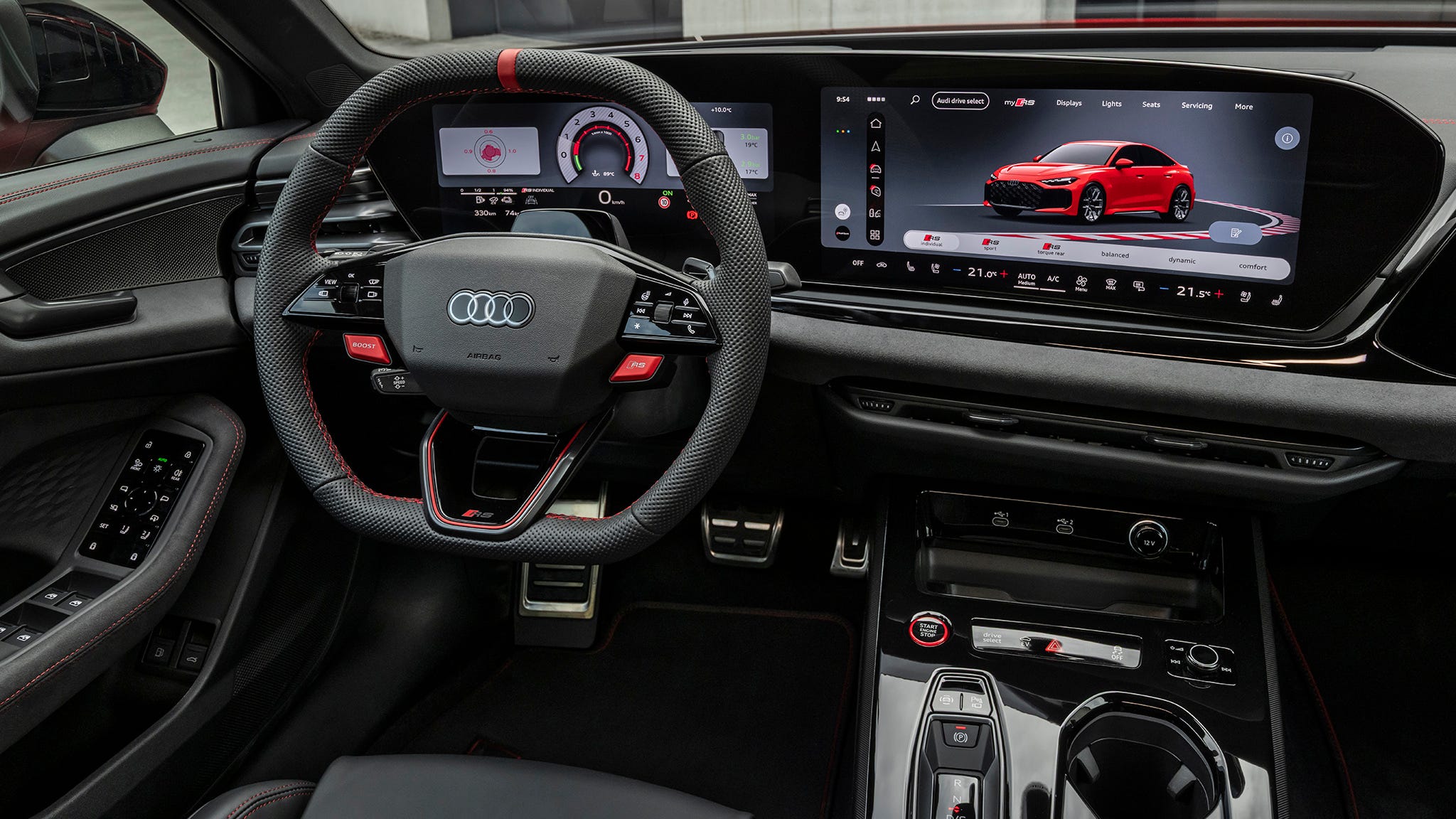
Inside, the RS5 largely lifts the three-screen layout from the A5 and S5, for better (great materials) and worse (that cluster of switches on the driver’s door panel). Audi’s marketing staff made quite a big deal about the Audi Design interior packages on offer in Europe, making us wonder if the emphasis was to be on color choices rather than powertrain technology. The Audi Sport package, for example, seems as focused on form (Dinamica upholstery with green accents, diamond-turned 21-inch wheels) as it is on function (sport exhaust, 177-mph speed limiter). Audi eased our concerns by telling us that performance options will be offered as stand-alone items, but we couldn’t help wonder if Porsche’s influence was rubbing off.
The plug-in hybrid powertrain is based on a 2.9-liter V-6, a same-size engine that was in the old nonhybrid RS5, but Audi says that displacement is the only thing this twin-turbo unit shares with the old engine. Boosted by a pair of turbos with variable-turbine geometry, the V-6 itself produces 503 hp and 443 lb-ft, with a 174-hp, 339-lb-ft electric motor sandwiched between the V-6 and the eight-speed ZF-sourced torque-converter automatic. The motor is fed by a 22-kWh battery that can be charged from an external source.
Thanks to the vagaries of hybrid math, total output is 630 hp and 609 lb-ft, though you can only access max power in 10-second increments using the red Boost button on the steering wheel. (We normally eschew gimmicks like this, but given the part-time nature of boost mode, it’s nice to know exactly what will happen when you floor the accelerator.) All four wheels are fed through a mechanical center differential that biases torque flow to the rear, with the ability to send up to 70 percent of engine power to the front and 85 percent to the rear.
Audi estimates a 0–62-mph time of 3.6 seconds, whereas the old RS5 Sportback, per the company’s testing, did it in 3.9. (We clocked a 2021 Sportback to 60 mph in 3.6 seconds, and we’d wager the new RS5 will be quicker in our testing, as well.) Audi had another interesting tidbit to demonstrate the advantage of electrification. In the first 2.5 seconds of acceleration from rest, Audi told us, a previous-gen Audi RS5 Competition traveled 42.8 feet, while the new RS5 Sportback traveled 74.1 feet.
Regardless, we can—and do—openly question the logic of a plug-in hybrid system for a performance car. One has to wonder how much of that extra power is consumed by the weight of the hardware. Of course, we know that making the RS5 a PHEV has little to do with performance; it’s all about fuel economy and emissions, which is not a bad thing (especially given what’s happening to fuel prices right now). Still, we’re sure many folks would happily forgo the complexities of electrification.
For those who doubt, bear this in mind: That awesome tail-happy behavior we described? It couldn’t happen without the hybrid drivetrain.
Let’s dive into how this new electromechanical torque-vectoring differential works. Rather than clutch packs, the new axle uses an electric motor and an elaborate planetary gearset that serves to drive the spider-gear carrier inside the differential. Actively turning that carrier biases torque in one direction or the other, without adding any meaningful power to the drivetrain.
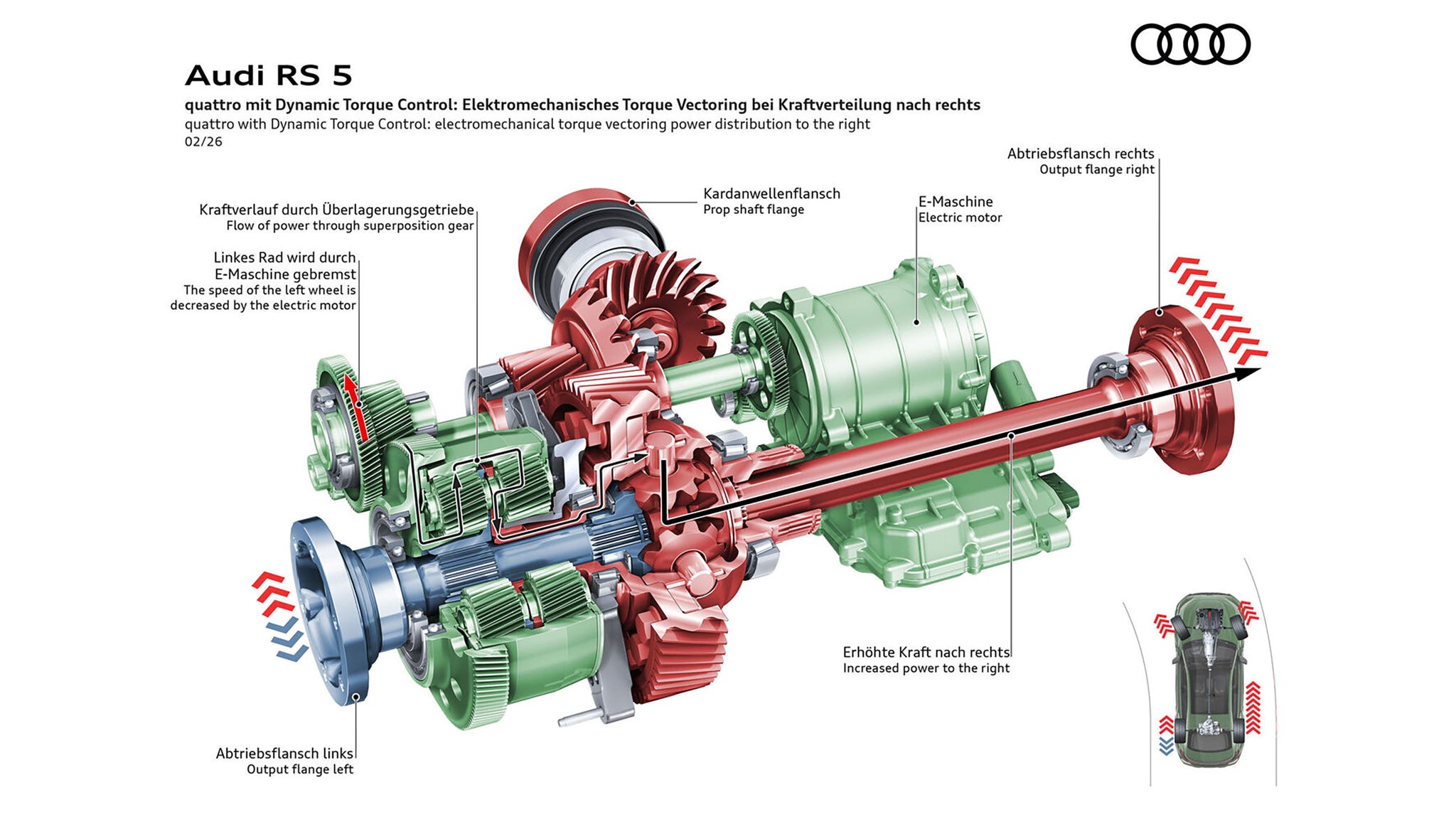
Unlike a traditional torque-vectoring axle, this new design—patented by Audi, by the way—does not require engine power to work, so it can be proactive rather than reactive and shift torque from side to side as needed, whether accelerating or decelerating, regardless of how much power is coming in from the powertrain. (If you want a deeper dive into how this system works, Audi has an explainer here .)
The key to the differential is the water-cooled electric motor, which feeds off the 400-volt hybrid powertrain. It’s the high voltage that allows for a suitably compact setup. Audi told us that with a 48-volt electrical system, like the one found in most mild hybrids, the system would be too heavy and bulky to be practical.
That’s one upside to the hybrid system, but we also found a killer downside, and it’s to do with the eight-speed automatic transmission.
Naturally, the first thing we did when we slid behind the wheel—this was before our eye-opening track session—was to nail the throttle in a straight line. With the transmission in Sport mode, all was fine; the shifts were quick and crisp, if not as smooth as Audi’s S-Tronic twin-clutch. But when we switched to manual mode and used the paddles, it all fell apart.
The RS5’s transmission is programmed to let you hit the rev limiter if you don’t shift before redline. (Curiously, this is not your typical bouncy rev limiter; the engine accelerates to maximum speed and stays there, screaming smoothly.) Normally, this is a feature we love, but here’s the problem: With electric boost, the redline comes up lightning fast. If you’re quick enough to click the upshift paddle before the engine hits the limiter, you get a snappy gearchange, but if the tachometer so much as brushes the redline before you bop that paddle, the shift is delayed—and when the transmission finally does shift, it does so with a jerk and a horrendous clunk that sounds like something has broken.
Our first assumption was that something was wrong with the RS5 we were driving, so we tried another car. It did the exact same thing on the exact same gearshifts (1–2 and 2–3)—a one-second burst of acceleration to redline followed by a nearly two-second delay between paddle input and upshift. We tried a third RS5. Same behavior.
Is this a programming error? It’s hard to imagine Audi’s engineers could have missed something so obvious, so it must be a limitation of the hardware or software. The “patch” is to leave the transmission in automatic mode, but even left to its own devices, the ZF eight-speed still doesn’t shift as quickly or smoothly (up or down) as Audi's twin-clutch transmission, which, so far as we know, is not paired with any of the brand's (or Volkswagen’s) hybrid drivetrains.
Of course, another advantage to the PHEV drivetrain is the ability to run up to 50 miles or so on battery power. Normally, with a car like the RS5, we’d say, “Who cares?” But when Audi told us the RS5 could scoot up to 87 mph on battery power alone, well, we had to try it. We hit the EV mode button and were genuinely surprised by how quickly the RS5 scooted to highway speeds and stayed there. When the RS5 makes it stateside, you’d better believe we’re going to be showing that off to our friends.
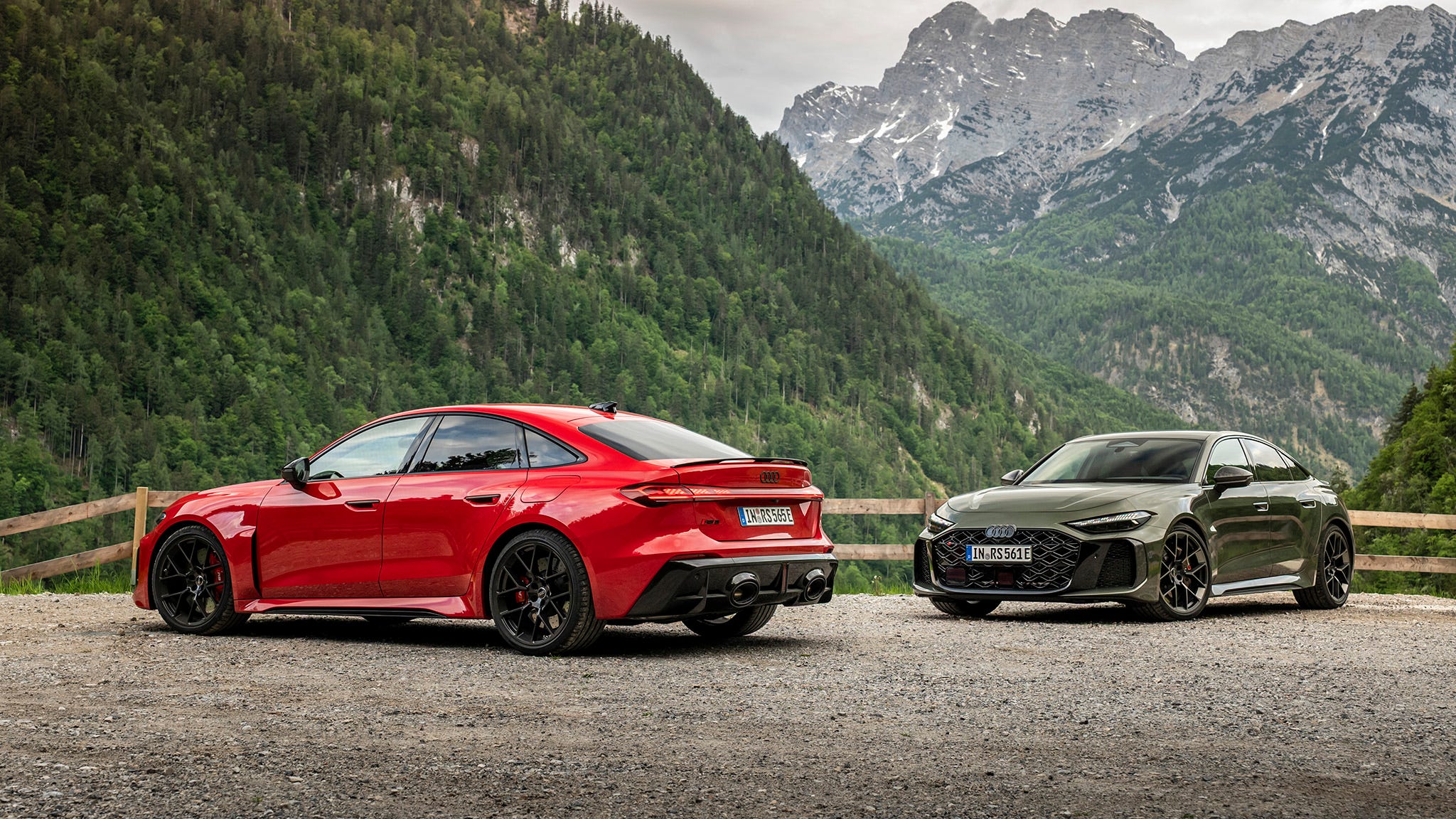
Overall, we’re impressed by the Audi RS5, especially the way it handles its prodigious bulk. We can’t help but wonder what the car might be like had Audi skipped the PHEV system, but then again, we probably know the answer: It’d be a slightly faster and much more attractive version of the outgoing RS5 Sportback. While that would be fine because we loved the old RS5, driving it wouldn’t be a transformative experience like the new RS5 with its trick rear axle.
But there’s another severe consequence of the PHEV system, and that’s price. Audi is still formulating the U.S.-spec model, but in Europe, Sportback pricing starts at €106,200, which is about $120,000. Compared to the outgoing RS5’s starting price of $81,195, that’s—well, it’s a lot higher. And all those design packages are bound to balloon the price even further. The old RS5 was a bargain for what it delivered, and we can’t imagine the new car will match the old one’s success with a price tag that high—otherwise, why not just spend an extra 10 or 20 grand on the RS6 Avant, which gets to 60 in 3.3 seconds without electrical assistance?
No question, the RS5 is an impressive car, and it’s a lesson to other automakers (are you listening, BMW?) about how to engineer around weight and turn the detriments of a hybrid drivetrain into advantages. But at the price Audi is asking—in Europe, at least—there are cheaper ways to get quick acceleration and oversteer. Cadillac CT4-V Blackwing , anyone?
Comments (0)