
According to the European Automobile Manufacturers Association (ACEA), the European new passenger car market grew by 5.7% in the first half of 2026, reaching 5,896,683 units. This result, achieved amid geopolitical turbulence, was made possible by an explosive surge in demand for electric vehicles (+35.1%), with hybrid cars also selling like hotcakes. Eco-activists are celebrating victory, yet the systemic crisis in the European automotive industry is only intensifying. We explain how this is possible.
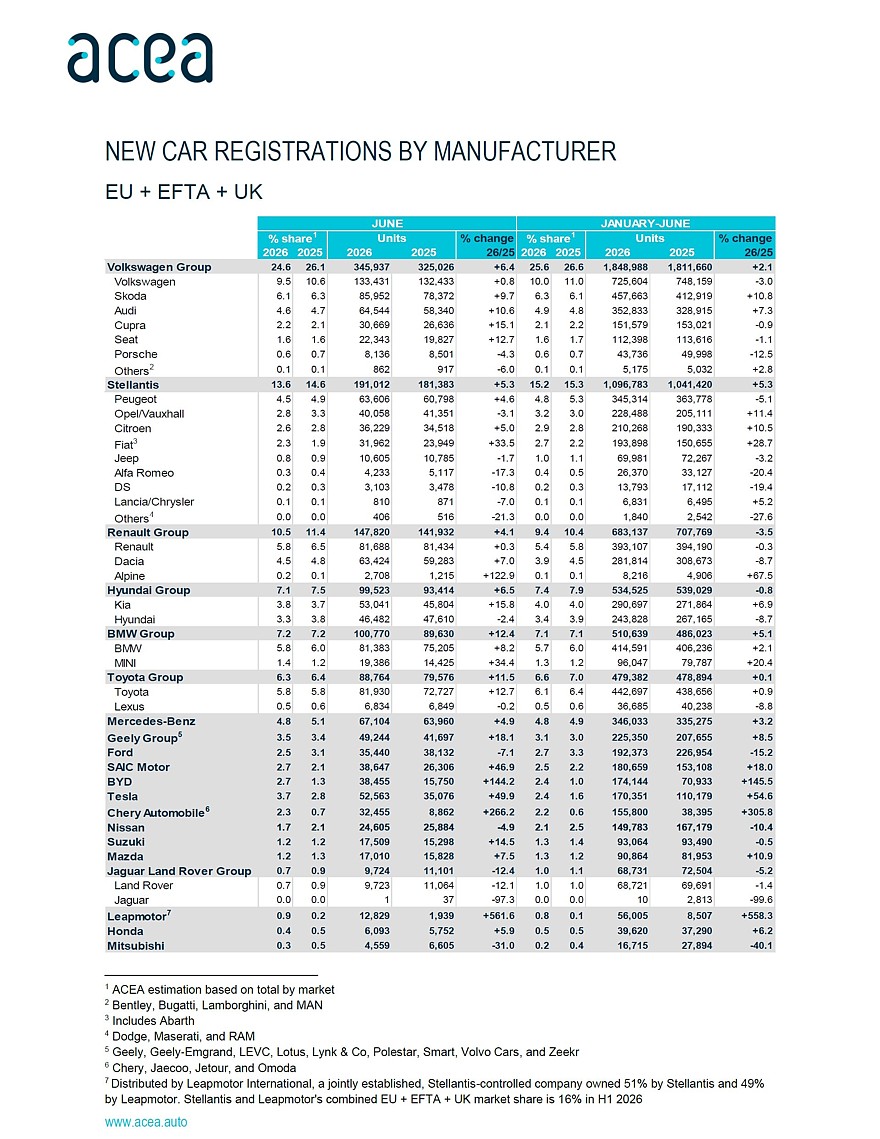
The key point is that strong sales do not mean strong profits: the costs of doing business in Europe today are so high (the green agenda, high taxes, social burdens, very strict market regulation by authorities, lengthy approvals for new projects) that achieving profitability here is extremely difficult even with good sales. All major European automakers are currently reporting declining revenues. Even the seemingly unsinkable BMW Group finds itself on the brink of a crisis, while the Volkswagen Group is already transitioning from crisis to catastrophe.
The current growth in the European auto market has been driven by electric vehicles, demand for which increased due to the geopolitical maneuvers of US President Donald Trump in the Middle East: military actions led to oil price spikes and delivery problems due to the blockade of the Strait of Hormuz. Even Tesla, which had been written off as an outsider in Europe due to its outdated model lineup and Elon Musk's political views, managed to sharply increase its electric vehicle sales in the region in the first half of 2026, specifically by 54.6% to 170,351 units.
ACEA statistics are based on registration data, which most accurately reflects the state of the European auto market, but for ease of understanding, we will use the word "sales" instead of "registrations" because it is more familiar. Unfortunately, ACEA does not publish sales statistics by model, and there are currently no other openly accessible data sources for Europe. The analytical agency JATO Dynamics, which previously provided excellent European overviews with model-specific statistics, stopped publishing them last summer.
Below we provide ACEA statistics for the first half of the year by manufacturer and individual brand. Unfortunately, this table does not include a breakdown of brands within Geely Group, BYD, and Chery. We only note that Chinese companies are gradually establishing themselves in Europe, and their share will only grow, including through the localization of key models at European plants. Yesterday, for example, it was officially announced that Geely will produce its crossovers at the Ford plant in Valencia, Spain.
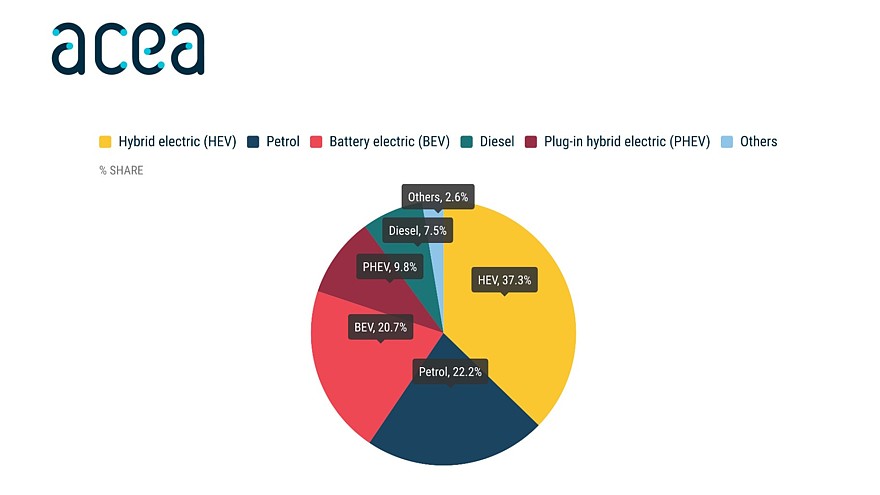
Next, let's look at how the European new car market is currently divided by powertrain type: the share of electric vehicles increased from 15.6% to 20.7% compared to the first half of 2025, the share of hybrids (non-plug-in) rose from 34.8% to 37.3%, the share of plug-in hybrids grew from 8.5% to 9.8%, the share of gasoline cars decreased from 28.4% to 22.2%, and the share of diesel cars fell from 9.4% to 7.5%.
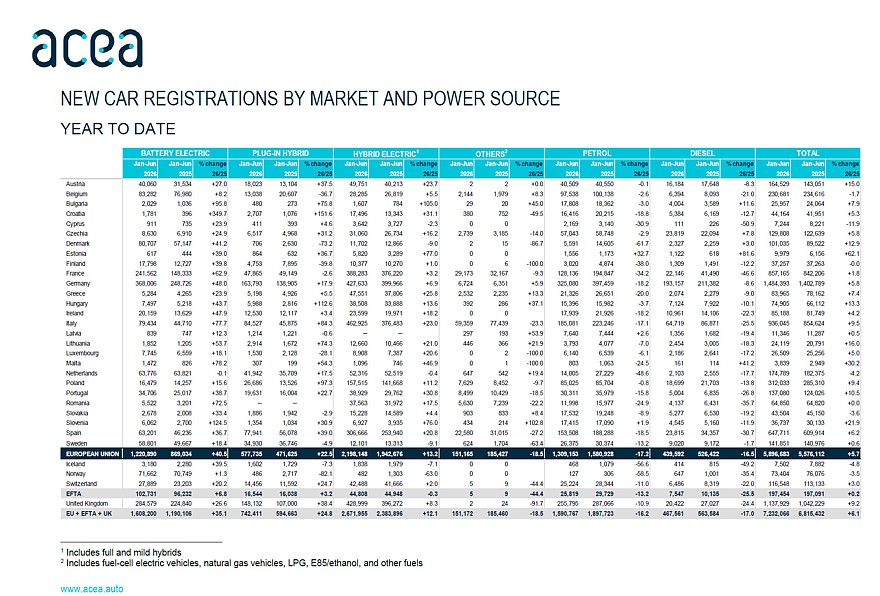
ACEA also has an interesting table showing the distribution of powertrain types by country. It shows that the main consumers of electric vehicles in Europe are Germany, France, Denmark, Belgium, and Italy. Interestingly, Spain, which has become the main production hub for Chinese companies in Europe, is in the middle of the pack in terms of electric vehicle consumption, while the Netherlands is the only country where electric vehicle sales did not grow in the first half of the year.
Comments (0)