
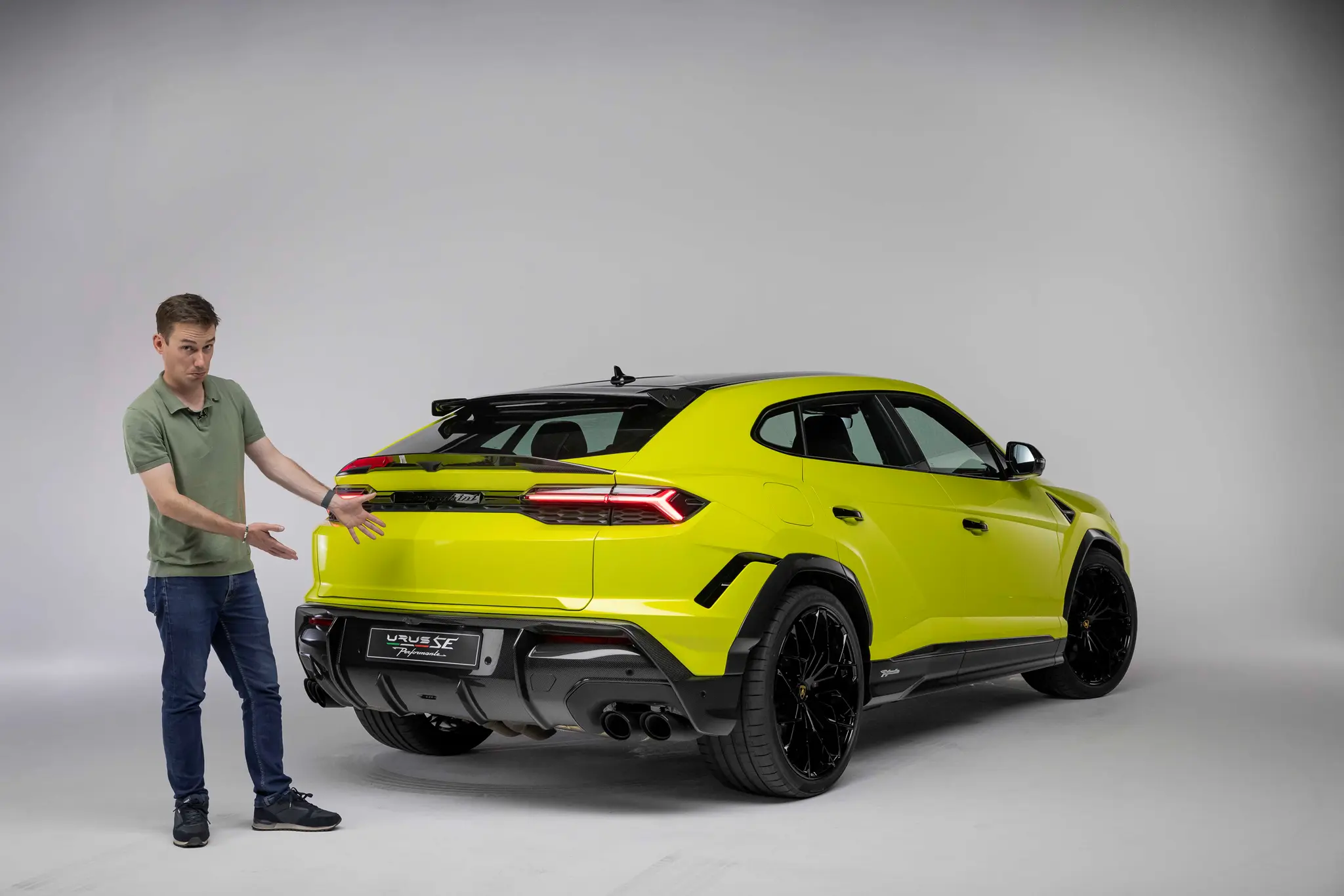
► New Urus SE Performante Unveiled ► Upgraded suspension, aero and power ► Likely to be priced from around £250k
Determined not to have its neighbours dominate the super-SUV headlines in 2026, Lamborghini has gone and made the Urus even more outrageous with this – the SE Performante.
Delivering over 800bhp, it comprehensively outguns both the Ferrari Purosangue and Aston Martin DBX S, plus there’s enough carbon fibre body parts to rebuild an entire F1 car. Maybe. But Lambo is rather proud of the fact that the SE Performante uses more carbon than any other SUV before it.
Keep reading for more info on the SE Performante’s powertrain, interior, styling, tech and price tag.
Sort of. The Urus Performante initially launched in 2022, however since the model line-up switched to plug-in hybrid in 2024 (hence the SE part of the name) this is the first time we’ve seen the Performante badge on Lambo’s SUV.
The result is 801bhp and 737lb ft torque from the twin-turbo 4.0-litre V8 coupled with a 25.9kWh battery and electric motor nestled between the engine and gearbox. Claimed electric range is almost 40 miles, but the real story is 144bhp and 110lb ft more than the previous Urus Performante. That means 0-62mph in 3.3 seconds and 0-124mph in just 10.8 seconds. Top speed is the same as the regular Urus SE, but that’s possible even with a 23% increase in overall downforce.
Part of the increase in aero performance is thanks to the swathes of carbon fibre exterior hardware, such as the front splitter, upper and lower rear spoiler and rear diffuser.
Plus, from a cooling perspective, new NACA ducts contribute to an 8% increase in brake cooling efficiency versus the Urus SE, while S-Ducts on the bonnet allow more airflow into the engine. Said bonnet is, you’ve guessed it, made of carbon fibre as standard, but if you want it partially exposed it’s an optional extra.
Further optional carbon adorns the wheelarches, the side-mirror covers, side gills (non-functional), side skirts and roof. It sounds overkill (and perhaps it is), but Lamborghini clearly recognises how well the material goes down with the core customer base and as such has gone to town with the availability.
Erm. No. Despite a new Akrapovic titanium exhaust system, reduced sound deadening, a new braking system and lighter cabin trim saving a combined 32kg, the Urus SE Performante still weighs in at 2473kg. That’s a hefty amount more than both the Ferrari Purosangue and Aston Martin DBX S and, from a power-to-weight point of view, means that all three cars are around the 330bhp per tonne mark.
Clearly, such a kerb weight calls for reinforcements. To that end Lamborghini has widened the track by 16mm and – more importantly – installed 2K2V dual-chamber air suspension plus the 6D sensor from the one-off Fenomeno and IPB (Integrated Power Brake system).
The latter in particular is very clever. It uses a sensor to measure six different physical parameters (hence the name) that build an accurate picture of what the car is doing in real time. This is then used to estimate variables such as tire grip, speed, body angle attitude and more, all of which are factored in to systems such as the Integrated Power Brake (IPB) unit and Integrated Vehicle Control (IVC).
This allows them to act proactively, rather than simply responding to situations. The result is, in theory, faster and smoother responses from the car with shorter braking distances despite using the same discs and calipers as the Urus SE. In fact, the only difference in the brake hardware from the standard model is the IPB acting as an advanced pressure modulator that eliminates the typical ‘on-off’ interventions usually seen with ABS.
Finally, the SE Performante is available with semi-slick Bridgestone Potenza Race tyres in 22-inch spec or, should that not be large enough, 23-inch P Zeros. Scorpion Winter 2s in the smaller diameter are also on offer.
Again, more carbon, more moody vibes. The car we sat in was trimmed in dark CorsaTex and Dinamica microfiber and together with a revised 12.3-inch central touchscreen and new steering wheel, felt just about different enough to the Urus SE. The Y-shaped anodised aluminium details around the air vents, particular, stand out.
Also new is the Rally drive mode. Essentially Corsa mode with the suspension and ground clearance eased off from full attack settings it is – unsurprisingly – designed for loose surface excursions. Lambo admits that many customers will likely just try it in a demo vehicle (rather than risk their own paintwork), but nonetheless it’s good to see some Sant’Agata making use of the Urus’ 4×4 credentials.
No confirmed price tag just yet, but in the region of £250k. It’s likely that a significant chunk of those customers will be existing Urus owners, with the model itself now attracting 40% repeat buyers from the wider Lamborghini range.
Comments (0)