
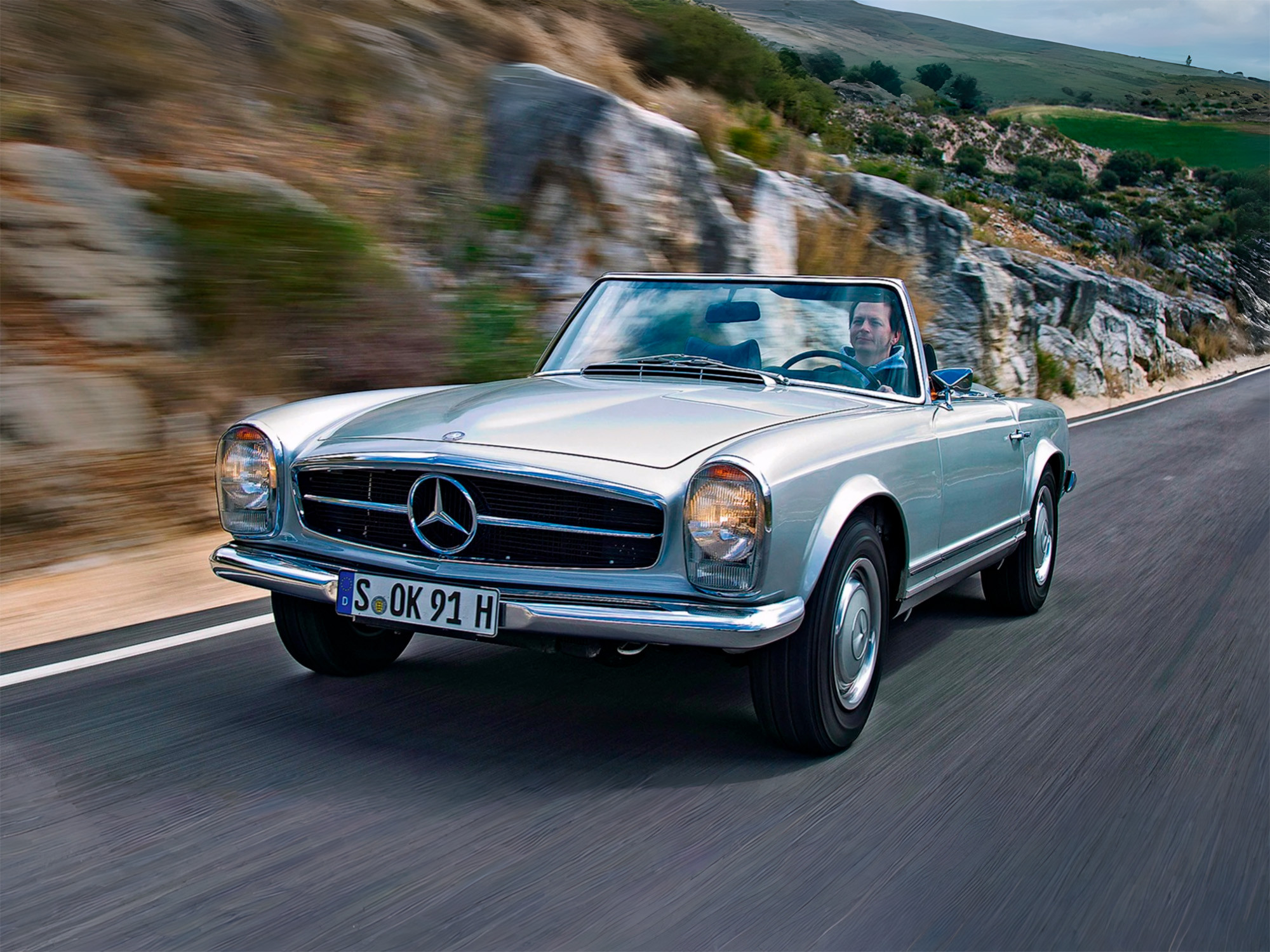
For most motorists, Mercedes-Benz is primarily about prestigious and comfortable four-door sedans, from the compact "190," which later became the C-Class, to the line of S-Classes: W116, W126, W140, and so on. Let's not forget the legendary G-Class SUVs, which have been in the Stuttgart brand's lineup for almost half a century. However, true connoisseurs always hold the letters "SL" in their hearts and minds, which for over seventy years have denoted special racing and sports cars from Mercedes. Today, we will recall one of the most famous and unusual roadsters in this family – the very "Pagoda," which is rarely seen in person nowadays.
Almost ten years after the end of World War II, Mercedes-Benz was doing so well that based on the 300 SL (W194) racing car, which won prestigious races like Le Mans, the Carrera Panamericana, and even the Nürburgring Grand Prix in its very first season in 1952, a civilian coupe was created with the same index but the internal factory designation W198.
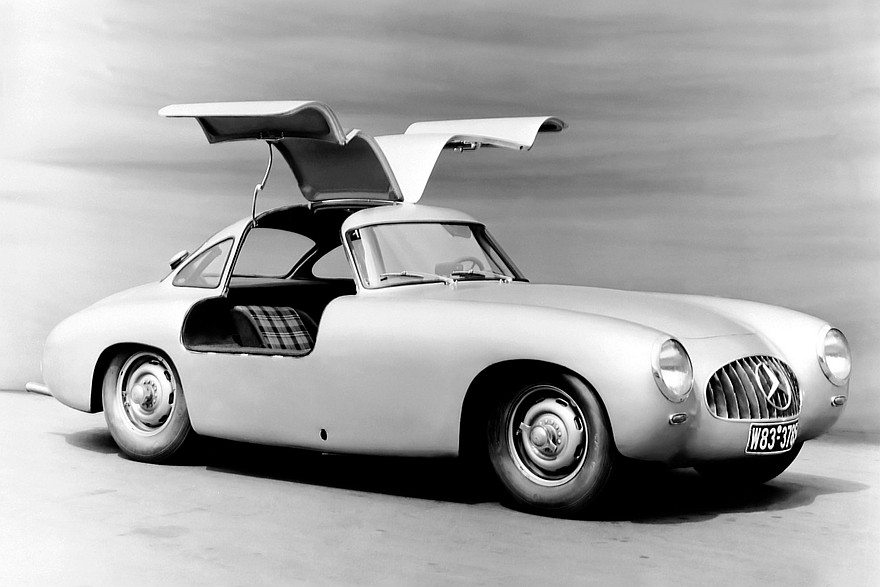
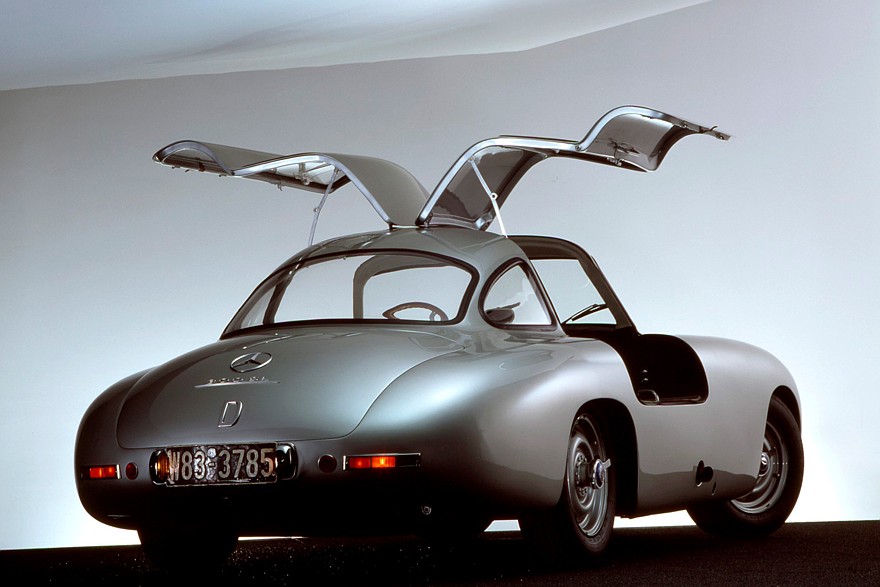
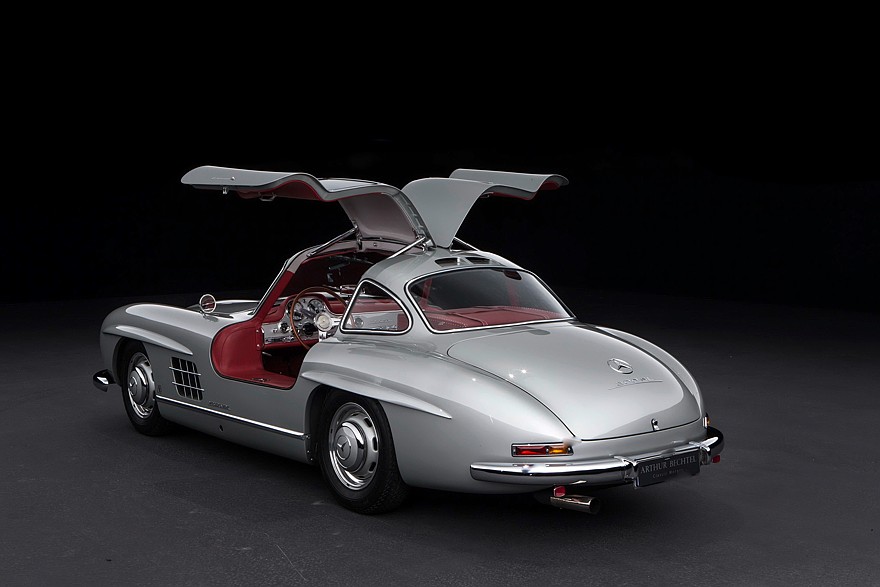
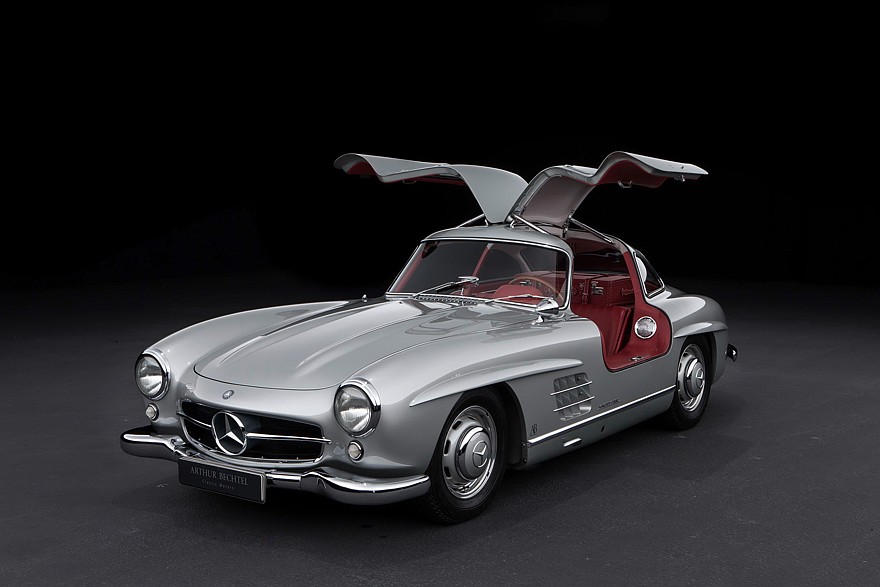
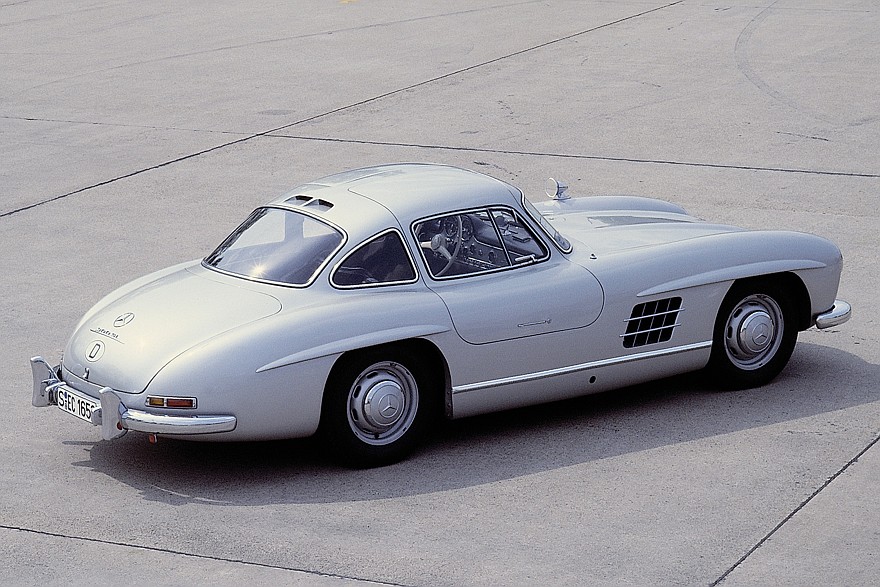
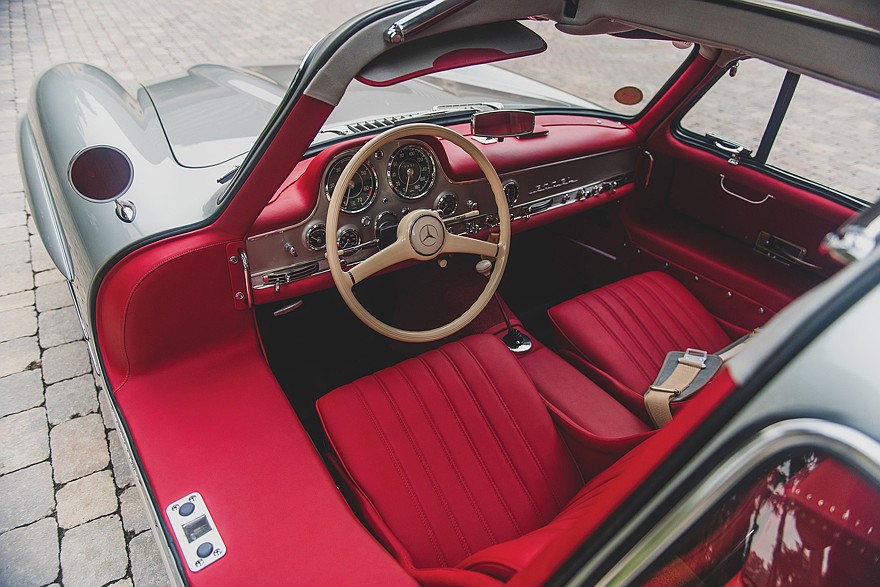
The legendary "Gullwing" was road-worthy only in comparison to the actual racing original, and it itself turned out to be too noisy, harsh, and, of course, expensive. Although in 1957, another step was taken towards ordinary consumers when the coupe was replaced by an open roadster.
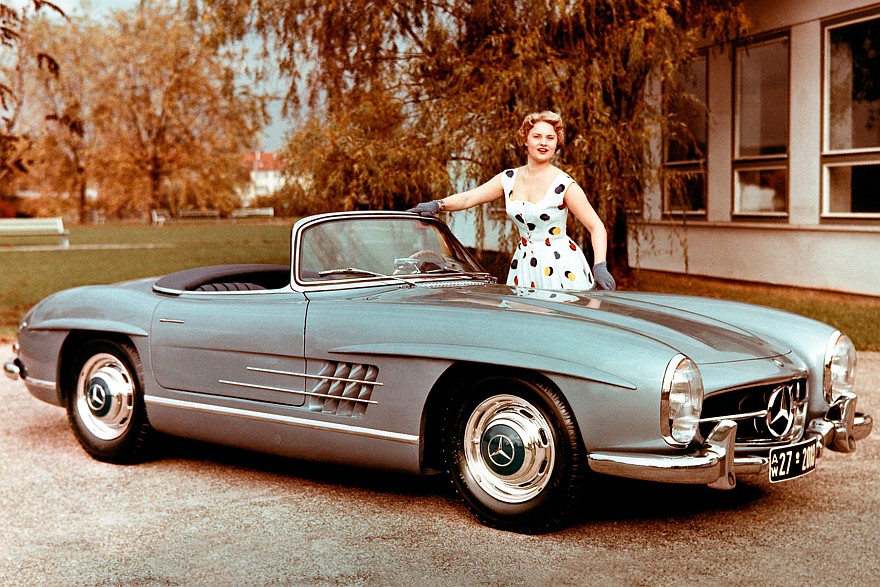
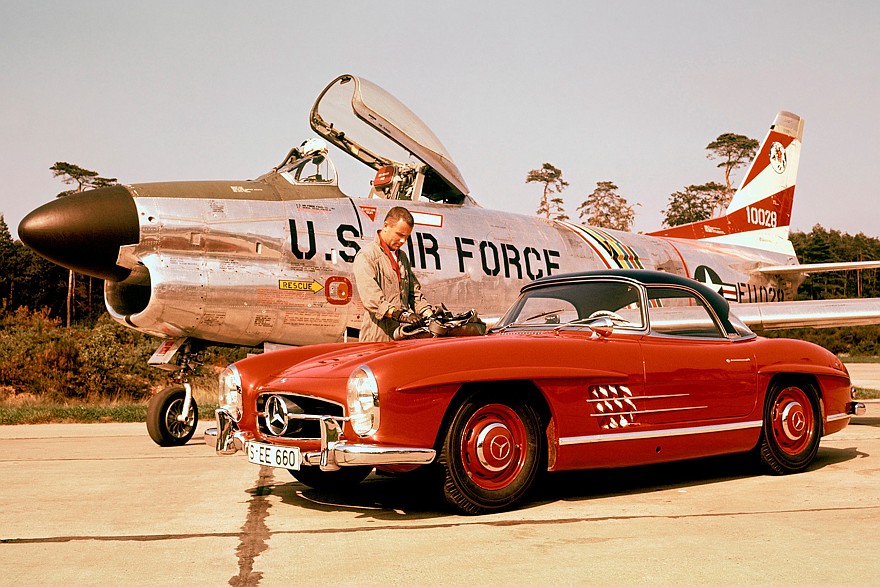
Still, the model remained excessive in every sense. It's no coincidence that two years earlier, in 1955, the "little brother" was released – the more compact 190 SL (W121) roadster, which looked like the previous SL, but under its unibody construction, there was no expensive tubular frame. The model was an order of magnitude more mass-produced than the 300 SL.
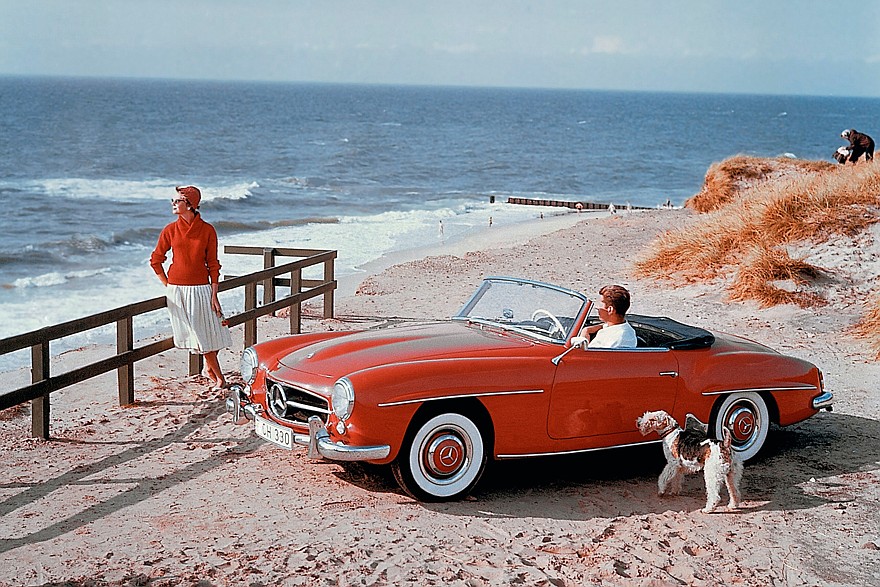
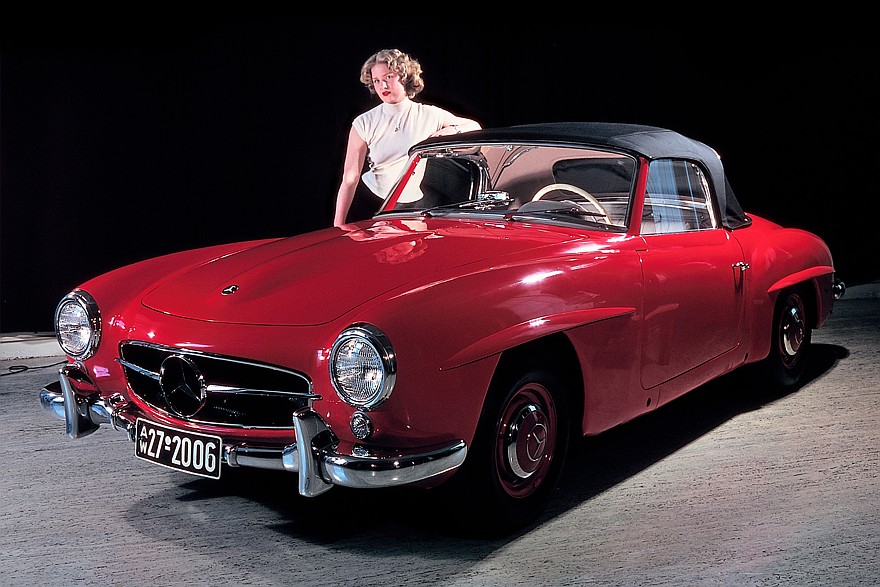
The base for the open car with a modest 1.9-liter engine producing 105 hp was the four-door "Ponton" with the index W120.
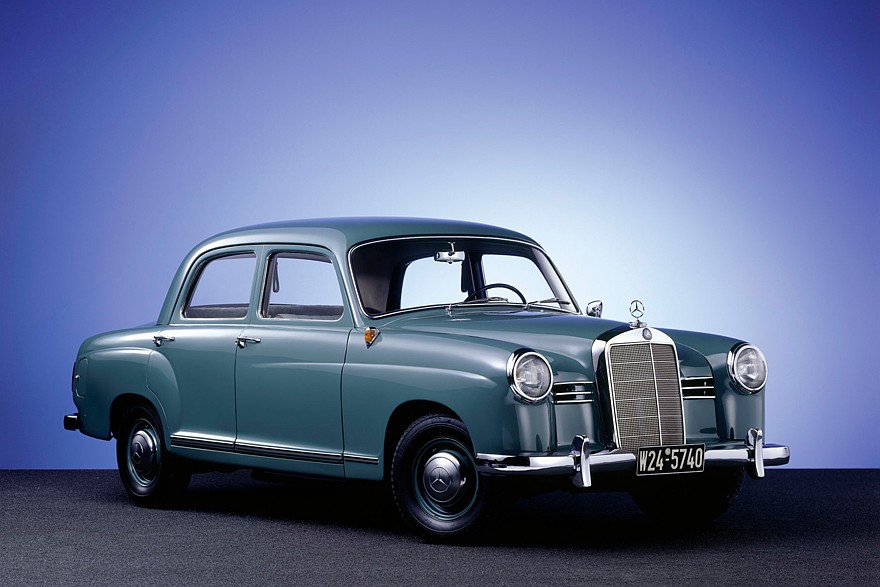
Understanding the insufficient power-to-weight ratio of this version, the Germans worked on a variant with a 2.2-liter gasoline "six" M127 and Bosch mechanical fuel injection, which promised a much more respectable and interesting power output of 130 horsepower.
But the "Ponton" itself, alas, had long since become outdated by then, and in the new decade, it and its derivatives had no future. Production of the "big" 300 SL roadster, as well as the "small" 190 SL, ended in 1963. And then the most interesting part began.
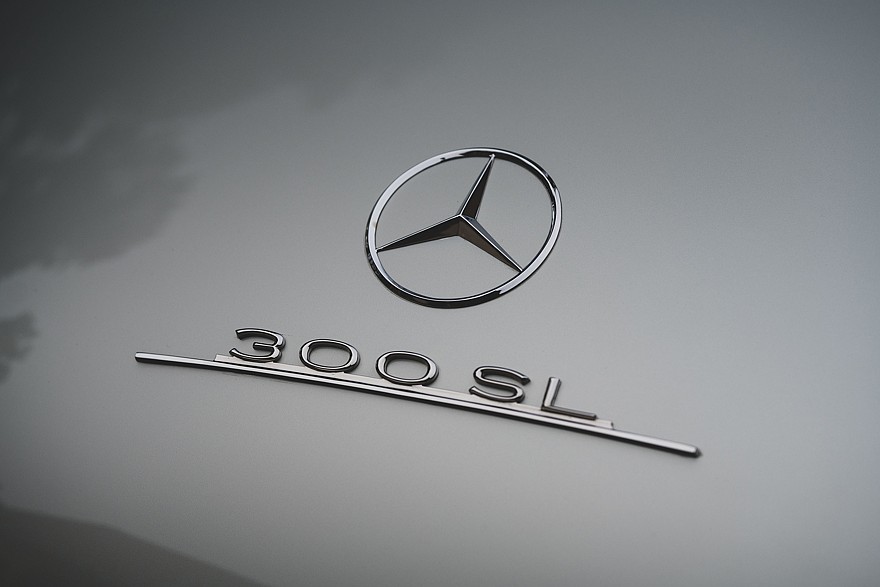
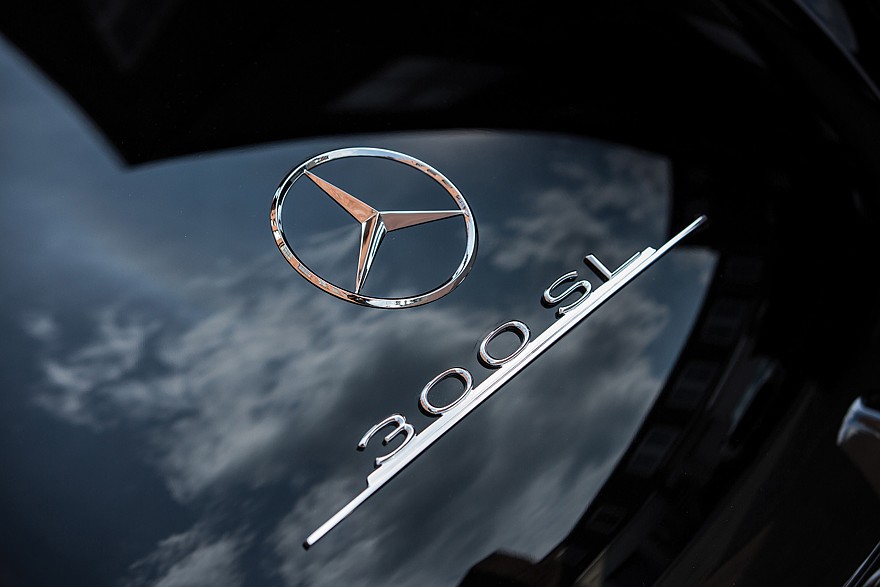
There are a couple of versions of how the abbreviation SL is deciphered. It is not known for certain whether the abbreviation SL originated from the 1931 Mercedes-Benz SSKL (Super Sport Kurz Leicht – Super Sport Short Light) designation. During the presentation of the racing 300 SL in 1952, Mercedes-Benz representatives did not share information about what the abbreviation SL meant. The German magazine Auto Motor und Sport, in its 2012 special issue Mercedes-Benz SL, stated that German engineer, head of the racing car department, and member of the board of directors of the Daimler-Benz automotive concern, Rudolf Uhlenhaut, indicated in his notarized letter that this abbreviation stands for Super Leicht (super light).
However, well-known German automotive journalists, historians, and authors of authoritative monographs, Günter Engelen and Mike Riedner, who also worked with Rudolf Uhlenhaut, claimed in the book "Mercedes-Benz 300 SL" that the abbreviation means Sport Leicht. But on March 15, 2021, Auto Motor und Sport magazine published in its issue a photocopy of a 1952 document in which the abbreviation SL is deciphered as super-leicht (super light).
Mercedes-Benz used both terms until 2017, when a chance find in the corporate archive finally settled the matter: the abbreviation still means "Super Leicht" (super light).
In such a specific car as a roadster, the most important thing is design. And it, in turn, depends entirely on its author.
The task of drawing the future W113 was entrusted to the young Paul Bracq, and it happened in a rather unusual way. Back in 1953-1954, Bracq worked as an assistant to Philippe Charbonneaux in his design studio. Then, from 1954 to 1957, Bracq served in the military in Germany and, finding himself in Stuttgart by chance, showed his work to the head of the Mercedes-Benz body department, Karl Wilfert. The meeting was so fateful that Paul immediately got a job as a designer for Daimler-Benz in Sindelfingen. And he was the one who was supposed to handle the appearance of the new SL roadster.
Incidentally, the "Pagoda" was the first Mercedes with a design by the French artist, who then, until 1967, also worked on the Mercedes-Benz W108/W109, the 600 limousine (W100), and the W114/W115. In fact, Bracq defined the strict and functional appearance of Mercedes cars of the sixties, which served as the basis for the cars of the Bruno Sacco era.
It cannot be said that the new two-door came easily to the thirty-year-old Frenchman, because in the early sketches, the car was still quite rounded.
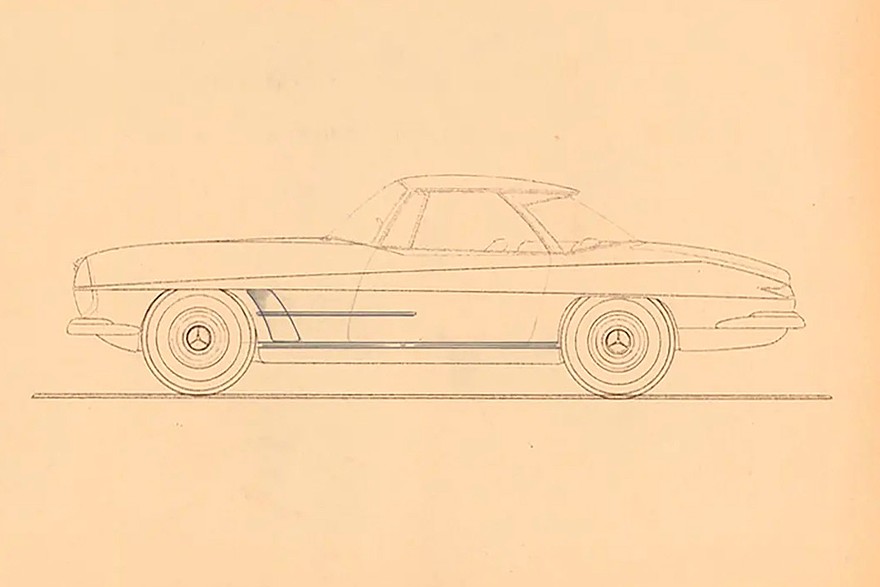
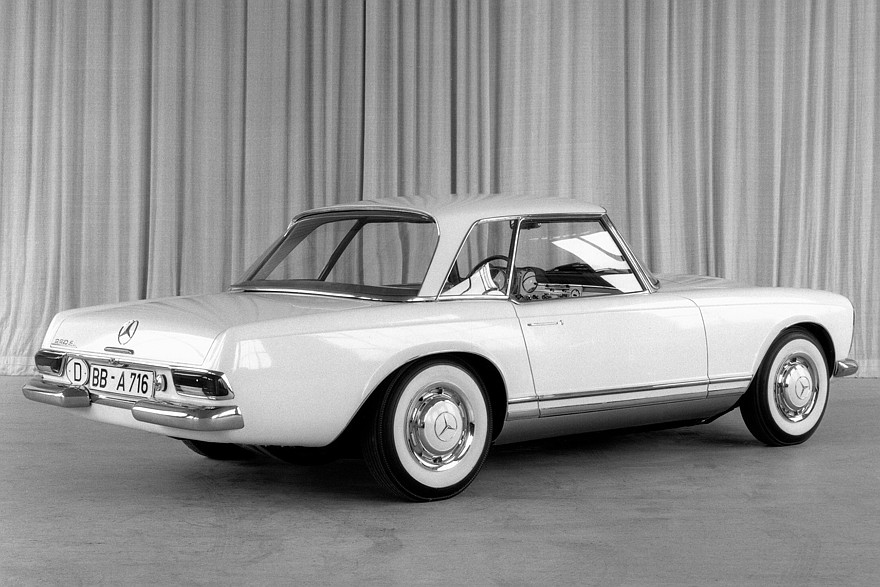
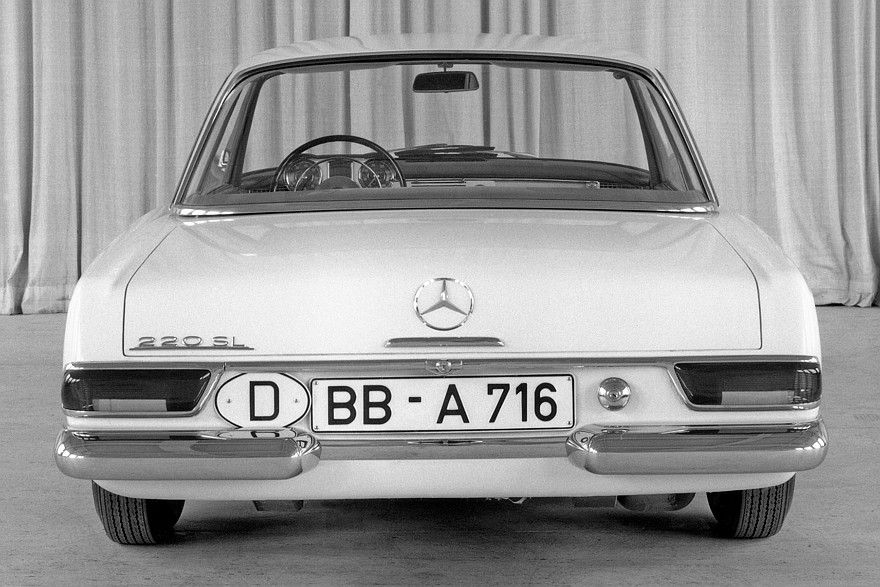
Overall, the project was overseen by Mercedes-Benz Technical Director Fritz Nallinger, Chief Engineer Rudolf Uhlenhaut, and Head of Design Friedrich Geiger, who had previously developed iconic models such as the 500K/540K and the 300 SL.
Besides Bracq, the body was also worked on by Béla Barényi, who was a pioneer in developing passive safety solutions in the automotive industry. This is why the W113 became the world's first sports car designed in accordance with passive safety requirements.
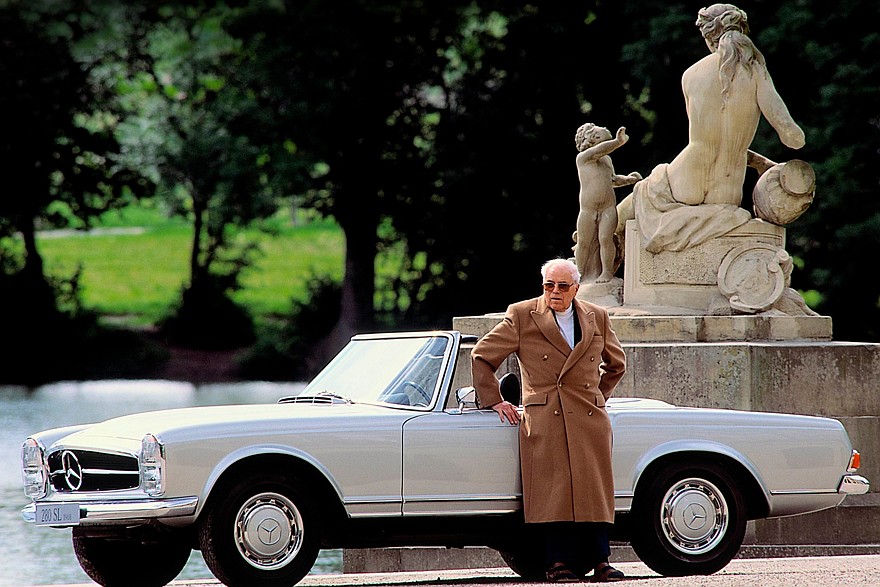
Its body, 4285 mm long, consisted of a strong, non-deformable passenger safety cell and front and rear sections with predetermined and programmed crumple zones, designed to absorb impact energy in the event of an accident. This fact alone propelled the two-door to the forefront of the automotive world in the sixties.
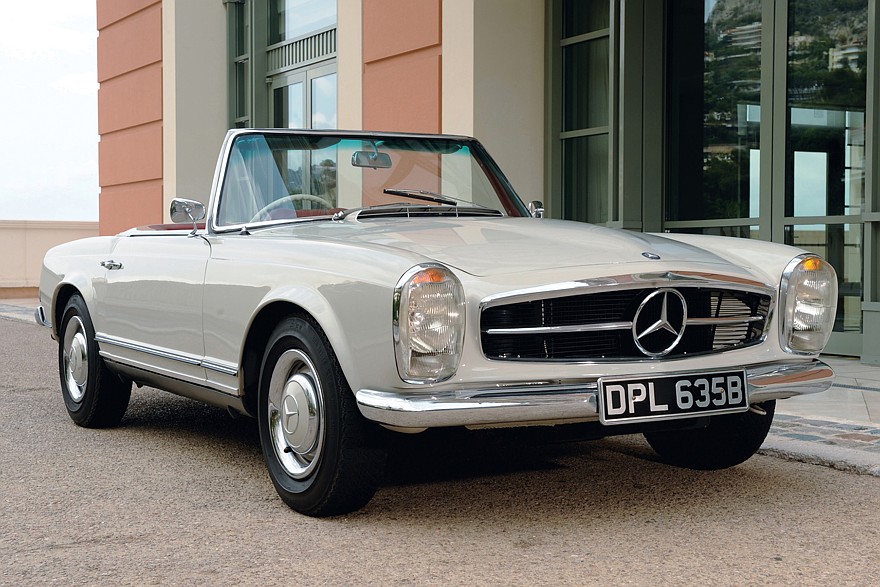
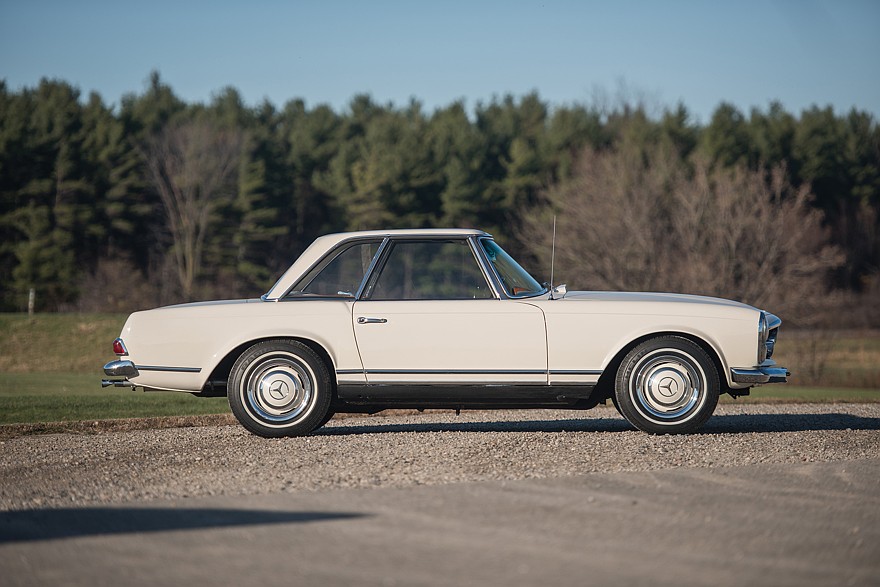
The new model was presented to the public on March 14, 1963, at the Geneva Motor Show. As stated by the head of the Mercedes-Benz engineering department, Fritz Nallinger, during the presentation, "our goal was to create a very safe and fast sports car with high performance, which, despite its sporting characteristics, provides a very high level of comfort on the road." That is, with the arrival of the new SL, the time had come for affluent motorists when driving pleasure did not have to be accompanied by physical exertion.
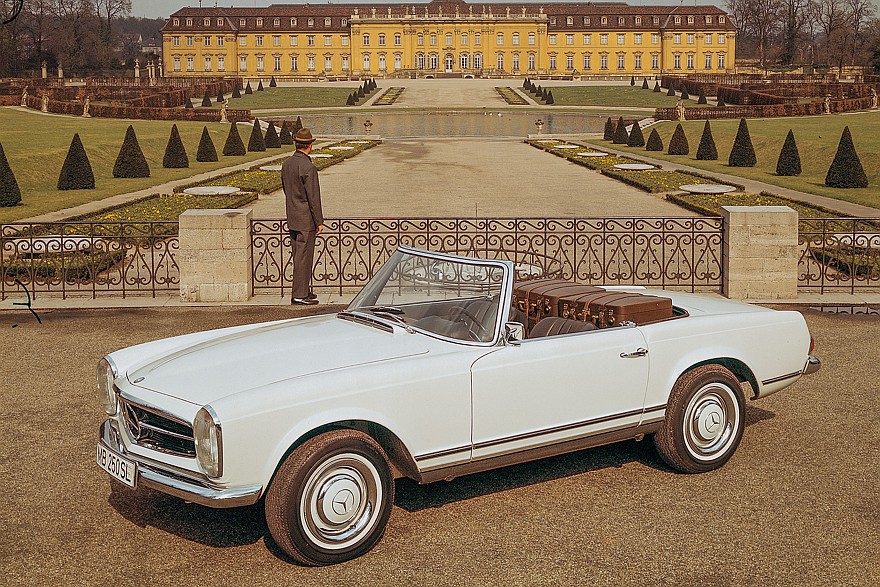
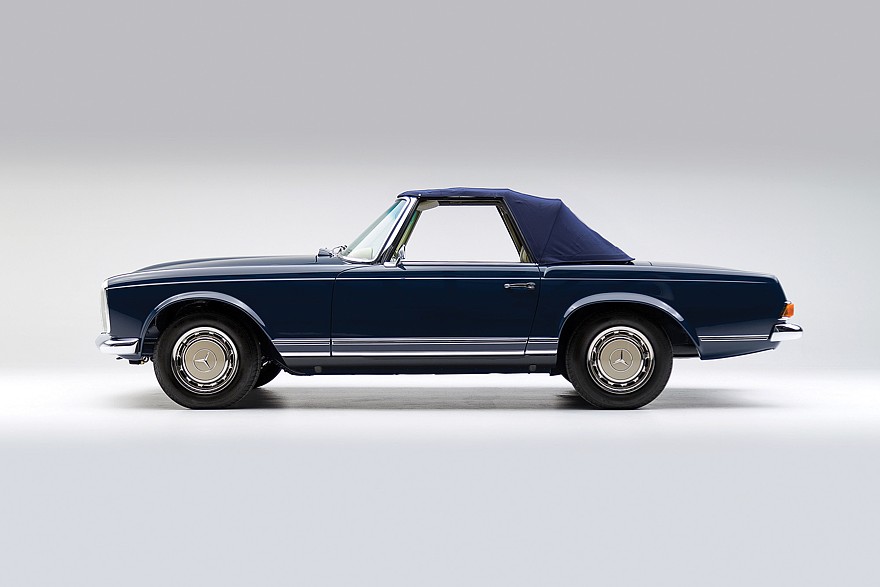
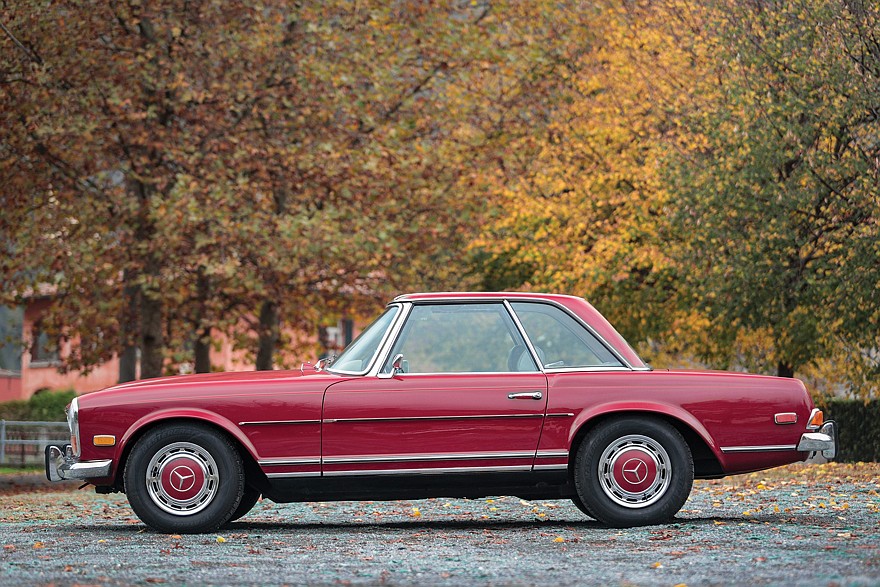
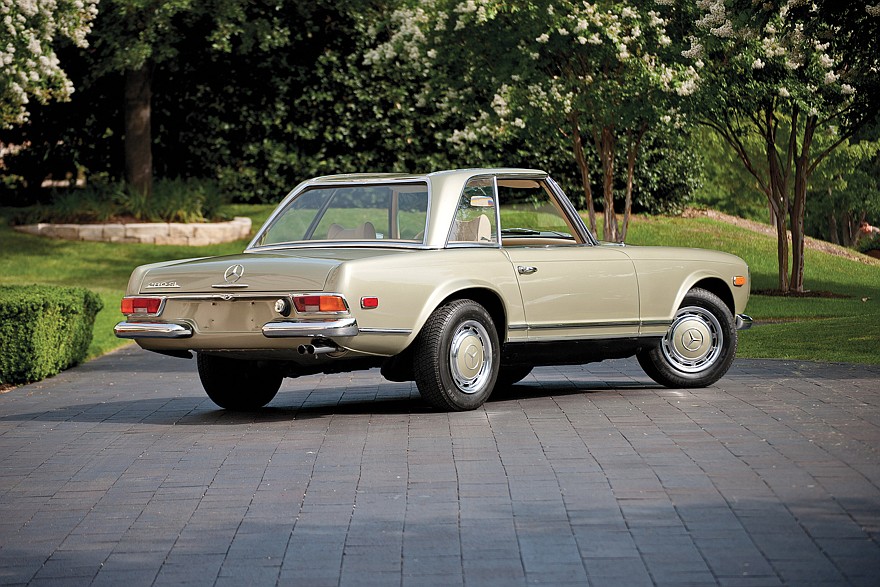
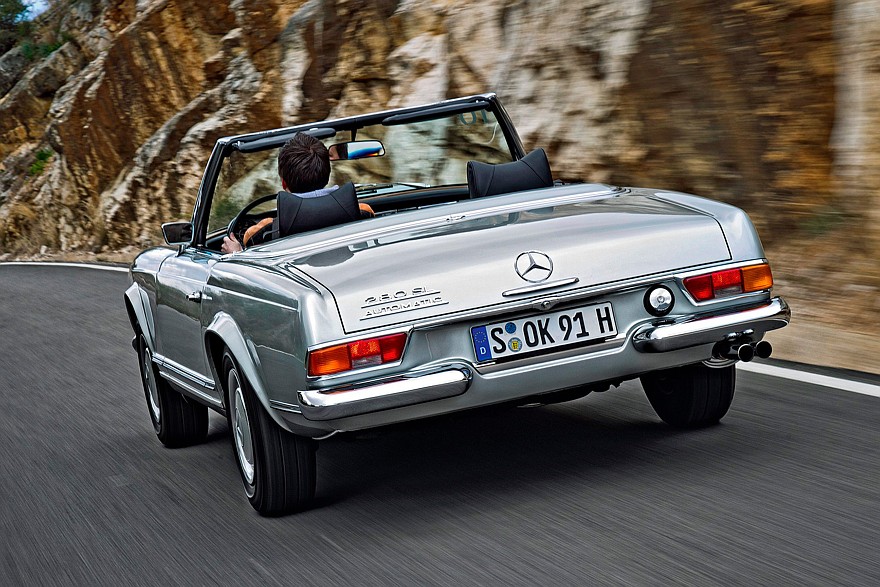
What did the new SL look like? Elegant, modern, and unusual. The vast glass area, long hood, and shorter trunk combined with a small passenger cockpit formed a very unconventional and memorable image.
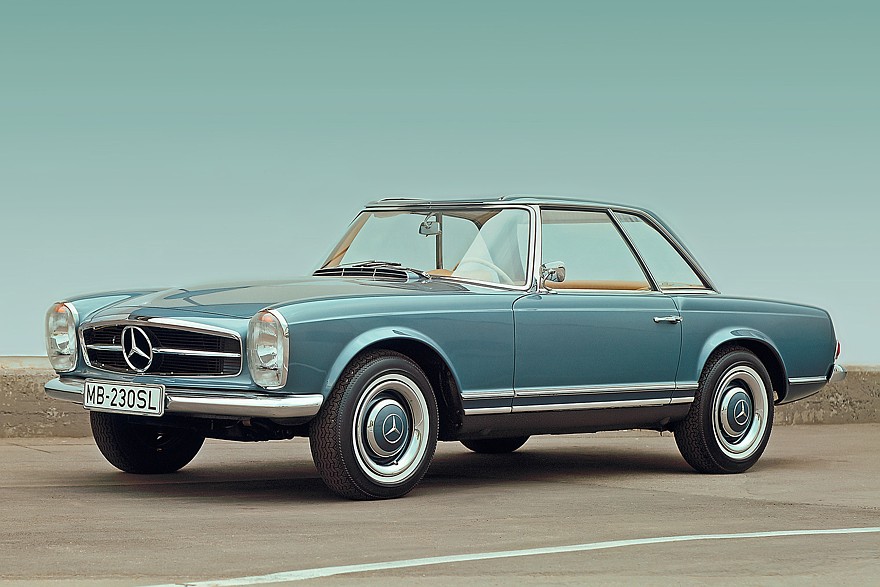
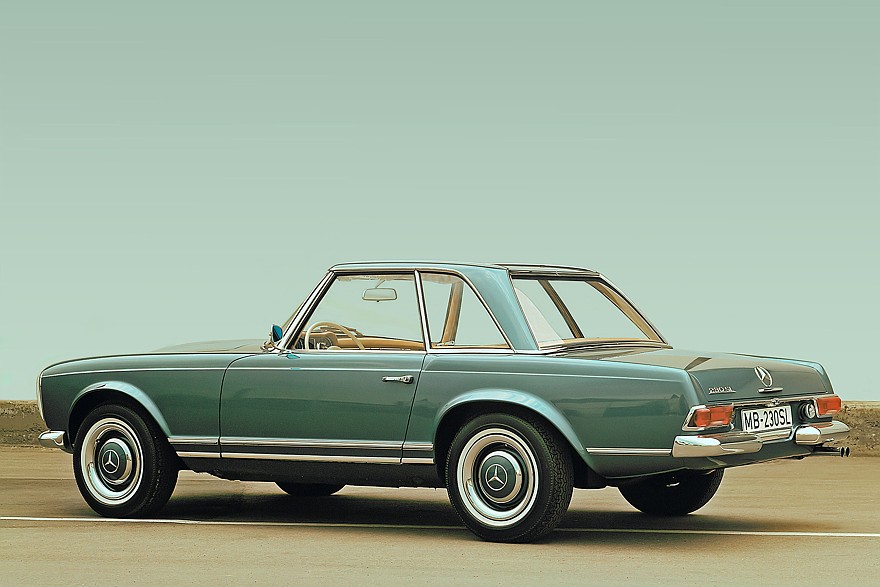
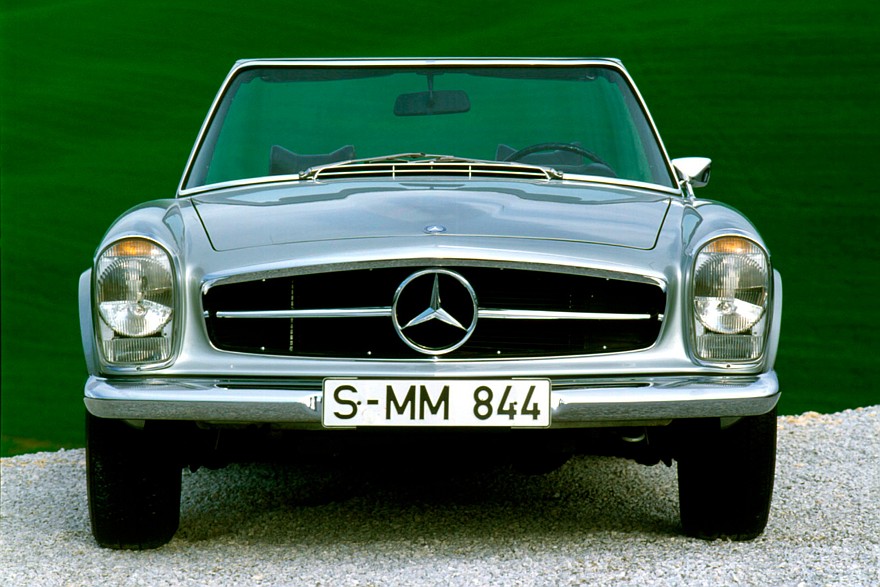
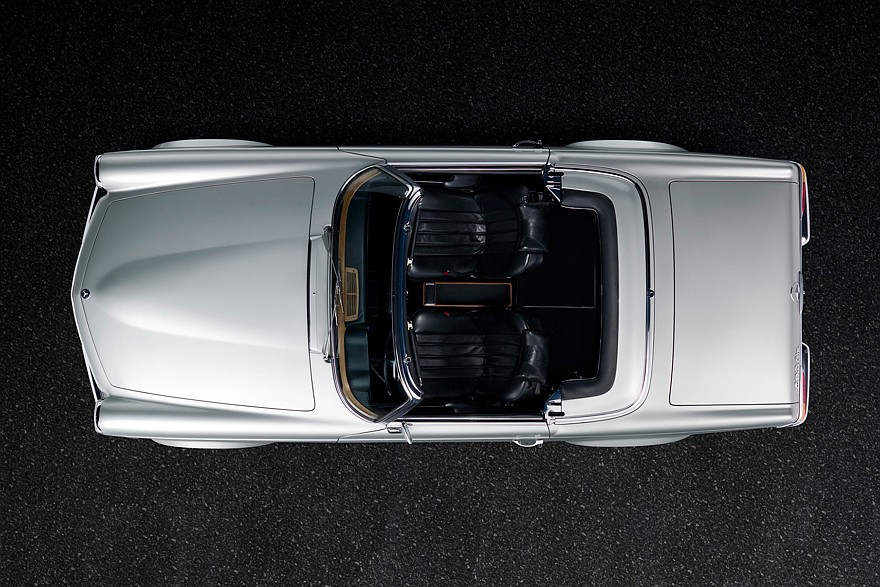
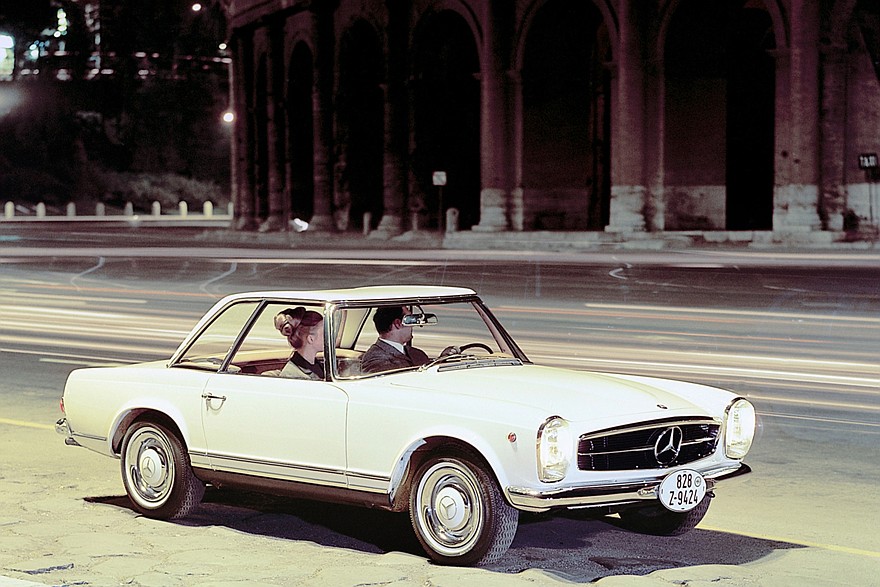
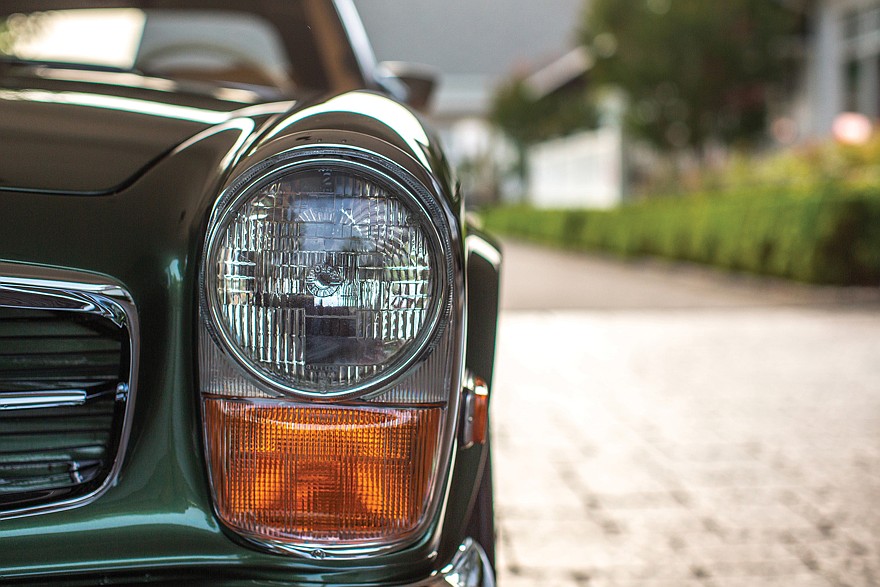
The minimalist design was devoid of previous puffiness and featured much greater flat parallelism, although the hood had a barely noticeable V-shaped profile, and the fenders stood out in height. At the front, attention was drawn to the large vertical headlights and the wide radiator grille, which differed markedly from the previous heavy "shields." An important accent was the large Mercedes emblem located in the center of the grille.
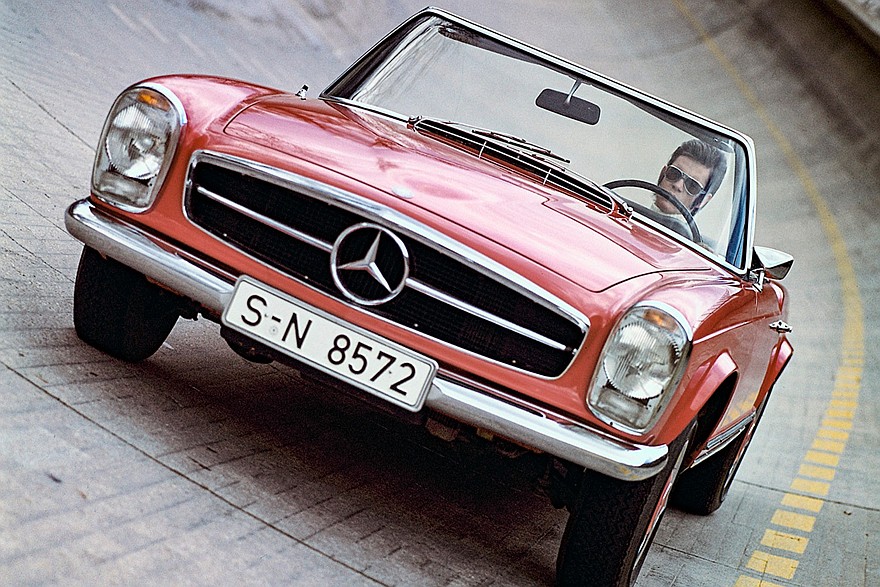
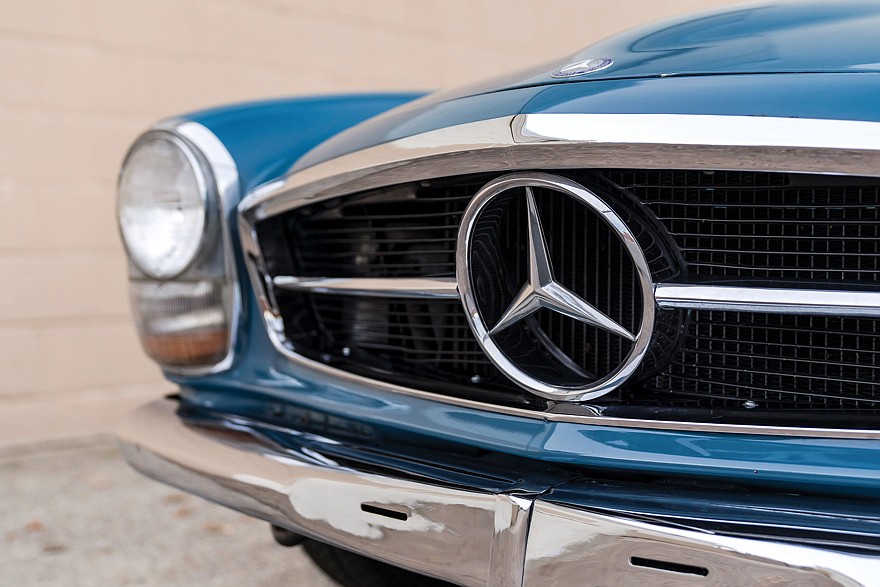
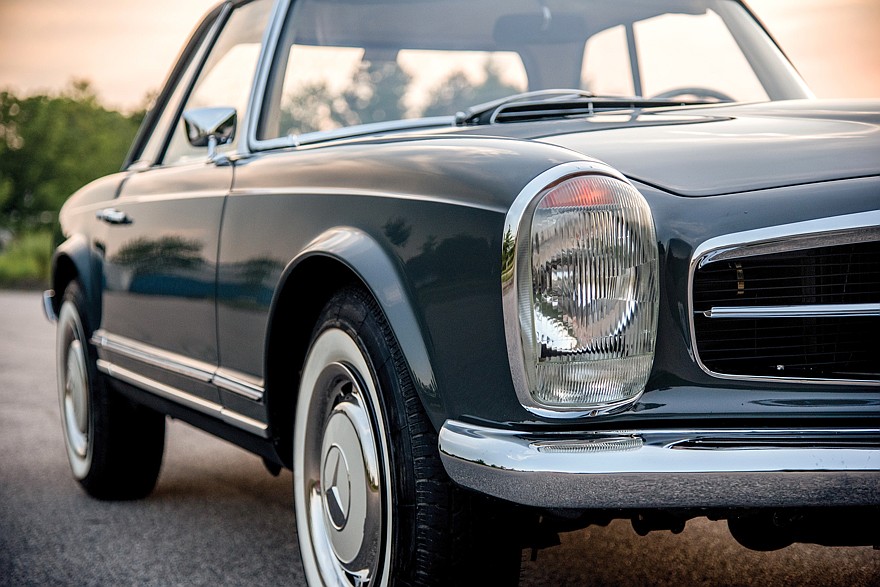
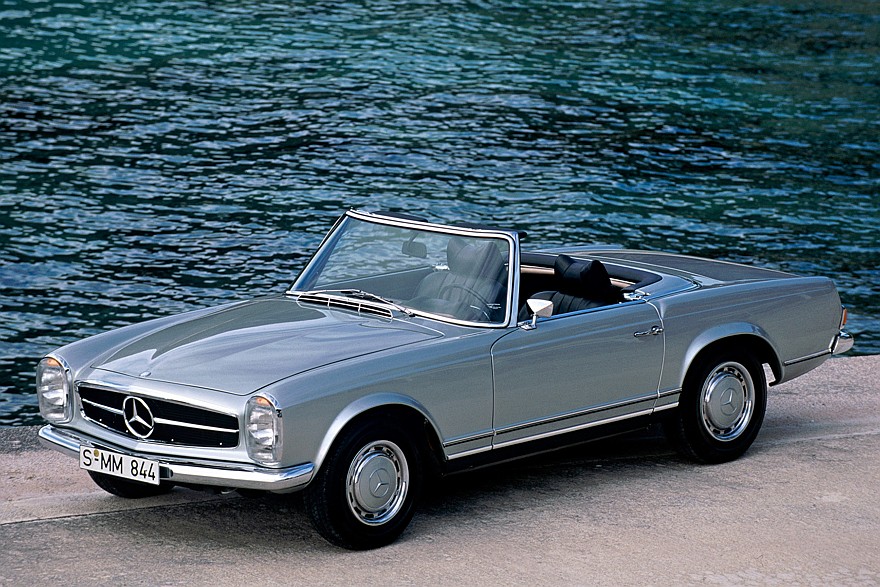
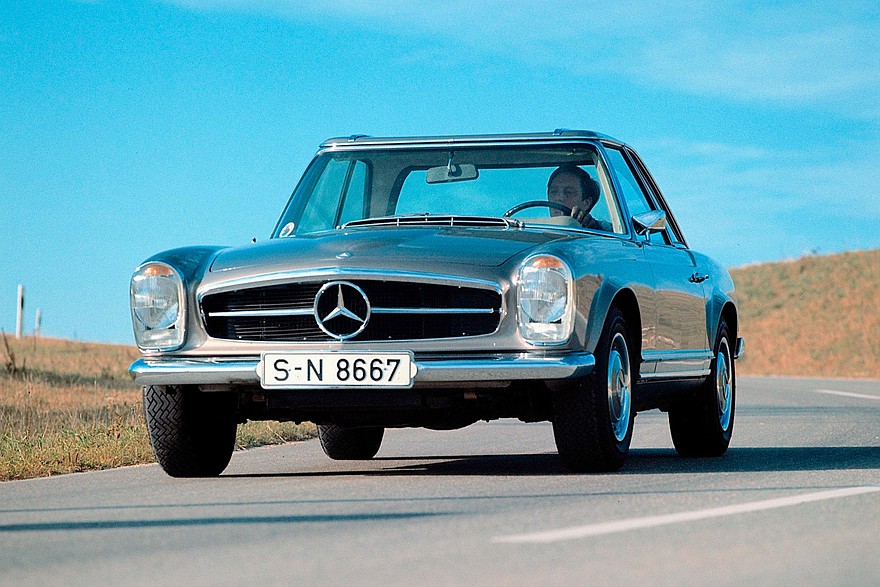
The rear lights, on the other hand, were small and fit perfectly into the rear, giving it lightness and elegance.
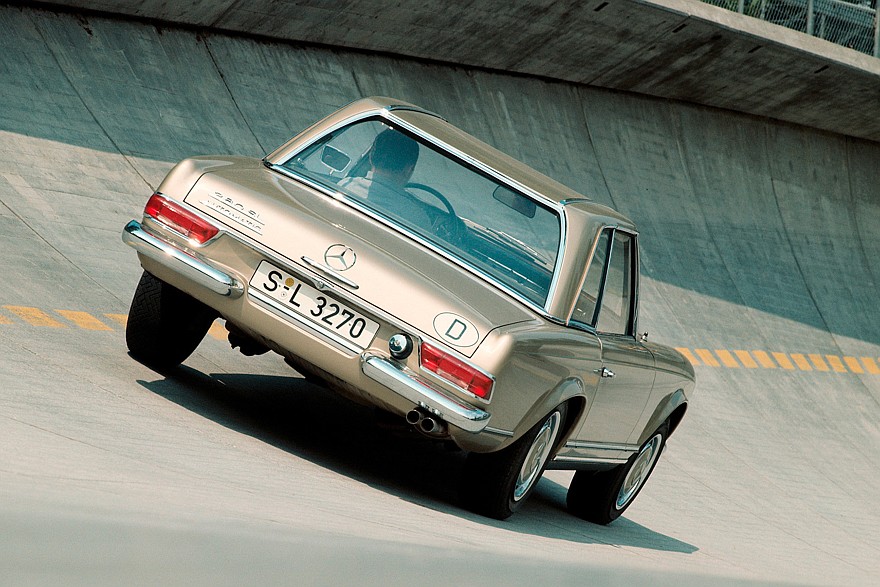
All together formed not only a distinctive but also an "intelligent" exterior, which, however, had one unexpected detail.
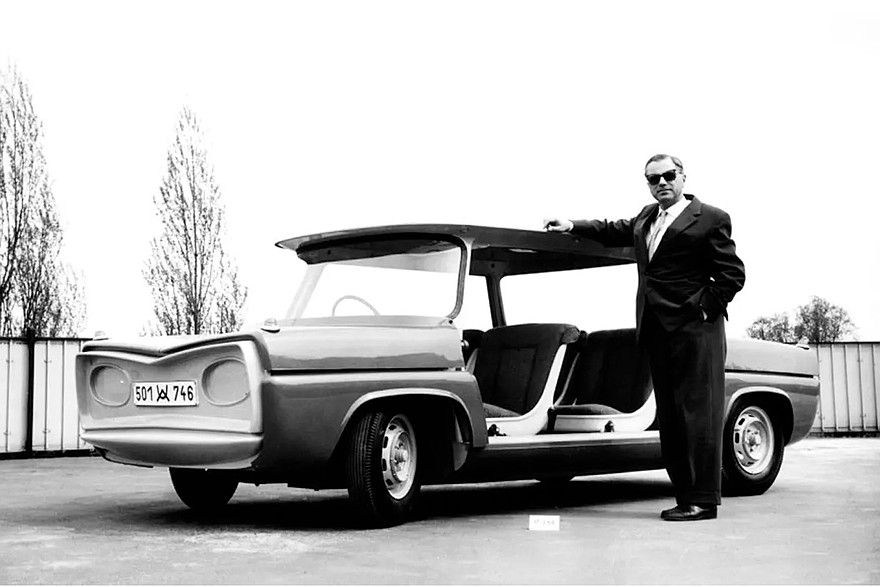
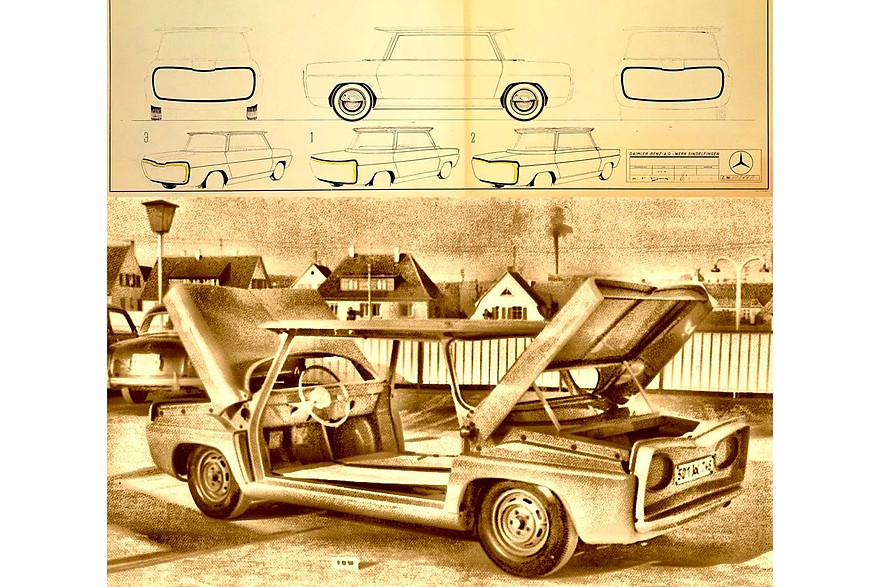
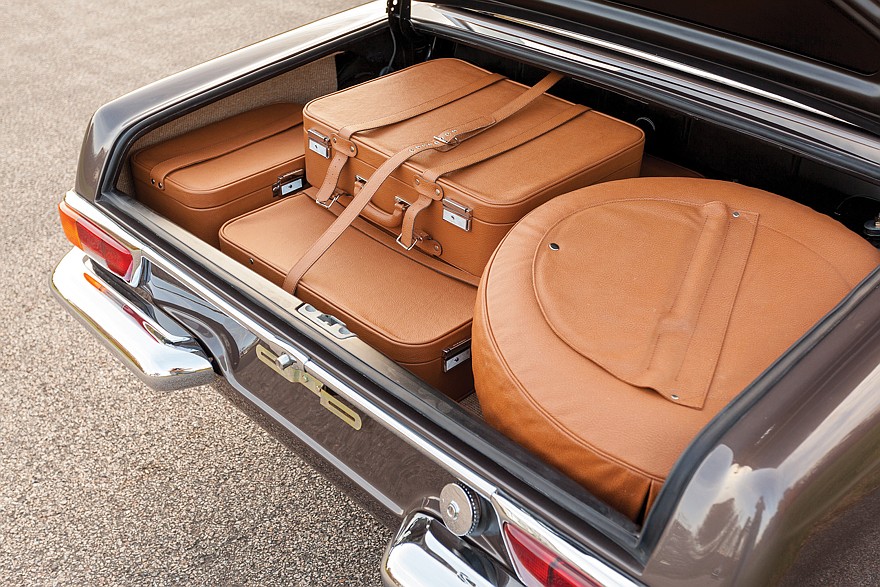
This refers to the removable roof, which, according to Barényi, would not only protect the driver and passenger from bad weather or injury in a rollover but could also serve as a cargo platform. This is why the central part of the roof panel was made slightly concave inward, and some journalist saw a resemblance to a pagoda – an Eastern tiered architectural structure of a cultic nature.
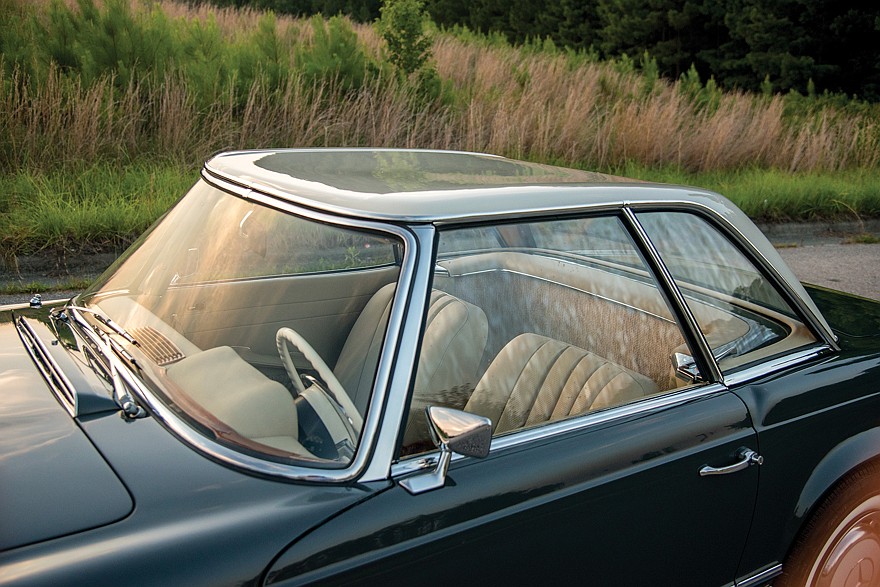
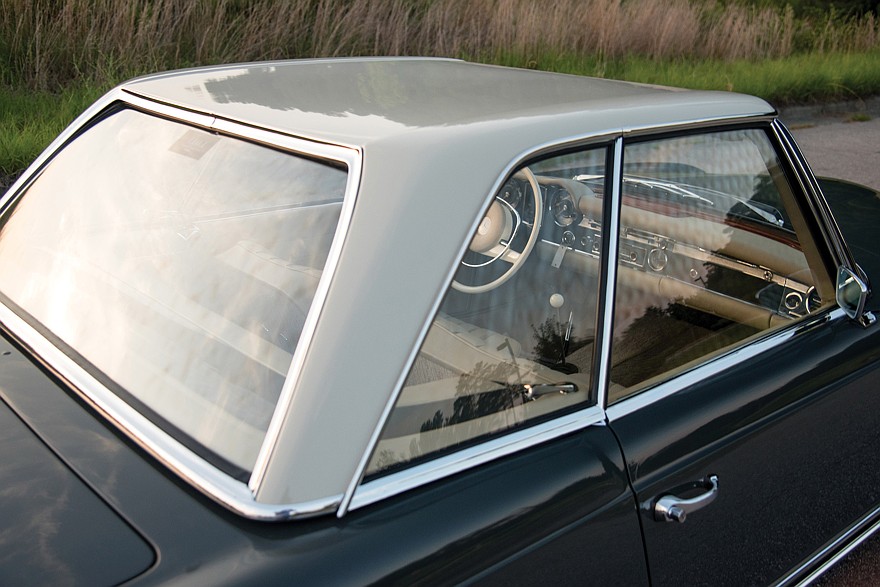
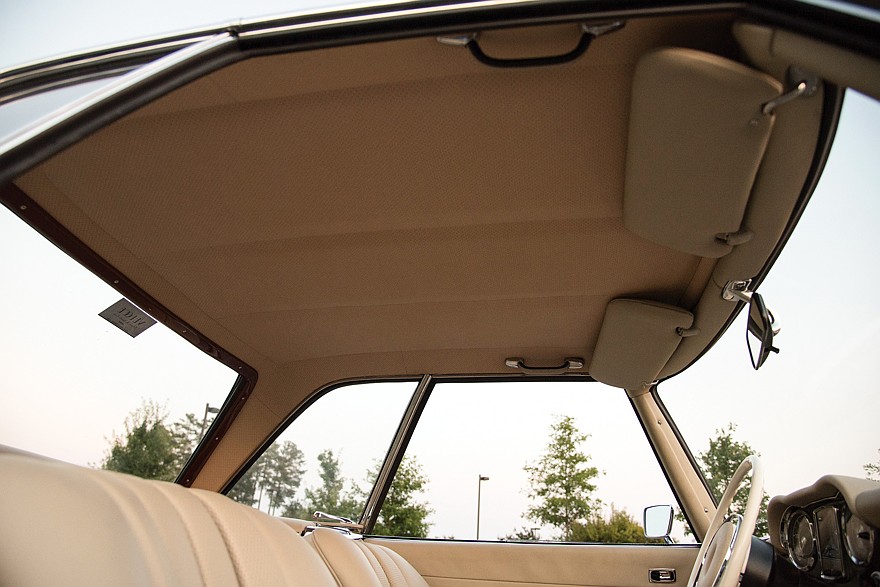
This name immediately "stuck" to the new car, as no one else had a roof of this shape at the time.
Once, Barényi even tested the idea of placing a full-fledged sleeping area on an ultra-rigid long roof on the K-55 concept. Of course, no one intended to sleep on the roof of the new two-door, but a roof rack as a signature Mercedes accessory soon appeared.
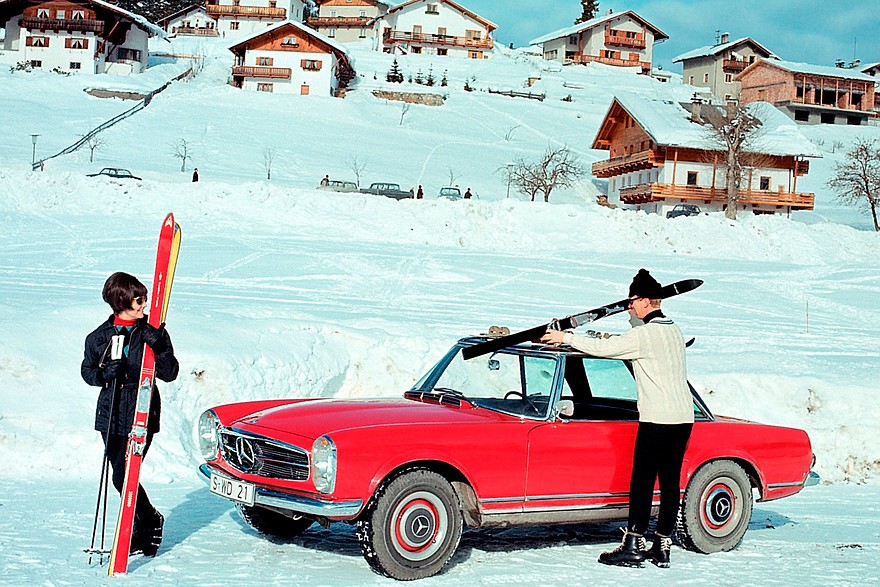
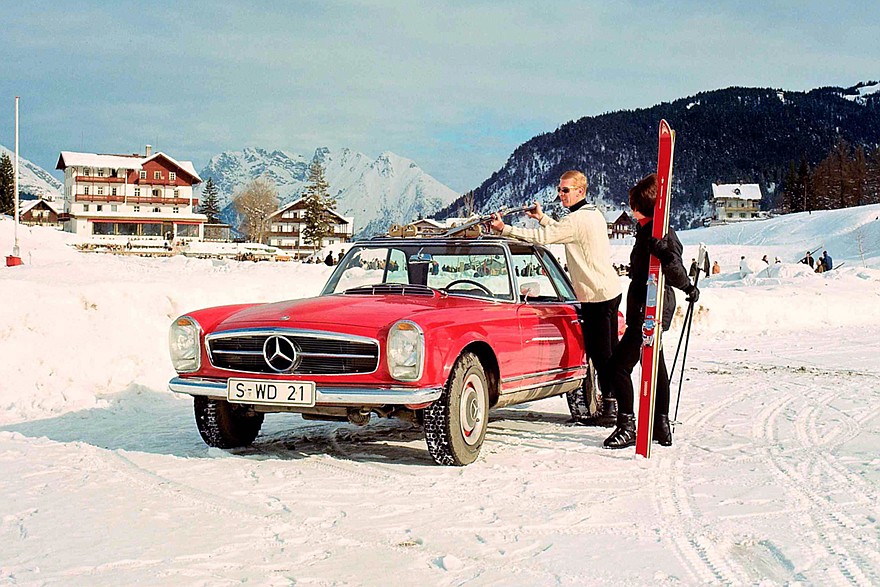
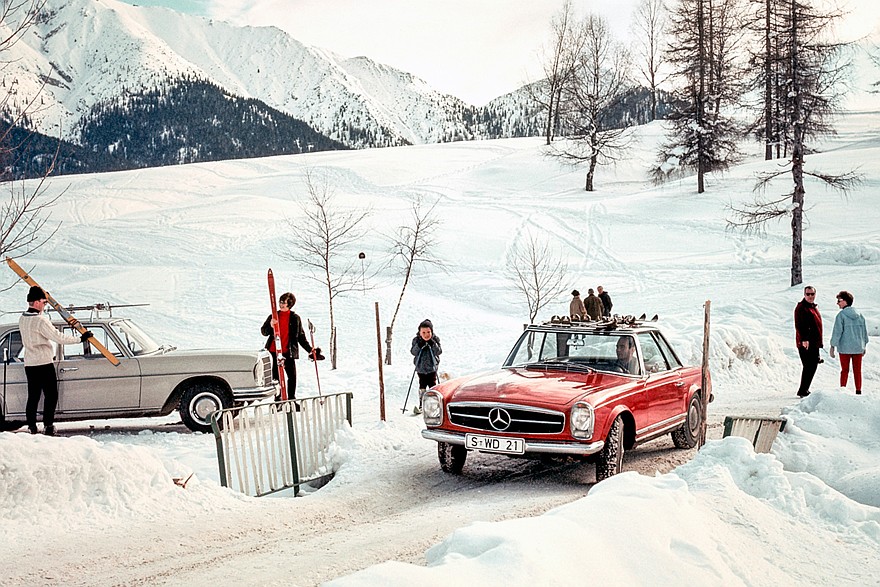
Paul Bracq himself later recalled that from an aerodynamic standpoint, this solution was highly questionable, if not unfortunate, but both the engineers and management unequivocally voted for its retention and series production precisely because of its unusualness. In essence, the "Pagoda" received a design solution that not only potential competitors lacked – it was something no one else had at all. And if Citroën and Jaguar eventually tried to amaze the world with concave rear windows, the Germans, back in the early sixties, did it with such a seemingly trivial element as the roof. Adding to the piquancy was the fact that the shape of the rear window was not too well coordinated with the lines of the rear pillars, which, combined with the unusual roof, created a memorable, impossible, and paradoxical image, making the SL W113 impossible to confuse with any other car.
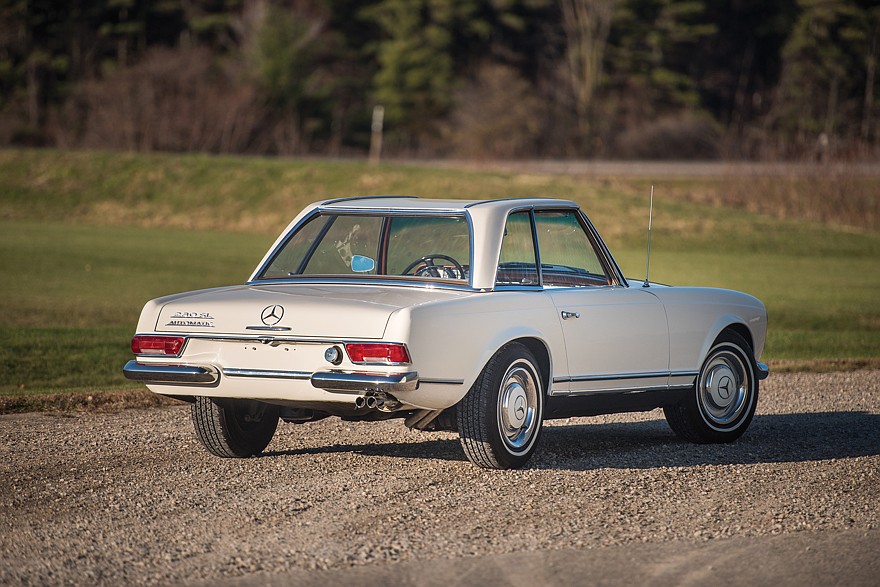
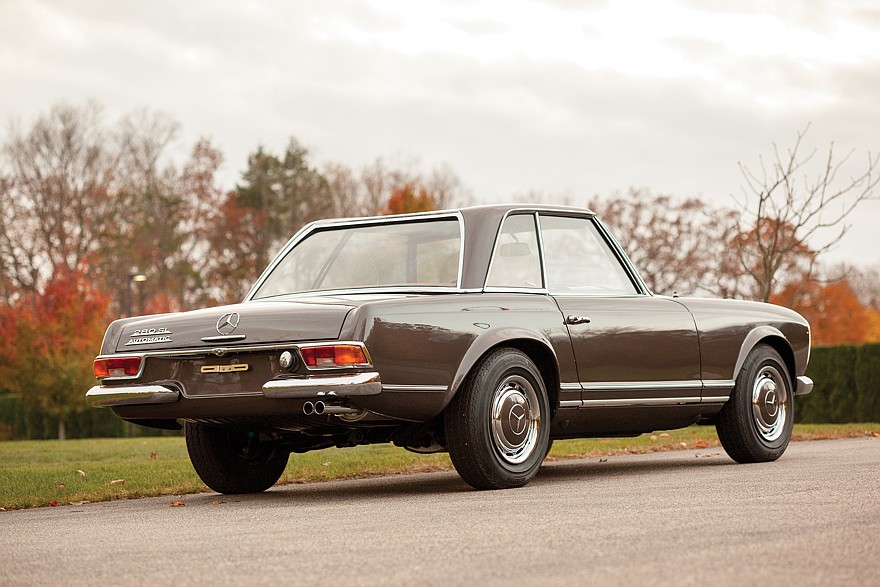
The car was presented in the 230 SL version with a 150-horsepower inline six-cylinder engine, and in terms of dynamic qualities, it fell between the previous 190 SL and 300 SL. Nevertheless, the two-seater could accelerate to 200 km/h, allowing it to be rightfully considered a true sports car.
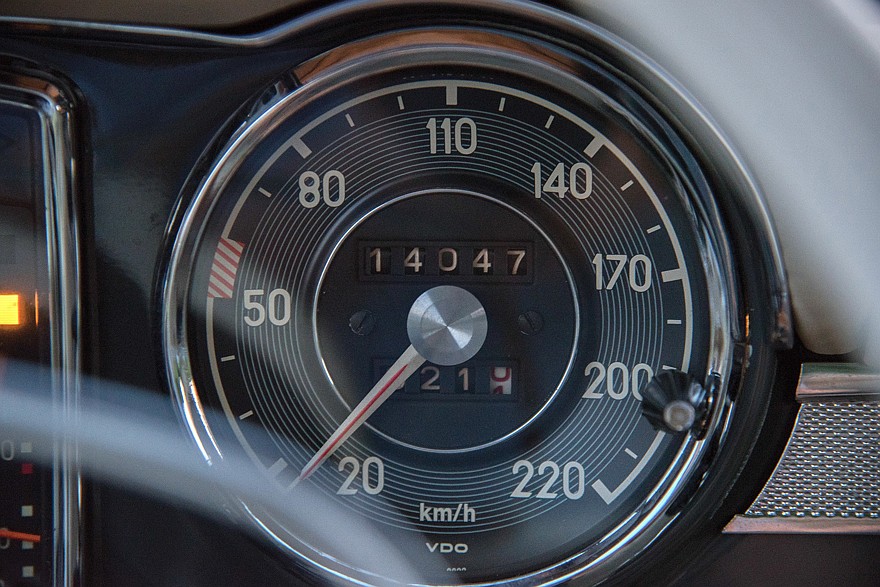
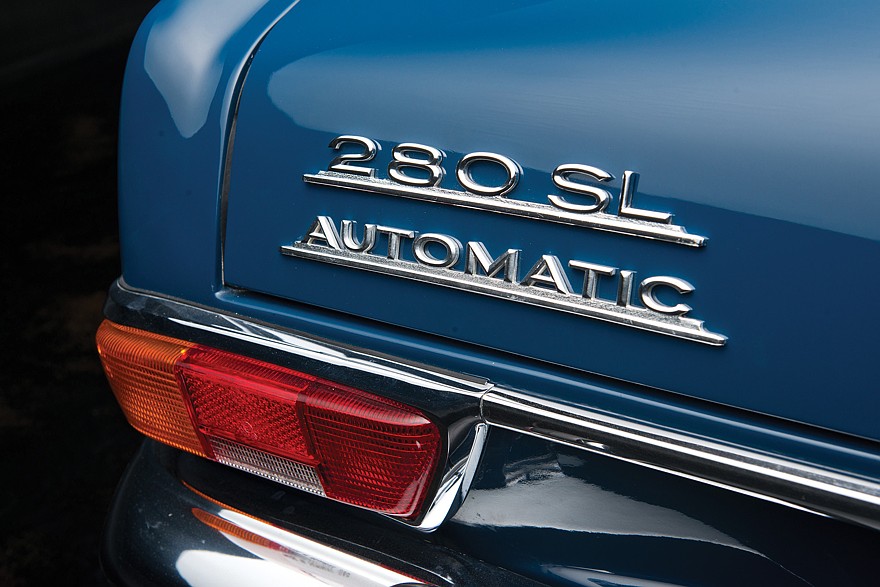
The car began selling actively from June 1963, and it was very popular with buyers, not only men but also women. The latter particularly appreciated the automatic transmission, which the Germans installed for the first time in a car of this class. Subsequently, about 77% of all SLs were equipped with an automatic, so the decision was timely and correct.
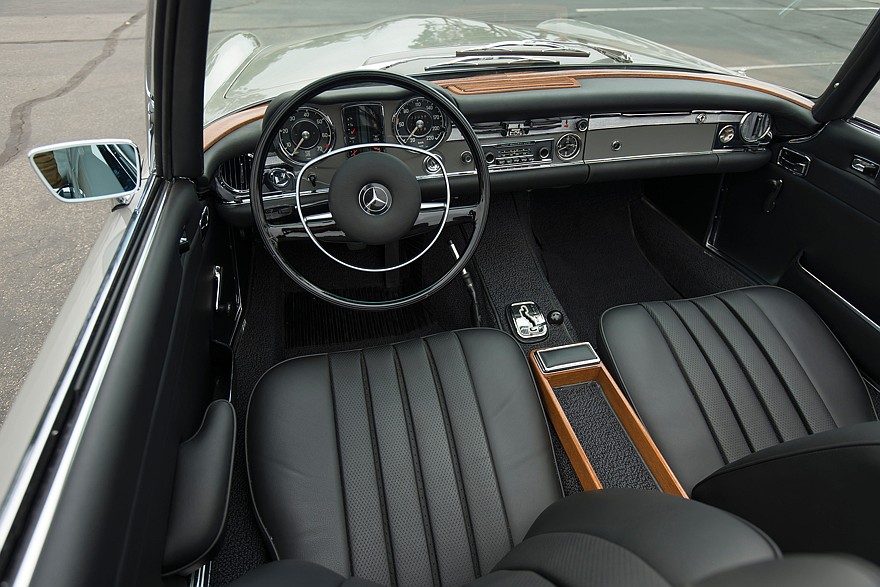
True, despite the aluminum hood, trunk lid, and doors, the curb weight of the compact car turned out to be quite large by sixties standards – around 1300 kg, not quite matching the interpretation of the SL index as "super light." Some contemporaries were also surprised by the presence of power steering and an optional automatic transmission in a sports car, but it aligned with the newly articulated concept of "more comfort and minimum physical effort."
Nevertheless, it was a true sports car with powerful brakes and excellent handling by the standards of its time. Of course, it wasn't as sharp and unruly as the rear-engine Porsche or Jaguar E-type, but that wasn't required of it.
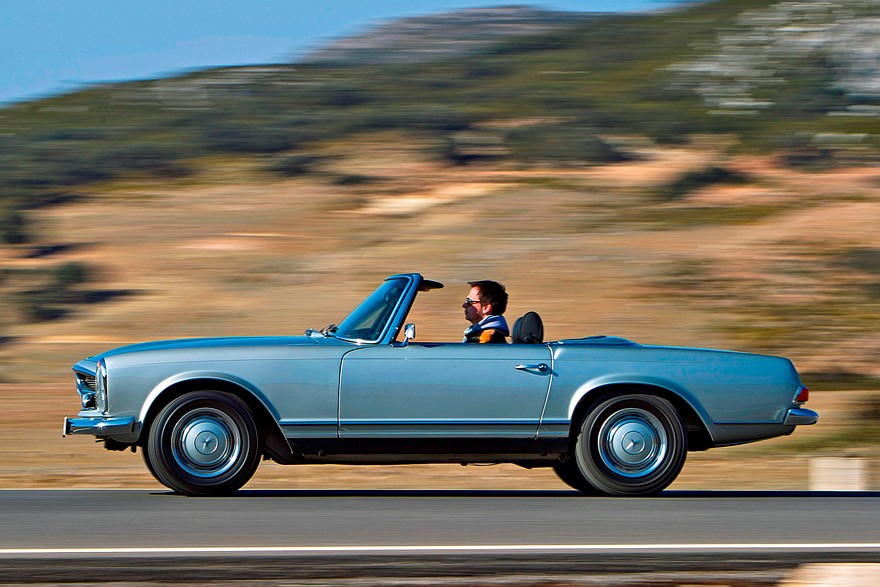
The concave roof shape was also explained by the fact that the designers wanted to make the side windows as large as possible for better visibility, and the ease of entry into the two-seater cabin also benefited from it. The interior was also a continuation of the "safety" theme started in the body construction. For instance, the dashboard had no sharp edges and was covered with soft material, and the center of the steering wheel received an energy-absorbing pad in 1967.
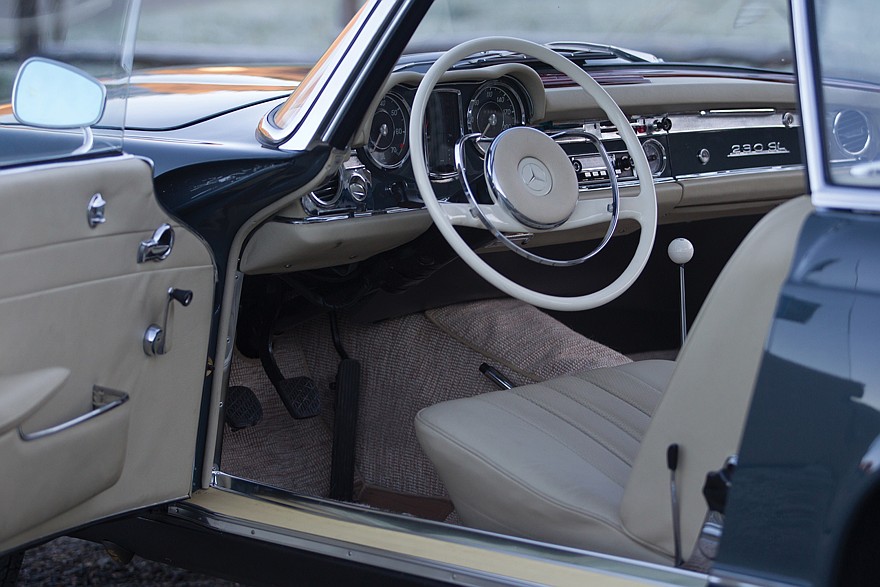
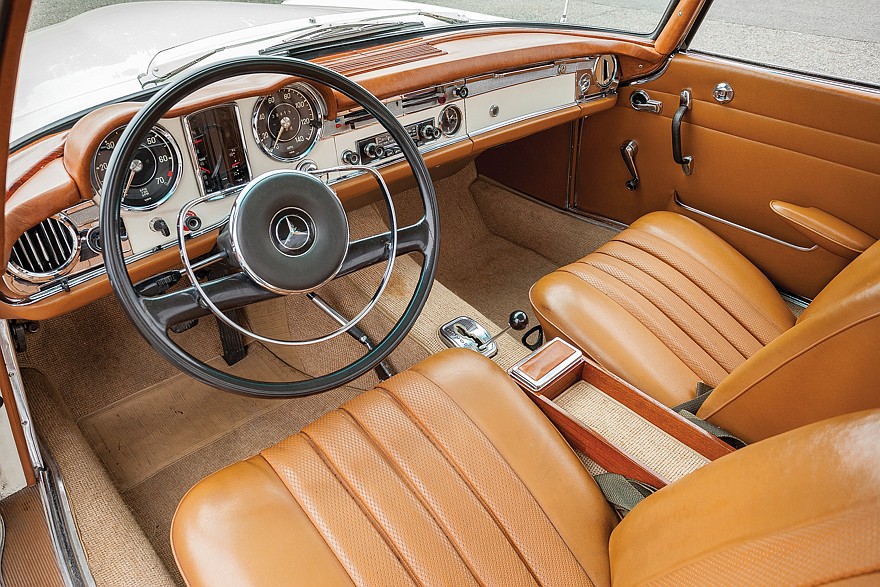
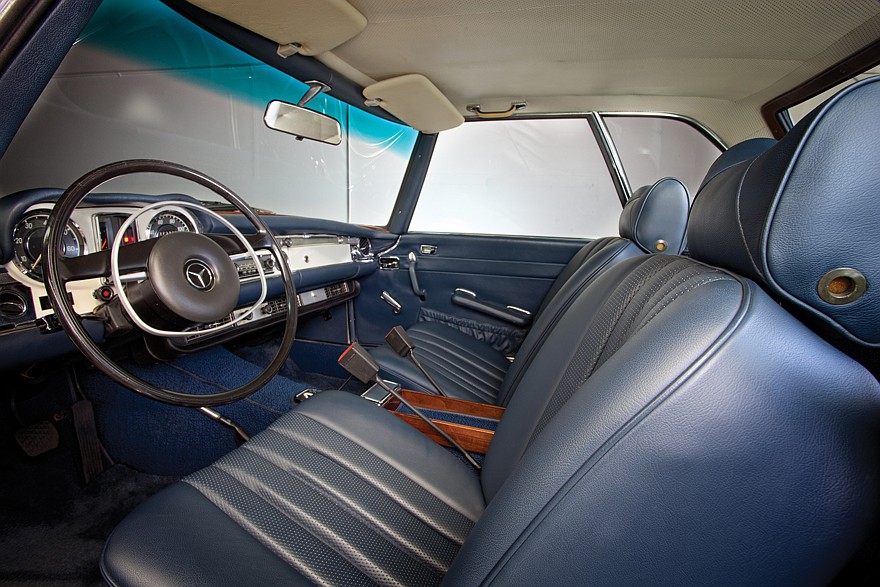
To the left of the steering wheel was that very signature "Mercedes" stalk, controlling the turn signals, windshield washer, and wipers.
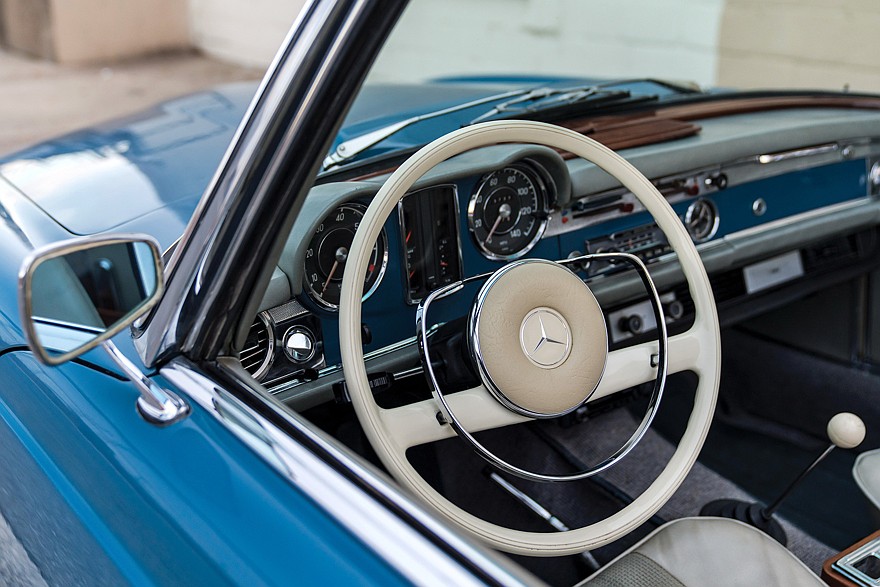
For an extra charge, the leatherette seat upholstery could be replaced with genuine leather, and the seats themselves could be equipped with headrests and seat belts.
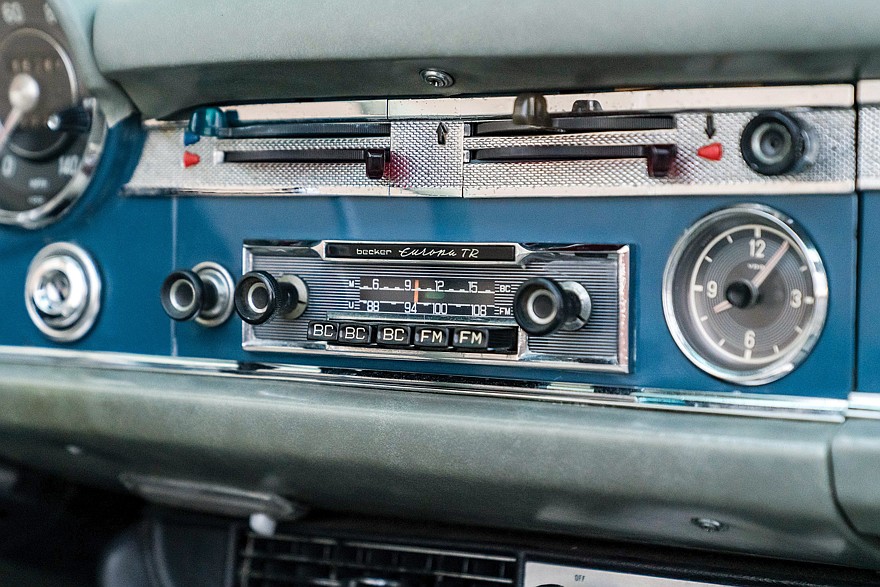
Despite the fact that visually the car was offered in two versions – with a soft top and a hardtop – it was the same car.
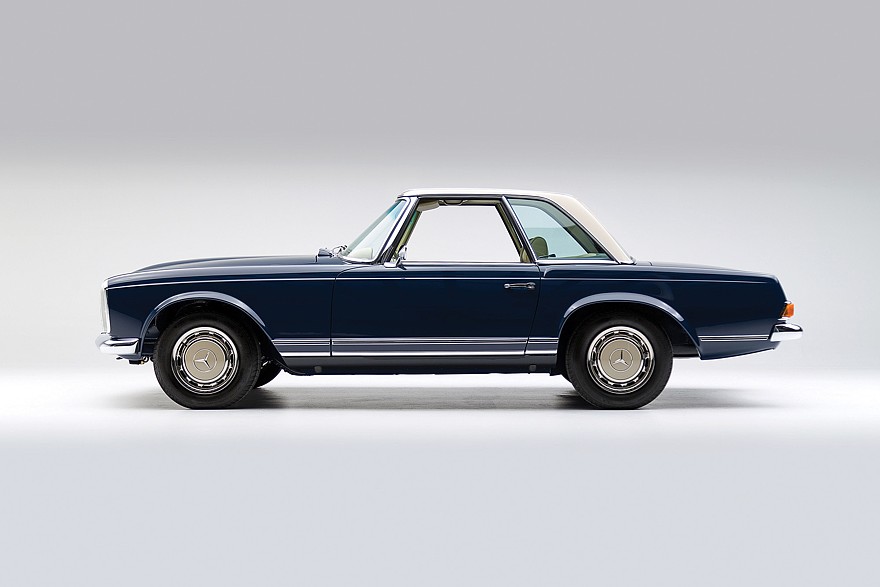
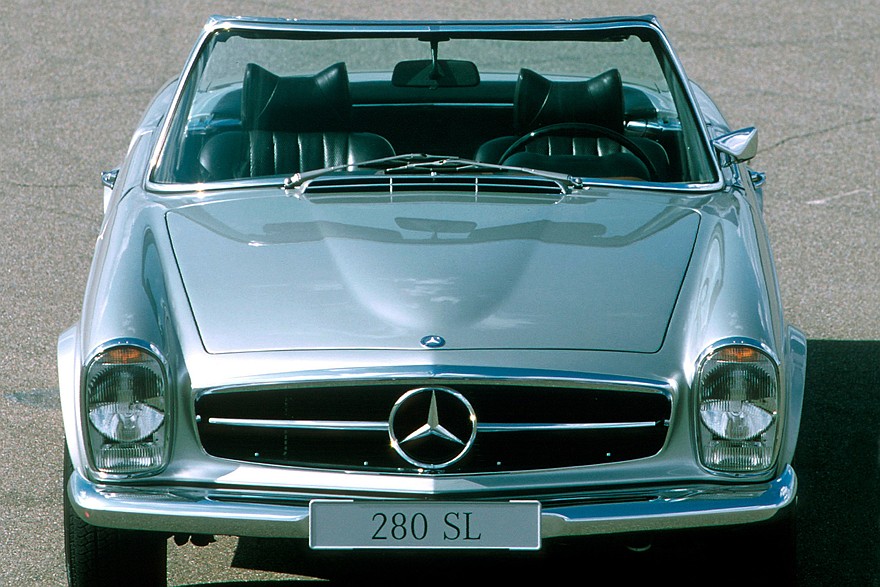
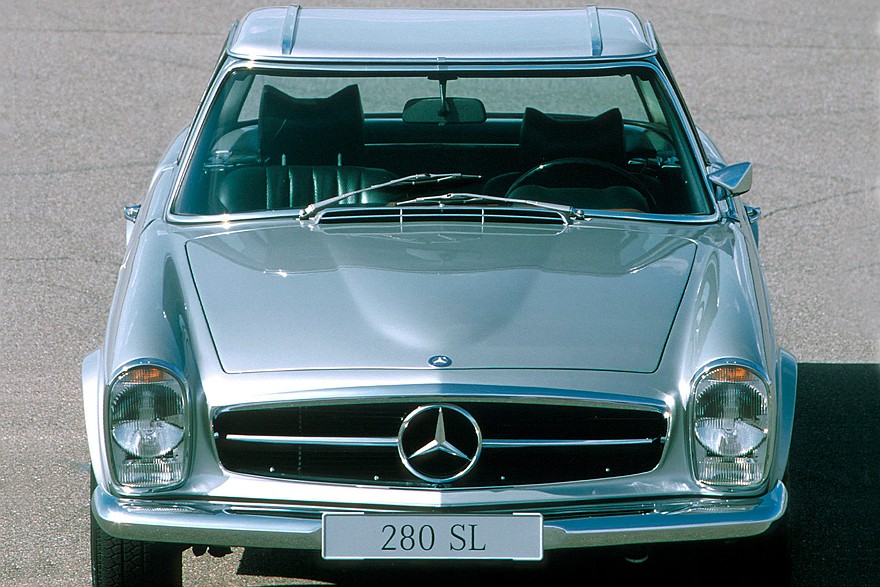
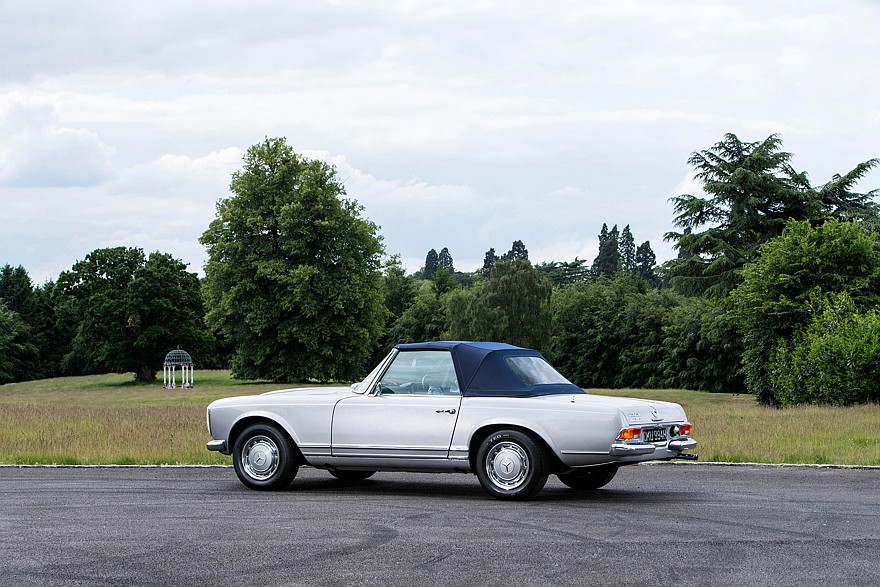
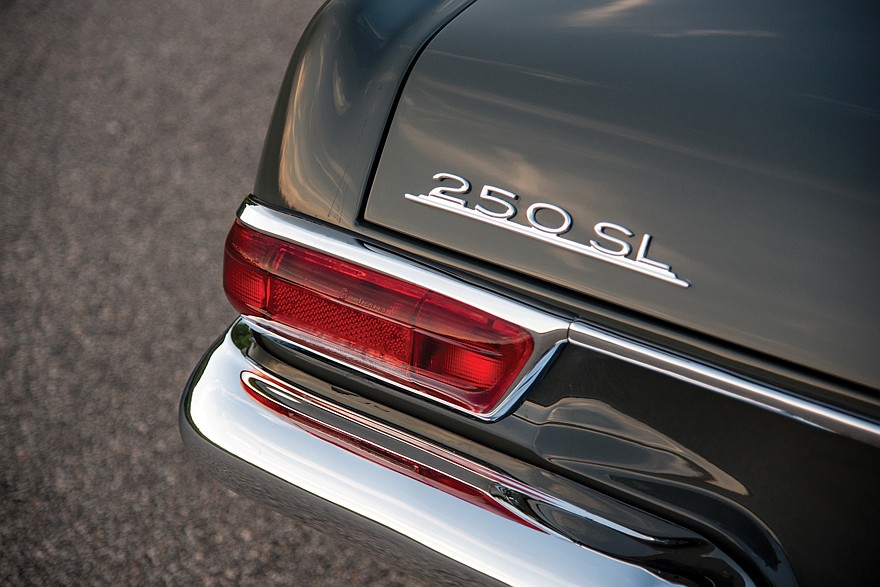
At the end of 1966, the 230 SL version was replaced by the 250 SL with the M129 engine, and in January 1968, it was in turn replaced by the 280 SL with the M130 engine.
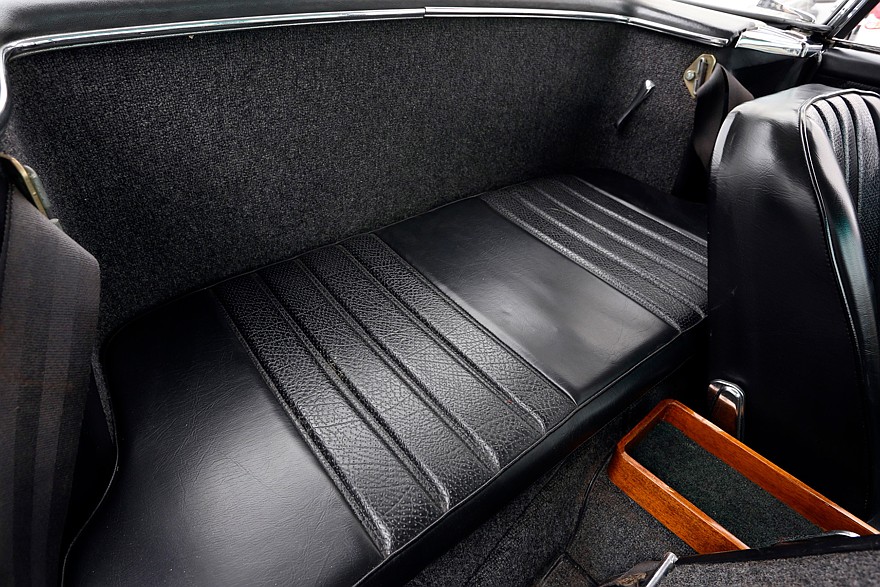
In 1967, a new version called the California was shown in Geneva. Formal "plus two" rear seats appeared because the compartment for the folding roof was removed.
In Germany, depending on the engine and equipment, the car cost between 22,000 and 24,000 Deutschmarks, and in the USA, between $6,500 and $8,000.
Mercedes also offered several additional options for the W113 model. For leather seat upholstery at the end of the model's production run, one had to pay an extra 1,048 Deutschmarks, for seat belts – 77 DM, headrests cost 222 DM, rear window heating – 244, metallic paint – 699. The most expensive options were the hardtop (1,459 DM), automatic transmission (1,443 DM), or an A-Netz car phone for an astounding 9,934 Deutschmarks.
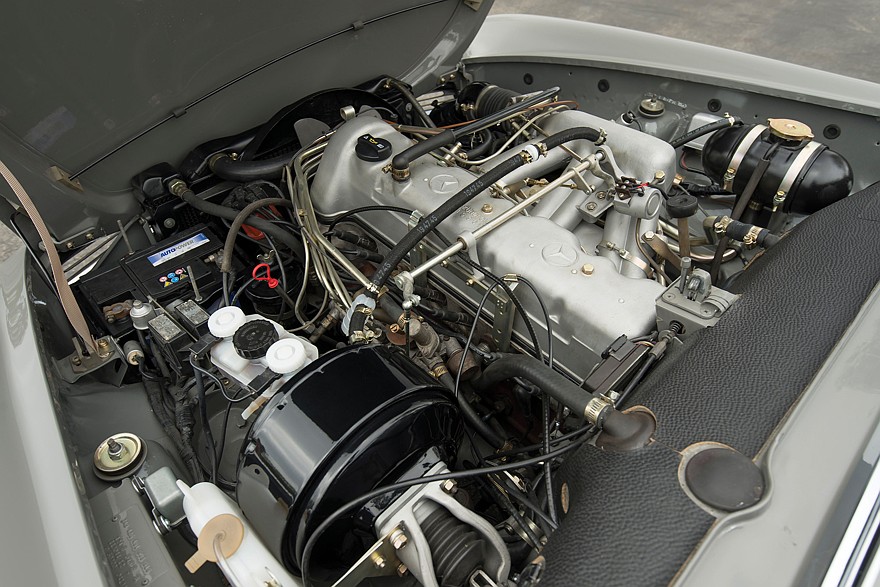
Initially, under the hood was an inline six-cylinder naturally aspirated engine with a cast-iron block and an aluminum head housing a single overhead camshaft (OHC) with two valves per cylinder. The valvetrain drive was by chain. A highlight for those years was the fuel system – Bosch multi-point mechanical direct injection with an electric fuel pump.
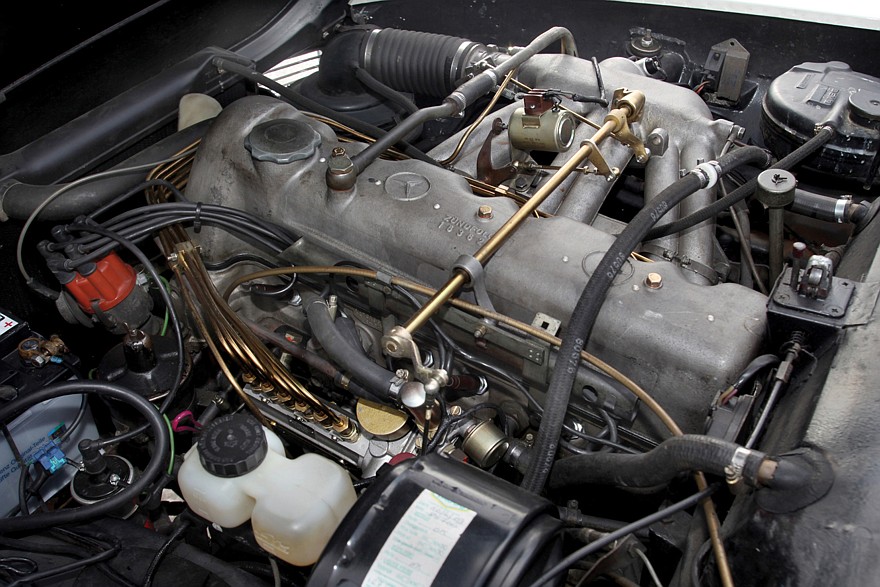
The engine of the 250L version retained the same power but became more elastic and torquey, increasing torque from 197 Nm to 216 Nm. The 2.8-liter engine, however, gained power – 170 hp and 240 Nm, and its oil was cooled by a separate oil cooler.
Each assembled M130 engine underwent bench testing for two hours before installation, so its technical characteristics were guaranteed.
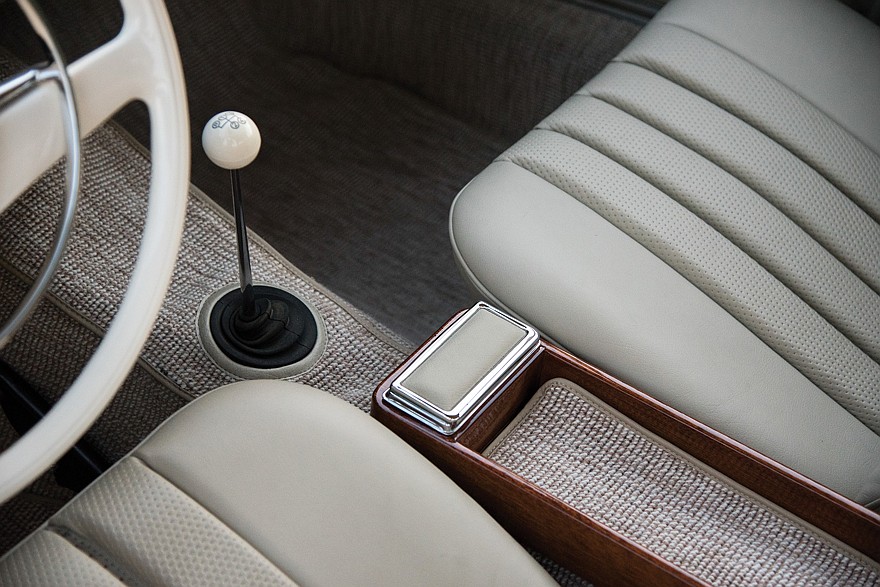
Starting with the 250 SL version, instead of the standard four-speed manual, one could order a five-speed ZF gearbox with closer ratios for first and second gears, as well as a limited-slip differential. This option, costing 1,459 Deutschmarks, was rare – according to available data, fewer than a thousand W113 units were equipped with it.
In other respects, Mercedes remained true to itself: independent suspension on all wheels, with a front anti-roll bar, and at the rear, above the central joint of the Mercedes-Benz Eingelenk Pendelachse (single-joint swing axle), a horizontal spring was provided that connected the swinging half-axles. On the 280 SL version, the third spring could be replaced with an optional Boge hydropneumatic element, which automatically maintained the height of the rear of the body.
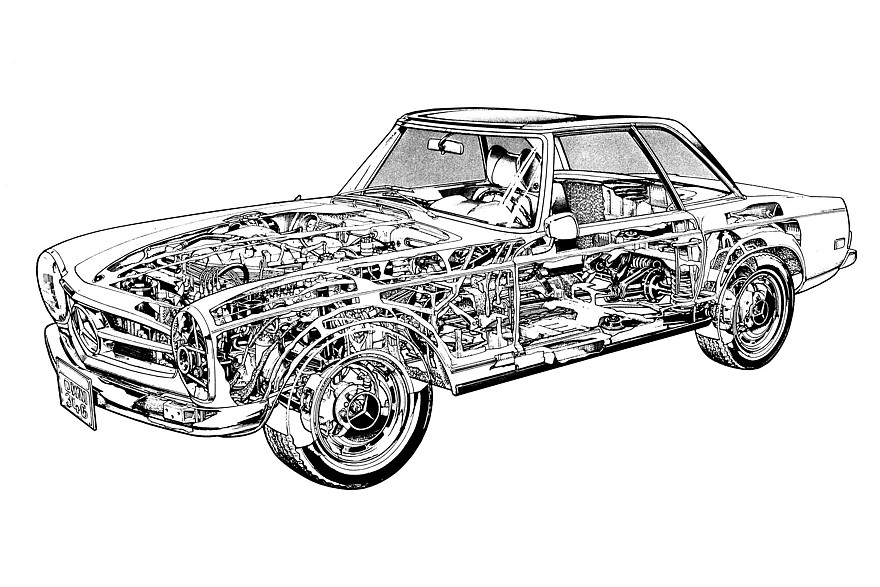
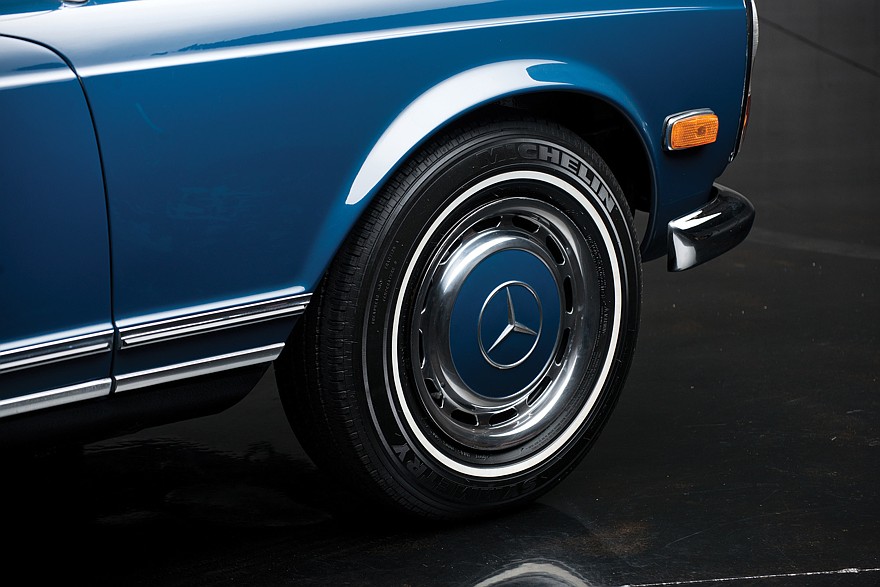
On the initial 230 SL version with a Girling brake system equipped with a booster, drum brakes were used at the rear, but from the 250 SL onwards, discs were fitted all around. The fourteen-inch wheels were stamped steel, but lightweight alloy wheels were available for the 280, and radial tires also appeared on this model.
In short, the W113's engineering was by no means extreme, but quite sufficient to make the car dynamic compared to ordinary passenger cars. After all, just over eight seconds to 100 km/h is a decent figure even by today's standards, let alone the sixties, when most ordinary sedans needed at least 15-20 seconds to reach sixty miles per hour.
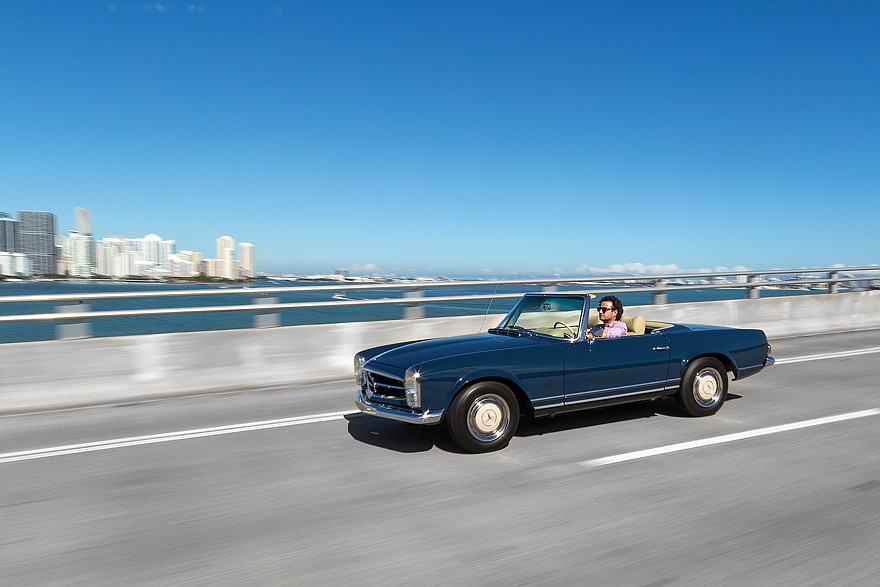
The Germans had an idea to install a mighty 6.3-liter 250-horsepower V8 from the Mercedes-Benz W100 under the SL's hood, and Rudolf Uhlenhaut even implemented it in practice as a prototype designated W113/12, but the car turned out too heavy and completely uncontrollable, which was absolutely undesirable for the brand in light of the Le Mans tragedy a decade earlier. Therefore, the SL of the sixties was offered only with three inline "sixes" of different displacements, which were more than sufficient for it.
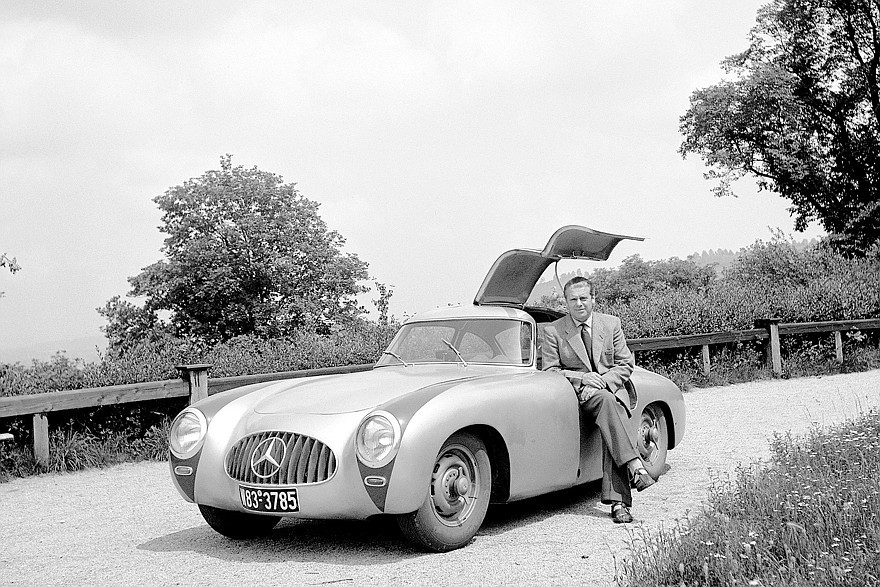
Back in 1963, the same Uhlenhaut demonstrated the capabilities of the 230 SL on the narrow Annemasse Vétraz-Monthoux circuit, three-quarters of a mile long, where he recorded the best lap time – 47.5 seconds compared to 47.3 seconds for driver Mike Parkes in his three-liter V12 Ferrari 250 GT.
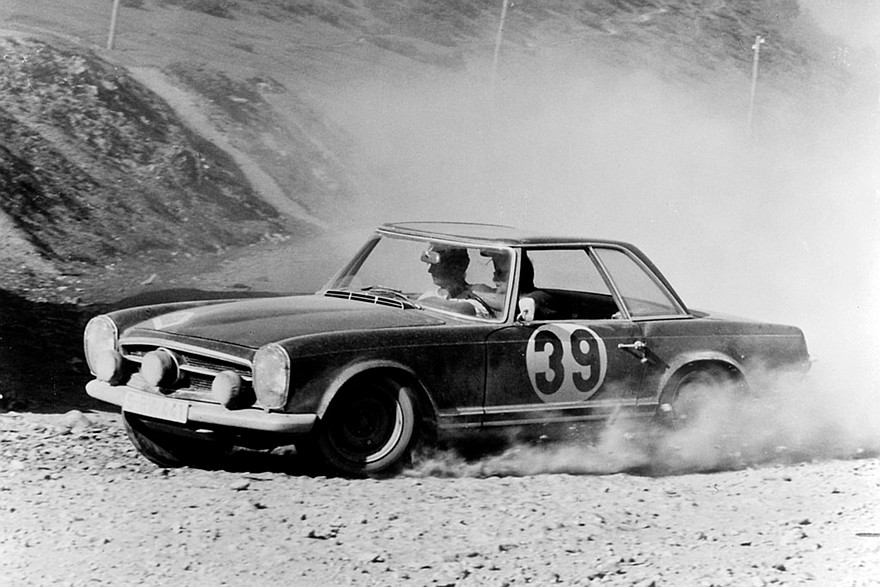
However, in 1968, Mercedes-Benz, as an experiment, equipped the 280 SL model with a three-rotor Wankel rotary engine M50F producing 206 hp, designated R113W 33-29. A top speed of 205 km/h and acceleration to 60 mph (97 km/h) in 8.7 seconds, combined with low noise levels, made it a very unexpected option as a prototype, but the rotary engine theme never progressed beyond the experimental stage due to high fuel consumption and low durability.
An important sales market for the model was the American one, where about 40% of the total number of cars produced were sold. Export versions for the US market, in accordance with American standards, differed in lighting, and visually the "American" could be distinguished by the bumper overriders.
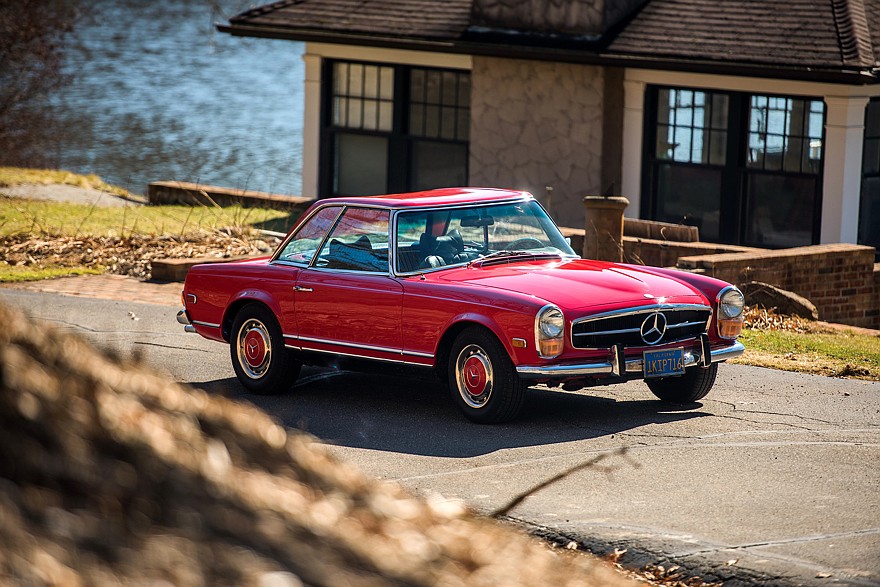
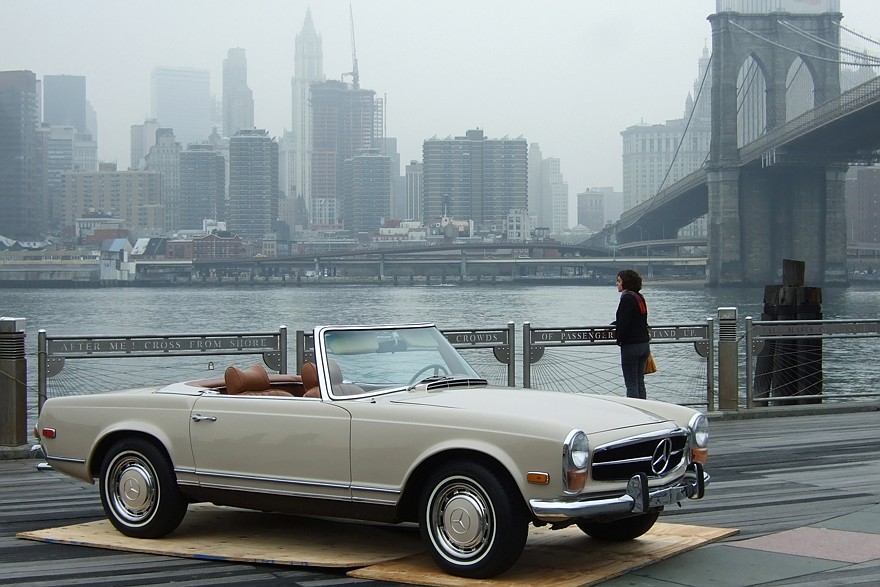
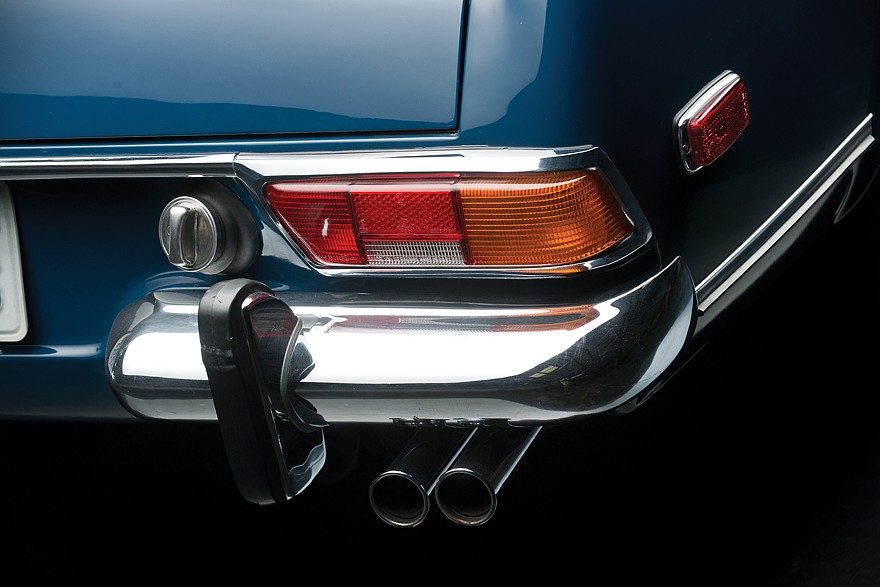
Of course, the instrument scales were marked in miles, and the equipment typically included an automatic transmission, air conditioning, and white sidewall tires. Stricter exhaust emission standards than in Europe forced the Germans to retune the engine of the 280 SL modification, reducing its output to 160 hp.
The injected 162-horsepower inline six-cylinder engine with an overhead camshaft starts and runs with a slight rustle, reminiscent of the sound of playing cards hitting the spokes of a bicycle wheel. The large-diameter steering wheel makes handling light, and the pedal of the power-assisted disc brakes feels like it sinks into mayonnaise.
The ability to manually shift gears with a light touch on the four-speed automatic transmission is the best way to accelerate as quickly as possible. Acceleration to 100 km/h in 8.6 seconds and a stop from 110 km/h in 70 feet prove that the old SL was built modern enough to handle today's traffic speeds.
You can drive this fairly old car every day even now.
Car and Driver, 2006
The new car turned out to be interesting not only to the public but also to coachbuilders: shortly after the debut, representatives of the Pininfarina studio approached Mercedes-Benz management with a proposal to create their own body variant. In those years, studios like Pininfarina, Ghia, and Bertone often created their own exterior versions based on existing production cars. The work was carried out by American Tom Tjaarda, and in 1964, a year later, the new variant was presented to the public at the same Geneva Motor Show.
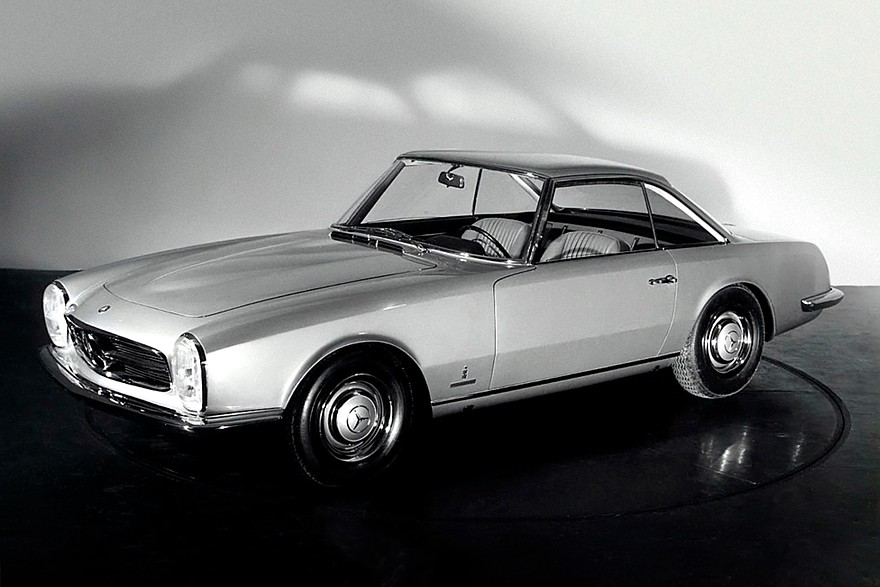
Despite three dozen preliminary orders, the Germans were not interested in the project, and the only example produced was sold to German newspaper magnate Axel Springer. In 2022, the one-of-a-kind SL with design by Pininfarina was sold for $1.2 million from a private collection in California.
Perhaps the most famous owner of a Mercedes-Benz 230 SL was John Lennon, and in 2011, his former car was sold for nearly half a million dollars. Other notable owners of the W113 (mostly 280 SL) included Joan Collins, David Coulthard, Tony Curtis, Walt Disney, Juan Manuel Fangio, Julio Iglesias, Gene Kelly, Sophia Loren, Kate Moss, Stirling Moss, Stevie Nicks, Colin Powell, Priscilla Presley, Nico Rosberg, and John Travolta.
The model's media achievements are also impressive:
Belgian web magazine Gentlemen's Corner included the W113 in its list of the "20 Most Stylish Cars of the Last 50 Years."
GQ magazine included the W113 in its list of "Ten Cars That Made Mercedes-Benz."
David Gandy of Vogue.com named the W113 one of his "15 Favorite Cars."
The Daily Telegraph placed the W113 in its list of the "100 Most Beautiful Cars" of all time.
On the British automotive TV show Top Gear (Season 3, Episode 8), the 280 SL was highly praised. Specifically, Jeremy Clarkson described it as one of the 1960s cars that stood the test of time, "from the time when Mercedes still built their cars properly."
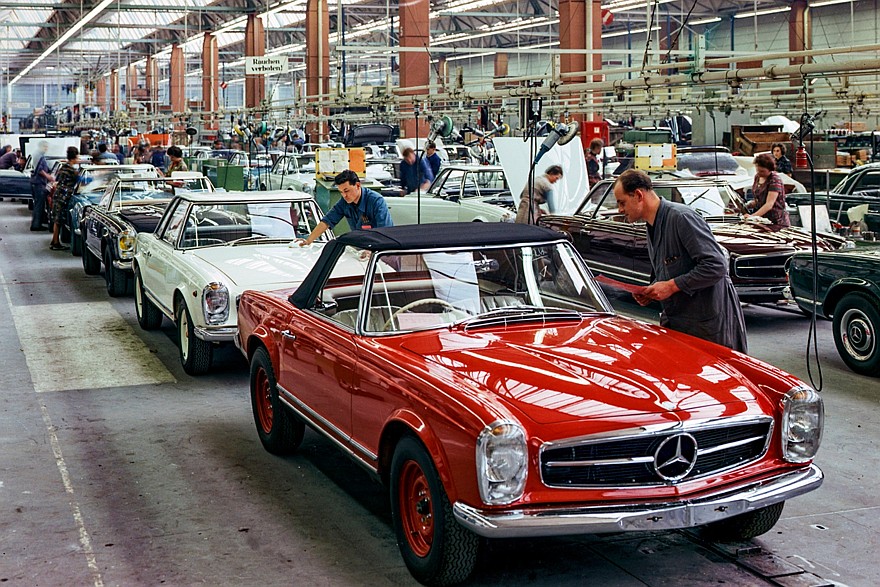
The "one-thirteenth" remained on the production line virtually unchanged until 1971. During this time, 48,912 Mercedes-Benz 230 SL, 250 SL, and 280 SL cars were produced, 19,440 of which were sold in the USA. This was by no means a bad result, as the previous 300 SL and 190 SL together could not surpass the 30,000 mark. The "Pagoda" was so good in its original form that no attempt was made to modernize it, and in 1971, it was replaced by the new SL/SLC model (C107/R107), which existed with a V8 engine, was produced until 1989, sold in 300,000 units, and became a true conqueror of America.
But that is a completely different story, and the elegant W113 accomplished a very important mission in its time, showing the world that a sports Mercedes could be not only beautiful but also comfortable and safe. And a phrase from a vintage 1968 test by Road & Track magazine perfectly concludes the memories of the "Pagoda": "This car is without equal in its category." Perhaps there is no better way to put it.
Comments (0)