
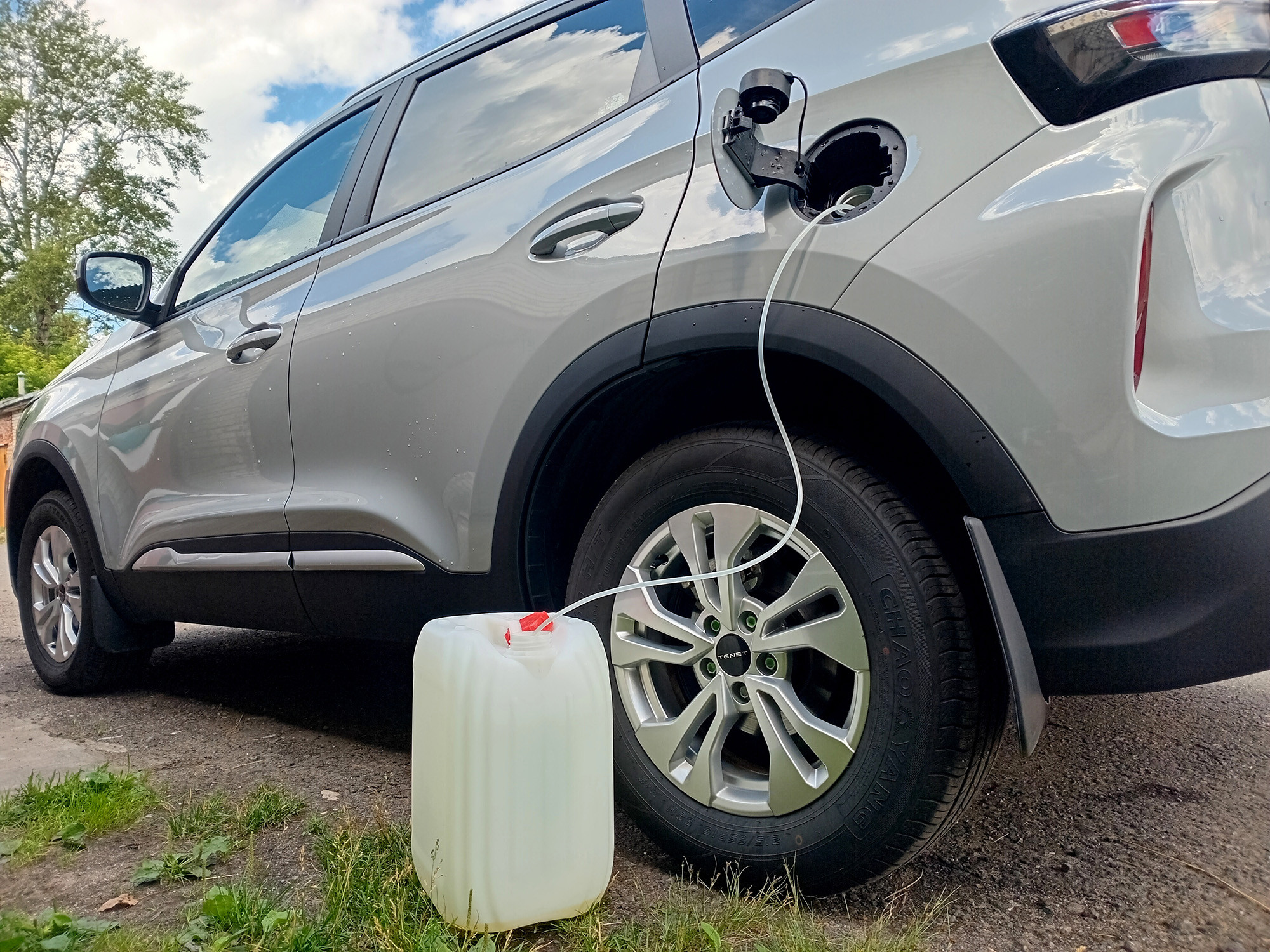
In many cases, creating a personal fuel reserve is not paranoia at all, but a perfectly rational tactic for experienced drivers who are not willing to take risks or play the lottery with gas stations. Not to mention the ever-present need to refuel small motorized equipment—gardening, construction, and watercraft. Today, obtaining a canister of fuel without unnecessary hassle is only possible by draining gasoline from your own car's tank. However, doing this is not so simple.
Reasonable, that is, non-commercial thriftiness has traditionally been a strong trait of the Soviet, and later Russian, car enthusiast. This thriftiness has helped out over the years, and sometimes even saved the day. Not so long ago, our grandfathers and fathers created garage reserves of everything they managed not just to buy, but to "get hold of" for their beloved cars. Garages accumulated tires and rims, silent blocks and ball joints, cans of oil and antifreeze... Prices rose before their eyes, far outpacing salaries, and some items regularly became scarce or disappeared from shelves altogether.

Since most gas stations today do not dispense fuel into canisters, draining gasoline from the tank into a canister is necessary and unavoidable in some cases. There are formally two ways to do this. The first is through the filler neck using a hose: by gravity or with the help of an additional external electric pump. The second is using the car's standard fuel pump.
For the first option, you need a thin, rigid, and fuel-resistant hose. Unfortunately, no rubber hoses, even those originally intended for pumping fuel, will work for a modern car. On most vehicles, there is a convoluted labyrinth from the fuel filler neck directly to the tank, which a thick and soft rubber hose cannot navigate. Studying numerous stories about draining fuel from modern cars shows that a rigid polyethylene tube (polyethylene marking – PE) is optimal for this. Such tubing is sold by the meter on marketplaces and in pneumatic equipment stores, and you will need at least two meters, preferably 2.5-3 meters.
A tube with an outer diameter of 6 mm and an inner diameter of 4 mm will fit into practically any car, but if you're lucky, a tube with an outer diameter of 8 mm and an inner diameter of 6 mm might also work. In any case, such a line imposes limitations on the drainage rate—filling a 20-liter canister through it quickly won't be possible. Without additional pumps, i.e., by gravity, it will take about forty minutes or even an hour. But this is an inevitability that simply must be accepted without argument.
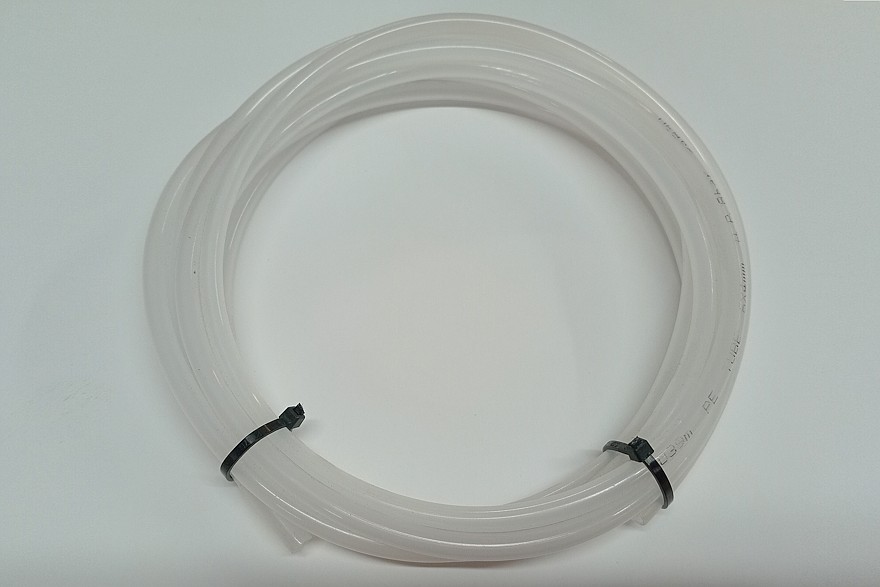
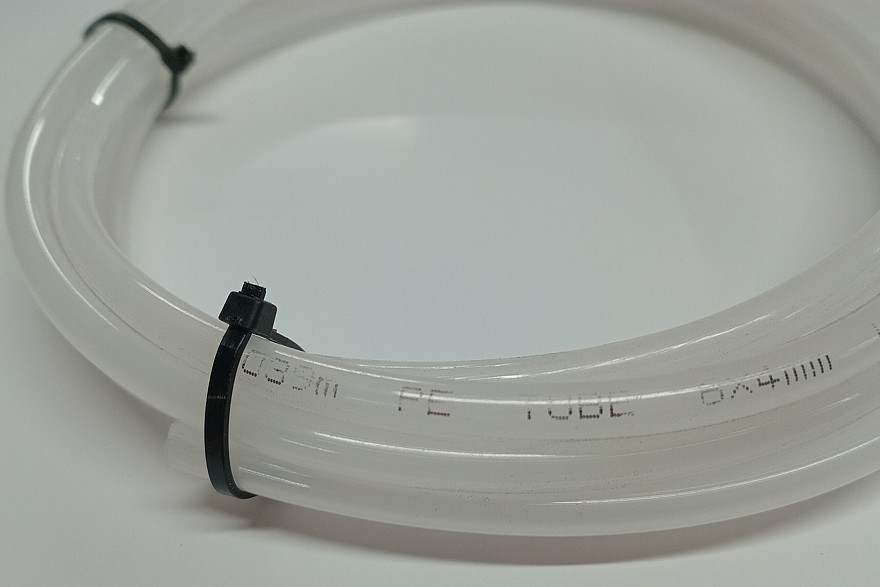
Before starting the process, it is advisable to find out from the technical documentation what the line from the filler neck to the fuel tank looks like on your specific car. Googling this is not difficult. As a rule, you will see an intricate network of tubes of a rather complex shape, but in most cases, a thin rigid hose can overcome all of this. It is advisable to look at the pipeline from the side to understand what the hose might hit and how it needs to be twisted to continue pushing it until it is submerged in the fuel, as well as where there is a dead end (an air vent, for example, or for the charcoal canister). By the way, it is advisable to slightly treat the end of the tube with a knife to smooth the edges—this will make it easier to pass through the labyrinth.
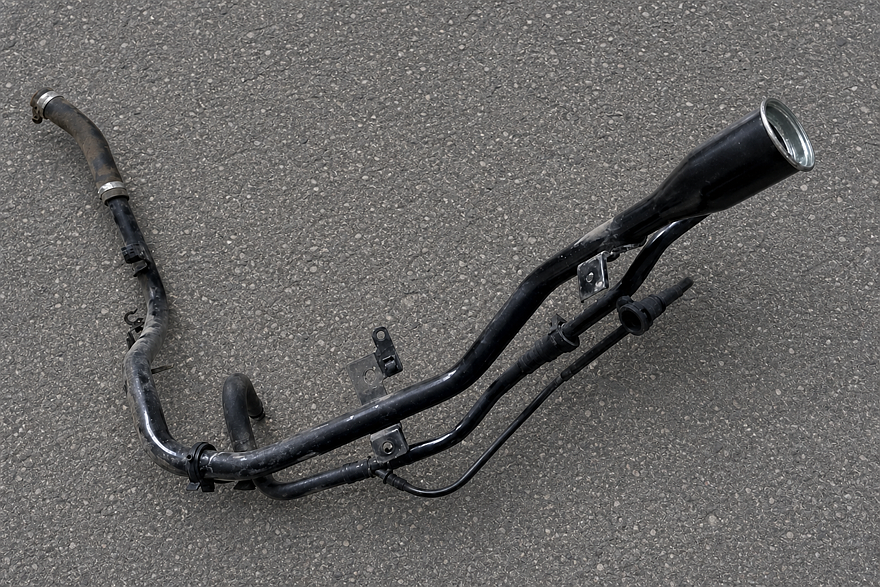
It is easy to determine whether the tube has reached the fuel level—simply blow into the tube periodically while pushing it in. No resistance to the air—push further. There is resistance and you hear gurgling—you've reached the spot!
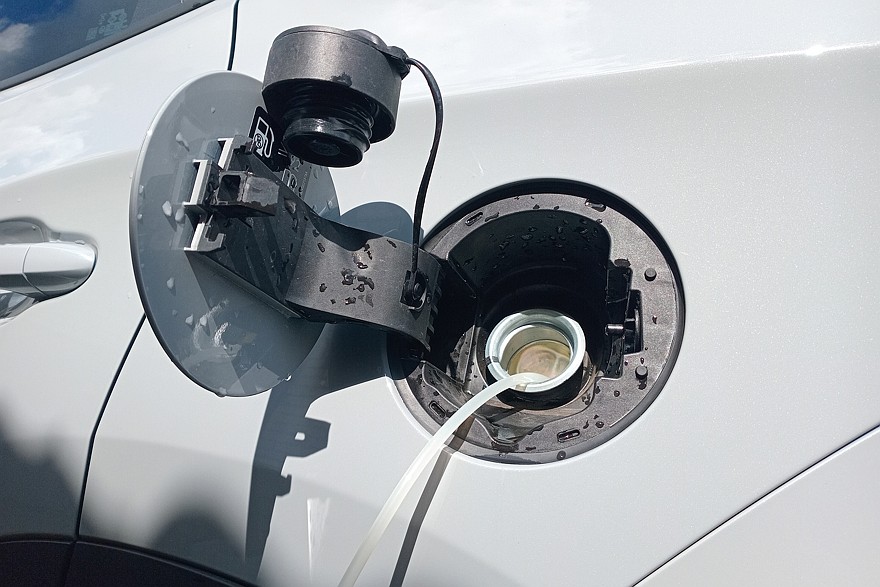
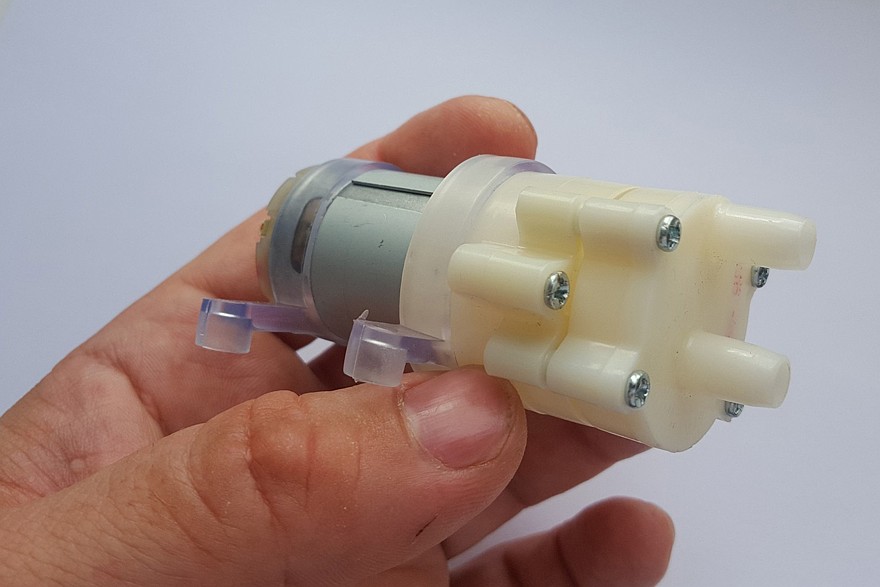
To start the gravity flow, you can again use your mouth, or you can arm yourself with some kind of 12-volt pump—similar to an aquarium pump. We once tested such a device for its ability to pump oil out of the crankcase through the dipstick tube, after which we washed it with gasoline—it withstood both hot oil and fuel without any issues.
Moreover, this pump can be used both to start the gravity flow and to speed up the entire process. With the pump, it will be at least three times faster, and the only inconvenience is that you will have to connect its fittings to the polyethylene tube using whatever pieces of rubber hoses, tubes, and clamps you have on hand, since you won't be able to fit the rigid, slippery, and completely non-elastic polyethylene tube onto them.
Another way to drain gasoline from the tank is to use the car's standard fuel pump. However, this requires some work inside the car, not just outside, which is not feasible for everyone. Using the fuel pump, fuel can be drained either directly from the pump's fitting or by connecting to the fuel line from the engine bay side—to the fuel rail or pressure regulator.
In the simplest version, the rear seat cushion is removed, the fuel pump access cover is opened, the supply tube is disconnected, and a hose is attached to the pump fitting instead. This does not require "gastroscopy" with thin and rigid polyethylene tubes—you can use a fuel-resistant reinforced hose with an outer diameter of 10-12 mm and an inner diameter of 8-10 mm. Through it, a 20-liter canister fills in just about five to seven minutes.
The difficulty lies only in supplying power to the fuel pump—you need to find its relay in the fuse box, remove it, and insert a jumper between the open contacts. On some cars, the pump can be forced to run through the diagnostic connector (also using a jumper), but in either case, you still need at least minimal knowledge of electrical systems. And don't forget about fire safety—if you are not confident in your abilities, it is better to use the method of pumping through the filler neck.



Comments (0)